Last week, a senior adviser to Downing Street broke ranks and blamed the weeks of complacency on a failure of leadership in cabinet. In particular, the prime minister was singled out.
“There’s no way you’re at war if your PM isn’t there,†the adviser said. “And what you learn about Boris was he didn’t chair any meetings. He liked his country breaks. He didn’t work weekends. It was like working for an old-fashioned chief executive in a local authority 20 years ago. There was a real sense that he didn’t do urgent crisis planning. It was exactly like people feared he would be.â€
…An investigation has talked to scientists, academics, doctors, emergency planners, public officials and politicians about the root of the crisis and whether the government should have known sooner and acted more swiftly to kick-start the Whitehall machine and put the NHS onto a war footing.
They told us that, contrary to the official line, Britain was in a poor state of readiness for a pandemic. Emergency stockpiles of PPE had severely dwindled and gone out of date after becoming a low priority in the years of austerity cuts. The training to prepare key workers for a pandemic had been put on hold for two years while contingency planning was diverted to deal with a possible no-deal Brexit.
There’s a cartoon I love by Stephen Collins about Michael Gove. It riffs on the film Independence Day, and features the MP volunteering to fly a plane to defeat an alien invasion.
When quizzed about his unsuitability – “you’ve never flown a fighter plane in your life!” – Gove is adamant that he’s the right man for the job.
“I used to be a journalist,” the fictional Gove says. “for The Times. I wrote two articles about planes [and] I’ve got strong opinions about aliens.”
The cartoon’s ending is one of my very favourite things.
Unfortunately it’s not so funny when the threat isn’t fictional and the strong opinions are about ventilators for coronavirus patients.
Earlier today, Financial Times public policy editor Peter Foster wrote about the “Ventilator Challenge”, where the UK government decided to specify a whole bunch of ventilators that aren’t suitable for coronavirus patients. His Twitter thread tells the story. It isn’t a happy one.
The short version, as Foster puts it:
What this speaks to is the deeply worrying tendency of this crop of politicians to think they know best.
The ‘cut-the-crap’ ‘how-hard-can-it-be?’ attitudes that leads to headless decision making. It’s embarrassing.
…Expert people TEARING their hair out at the willful numbskullery of the people at the top.
If it weren’t for a combination of medical skill and sheer good luck, this fiasco would have killed people.
The two Chinese companies were offering a risky proposition: two million home test kits said to detect antibodies for the coronavirus for at least $20 million, take it or leave it.
The asking price was high, the technology was unproven and the money had to be paid upfront. And the buyer would be required to pick up the crate loads of test kits from a facility in China.
Yet British officials took the deal, according to a senior civil servant involved, then confidently promised tests would be available at pharmacies in as little as two weeks. “As simple as a pregnancy test,†gushed Prime Minister Boris Johnson. “It has the potential to be a total game changer.â€
There was one problem, however. The tests did not work.
I fear that this extraordinary photo will become a tragedy in hindsight. It’s of protesters in Michigan, many of them armed, demanding the government lifts lockdown because “we’re tired of not being able to buy the things that we need, go to the hairdressers.” Some protesters’ cars blocked the entrances to a hospital, preventing ambulances from getting through.
This potentially lethal idiocy is being inflamed by – of course – Fox News. Earlier this week, Fox’s Bill Bennet told Americans once again that the coronavirus isn’t a pandemic and that social distancing isn’t necessary. Protesters’ claims that the virus was less dangerous than the flu are just echoing what Fox has been telling them, and their president, for the last five weeks.
The pandemic is not a hurricane or a wildfire. It is not comparable to Pearl Harbor or 9/11. Such disasters are confined in time and space. The SARS-CoV-2 virus will linger through the year and across the world. “Everyone wants to know when this will end,†said Devi Sridhar, a public-health expert at the University of Edinburgh. “That’s not the right question. The right question is: How do we continue?â€
The Conservatives are working on their exit strategy. Not how we’ll exit the lockdown; how they’ll shift the blame for their failures onto others, such as the NHS. For example:
Care homes are not run by the NHS.
Care homes used to be run by councils, but years of funding cuts have seen that provision almost disappear. Today, care homes are primarily for-profit private businesses.
The state has abdicated its responsibility for providing care over recent decades. The private sector may have filled this gap but it consistently puts profits before people.
…The fact that private equity-backed firms have taken over a significant share of the UK’s care provision, fuelled by debt and driven by the prospect of rising property prices and ever-lower care costs, puts our vital social care system at ever-increasing risk.
One of my best friends is a care home worker. Like many in the sector they are on a zero hours contract and paid a pittance by a private and very profitable company; they have not been given PPE because the company doesn’t want to pay for PPE. Care homes can do, or in this case not do, whatever they want. Which is why so many people are dying in them.
The government doesn’t want to be on the hook for those deaths, or for the growing death toll among front-line NHS staff. Hence the emerging narrative that it’s all the NHS’s fault. But it isn’t. The lack of PPE for front-line workers and other key equipment is the result of government decisions and indecision going back to January.
The dread hand of news management has already kicked in: the allegation is now that key workers aren’t getting PPE because the lumbering, inefficient NHS isn’t allocating resources properly, not that the resources weren’t there in the first place. There are a lot of carefully worded claims doing the rounds, so for example the government is keen to talk about the overall number of items of PPE that have been distributed rather than the details of which items have gone where and in what quantities: there’s a big difference between a gown (which is inappropriate for aerosol-generating procedures) and an FFP2 surgical mask. If there were enough PPE, everyone in the country with a 3D printer wouldn’t be making making visors for NHS staff and nurses wouldn’t be making their own PPE from bin bags.
Still, we can count on our fearless, non-partisan press ensuring they don’t get away with it. Can’t we?
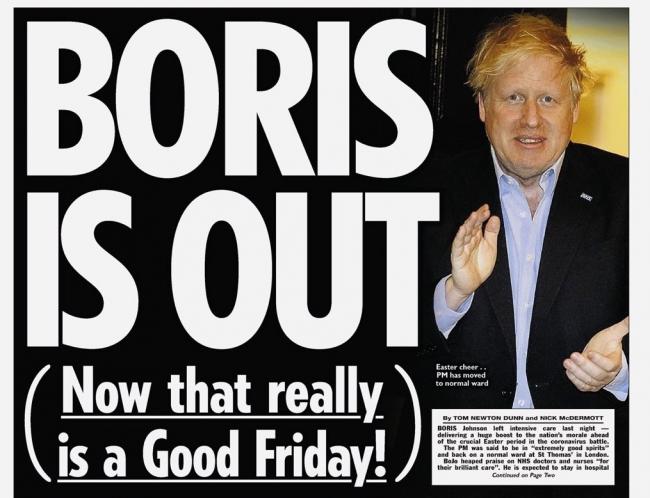
Image by Liz Gerard on Twitter. It shows the Sun’s reporting of the COVID-19 death toll last week.
The Sun’s front page after nearly 1,000 people died in a single day.
The official UK coronavirus death toll will crack 10,000 today. The real death toll, which unlike the official figures includes those who died in care homes, those who died at home and those who had not already been tested positive for COVID-19, is much higher.
Here’s an example. The figure for 8 April was 828 deaths, but none of the 828 deaths happened on the 8th of April. They happened on the 4th of March, and the 5th of March, and the 31st of March, and the 4th of April, up to the 7th of April. Some of the people who died on the 8th will be reported in the figures for the 9th, and the 10th, and so on.
What that means is that there’s a big lag between people dying and their deaths being counted, and that lag can be dramatic: the officially announced death toll for 31 March was 679, but NHS England’s statistics now say it was 1,710. The difference isn’t usually that dramatic, but it does mean that the figures are at best a guide to what’s been happening rather than an accurate picture.
[Update: that means you should prepare for very bad news in the early part of next week: there will be a lag due to the Easter holiday, so we’re likely to see a spike in numbers when those reports come in.]
However you count it, we’re now on track to have the highest death toll of any country in Western Europe, despite having had more time to prepare than the rest of Western Europe.
It is a jarring experience to wake up to a British death toll that is almost a thousand a day, and not see that number on every front page, being put to every politician in every single interview, with a demand for an explanation. It is as if those who should be asking these questions, from the media to opposition politicians, have been subjected to a mass memory-erasing exercise. Every report showing the scale of the crisis should be framed in the language of accountability and anchored in the premise of preventability. With all the benefits of hindsight, the government dragged its feet, wasted precious time and infused the issue with a sense of British exceptionalism: drastic measures need not be taken because in the UK things will somehow be different.
… It’s hard, as we lock down, to nurture an outrage that is based on decisions in the past when the loss of life is happening today – more so when the government has stealthily removed itself from the picture and shifted the responsibility entirely on to the public…
…Relocate the pain and recall that this need not have happened. Ten thousand people, in UK hospitals alone, have now died.
8,958 – total UK deaths from the same virus, excluding hundreds more in care homes
The UK has nearly one in ten of the global deaths from this virus despite being one of the most recent countries to get it.
Today’s daily death toll, 980, means for two days running the UK has had more daily deaths than the worst days in Italy or France.
That’s despite having the benefit of time to see how the virus has spread in other countries, time to order protective equipment and ventilators, time to plan an effective response. Time other countries didn’t have.
Things could have been even worse. If the football authorities hadn’t become fed up with government inaction and decided to cancel multiple big games in March, the numbers  would be even higher.
This is a political failure on a truly horrific scale.
It’s time for the press to do its job and hold the government to account.
I fully support Peter Hitchens and Brendan O’Neill’s inalienable right to be infected with a deadly virus. If they existed in a vacuum, I might buy myself one of those big foam fingers and cheer them on, as they march to the extinction that is the destiny of every dinosaur.
But they don’t exist in a vacuum. They have no more a ‘right’ to keep congregating in pubs than they have a right to set fire to their flat on the ground floor of a skyscraper. Not following guidance, not distancing socially, doesn’t just imperil you. It is something that imperils my friends, my loved ones, everyone. Nobody has a right to put others at risk.
… the very talking heads who have been, for some years now, telling everyone else to rediscover the Spirit of the Blitz, were revealed to be the morons who refused to turn their light off during a blackout and endangered their entire neighbourhood.
It’s becoming very clear who the real “enemies of the people” are.
The report, while accurate and worthwhile, also serves to demonstrate that the BBC clearly doesn’t have any trans people or experts on trans healthcare anywhere near the newsrooms it so happily fills with anti-trans activists. This is not a new story, and it’s definitely not a new problem. Long lists forcing people to self-medicate have been a huge problem in the trans community for very many years, and the ongoing trans healthcare crisis is a much bigger concern to us than any reform to our paperwork.
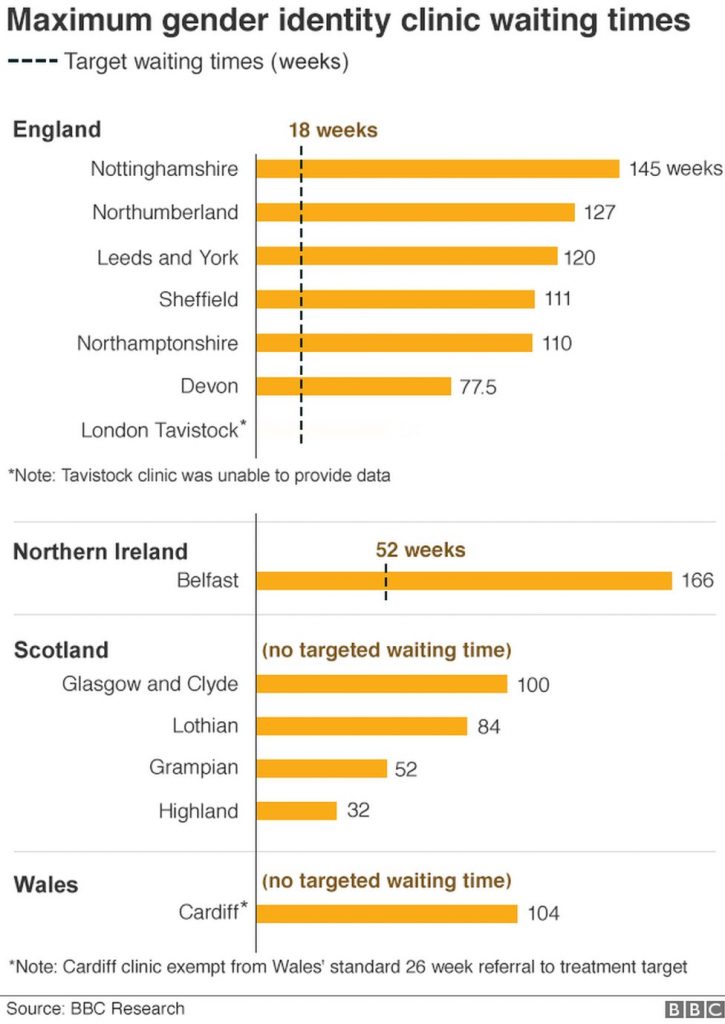
Here’s the graph showing waiting times.
These are not times between referral and treatment; these are times between referral and first appointment. To be given any medical treatment such as hormone therapy there are more assessments first. In my own case, they took a further seven months.
It’s interesting to change the measurements here. Talking about timescales in weeks sounds like a short time, but the 100-week waiting list in Scotland means two years. In Northern Ireland it’s over three years.
We’re talking here about medication that is proven to be safe, effective and in many cases life-saving; if these waiting lists for initial assessment were for any other group of people there would be outrage. But it’s us, so instead we have to endure endless bullshit in the papers about the supposed fast-tracking of trans people while the reality is the complete opposite. I fear that if there’s any outrage at all it won’t be at the broken system but at the people forced to go outside it.