Category: Bullshit

Pernicious nonsense and other irritants

  • What’s wrong with this picture.

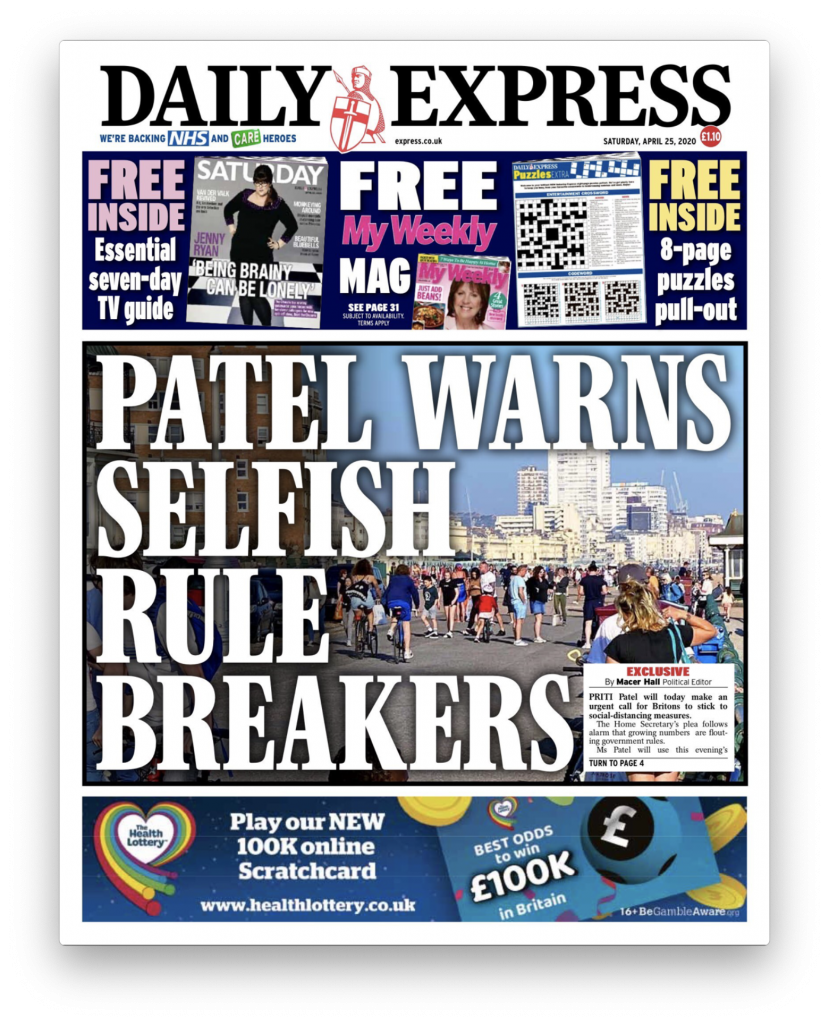
    This is the Daily Express, apparently showing crowds of “selfish rule breakers” during lockdown.

    The photo is of Brighton and Hove seafront. Rob Shepherd lives there. See the cranes in the background? As Rob demonstrates, they aren’t there any more and haven’t been for some time.

  • Never trust a Tory

    The UK government’s new equality minister, Liz Truss, has set out her priorities for the coming months. It isn’t good news for trans people.

    This isn’t a surprise. In 2019 Andrew Gilligan, the journalist who spearheaded The Sunday Times’ scaremongering about trans people, was appointed as a key advisor for No. 10. The conservatives have long discussed demonising trans people as a culture war strategy. It’s entirely on brand for the party of Section 28 to want to roll back trans people’s rights.

    Truss says the UK government will respond to the Gender Recognition Act “by the summer, and there are three very important principles that I will be putting in place.”

    First of all, the protection of single-sex spaces, which is extremely important.

    Secondly making sure that transgender adults are free to live their lives as they wish without fear of persecution, whilst maintaining the proper checks and balances in the system.

    Finally, which is not a direct issue concerning the Gender Recognition Act, but is relevant, making sure that the under 18s are protected from decisions that they could make, that are irreversible in the future.

    The announcement is already being misreported by the right-wing press, so for example the Telegraph claims that “trans children [are] to be banned from surgery”. Surgery isn’t given to under-18s. The announcement clearly means puberty blockers, which it seems the government wants to withhold from teenagers until after puberty.

    “Single-sex spaces” is a dogwhistle. They are not affected by the Gender Recognition Act. The equalities minister of all people should know that.

    The second point suggests that letting trans people live free from persecution is conditional rather than universal.

    That third point is a direct threat to Gillick competence, which says that you do not have to be an adult to get essential healthcare without parental consent: it’s what enables teenage girls to get contraception. By saying that under-18s lack “decision-making capabilities” even though they are old enough to legally become parents, get married or join the army, it paves the ground for an assault on young women’s reproductive rights.

    I hope I’m wrong, but I’ve said previously that I think the government will do something with gender recognition that they can pitch as progressive but that actually removes trans people’s rights: I think it’s highly likely that they will make the existing gender recognition system very slightly more accessible but change the role of the Gender Recognition Certificate so that if you don’t have one, you are not protected from discrimination.

    As the Labour Campaign for Trans Rights put it:

    In her speech she says there must be “checks and balances” before trans people can live freely; an ominous admission that we will not be allowed to live without special restrictions, because of the “danger” of us being trans. This is not equality.

  • Overconfidence and incompetence

    Something we’re seeing a lot of during the coronavirus crisis is the rise of the armchair epidemiologist: the men (it’s mainly men) presenting themselves as authoritative voices about things they have no expertise in.

    Sarah Weinman, for InsideHook.com:

    They are lawyers, former reporters and thriller writers, Silicon Valley technologists, newspaper columnists, economists and doctors who specialize in different parts of medicine. Their utter belief in their own cognitive abilities gives them the false sense that their speculation, and predictive powers, are more informed than the rest of ours.

    They’ve been with us for a long time, of course – the blogging world is full of them – but coronavirus has given some of them a much bigger audience, and that has made some of them dangerous. The UK press and social media is full of grifters speaking with great certainty about things they know nothing about, and those things currently include how to deal with a lethal global pandemic.

    There is a name for this, and it is the Dunning-Kreuger effect. The effect is often explained as “stupid people are too stupid to know they are stupid”, but it’s more nuanced than that. It’s not that people are stupid. Many of the people who clearly have DK are very clever. It’s that they are blinkered: they lack the knowledge to understand what knowledge they are lacking.

    For example, let’s say you’re an economist. If you turn your attention to the likely outcome of the coronavirus, you may come up with different answers than the virologists and epidemiologists do. That doesn’t necessarily mean the virologists and epidemiologists are wrong; it’s much more likely that you’re making ignorant assumptions and rookie mistakes that people in the field don’t make. You don’t know that you’re making them, because this isn’t your area of expertise.

    Where the Dunning-Kreuger effect comes into play is when you decide that if the experts disagree with you, it means it is the experts who are wrong.

    Who better to speak to about the Dunning-Krueger effect than David Dunning, one of the two professors who coined the term? That’s who Sarah Weinman interviewed.

    The problem is that some people can take things they know and misapply it to this new situation. A lot of people think, “Oh, this is a flu,” so they use what is common knowledge of the flu to guide them. But this virus is not the flu. Knowledge is a good thing, but they don’t realize it’s a misapplication.

    I used the example of an economist because that’s a field Dunning specifically mentioned.

    Confidence comes from knowing something, but not realizing you don’t know everything you need to know. If you’ve been rewarded as a successful economist, you deal with formal models in math, and you have confidence in what you do. This can be true of all of us in our area of expertise.

    That confidence may be perfectly justified in economics, but that doesn’t necessarily mean that you have anything valuable to say in other fields.

    Elon Musk is a great example of this. The Tesla boss has an electric car company and launches rockets into space. And when a bunch of kids got stuck in a cave in Thailand, Musk rode to the rescue with a special high-tech submarine to save them.

    The submarine was useless, because it wasn’t able to navigate the caves. When criticised, Musk called an expert diver – the diver who actually helped rescue the trapped kids – a “pedo”.

    Musk has since moved into providing ventilators for coronavirus patients. The machines he supplied are not ventilators. It’s surely just a matter of time before he calls the doctors “pedos” too.

    Here’s one example of why these overconfident men are dangerous: Richard Epstein. Epstein has arguably contributed to the US death toll: his prediction that the coronavirus would only kill 500 Americans was widely shared in US conservative circles and helped inform US government policy on how to respond to the potential loss of life.

    As NY Mag reports:

    A week later, Epstein conceded that he had committed a math error, and the real number would be 5,000 deaths, though “it, too, could prove somewhat optimistic.”

    At the time of writing, the US toll is about to pass 50,000 deaths.

    …Somehow this experience has not shaken Epstein’s confidence in his own ability to outthink the entire field of epidemiology.

    There’s an astonishing interview with Epstein in The New Yorker where he throws a tantrum.

    O.K. I’m going to tell you. I think the fact that I am not a great scholar on this and I’m able to find these flaws or these holes in what you wrote is a sign that maybe you should’ve thought harder before writing it.

    What it shows is that you are a complete intellectual amateur. Period.

    O.K. Can I ask you one more question?

    You just don’t know anything about anything. You’re a journalist. Would you like to compare your résumé to mine?

    Part of the reason grifters have achieved such prominence is because the people in authority often have the Dunning-Krueger effect too.

    The UK government is a stellar example, but you can also see it in things such as authorities urging us not to wear masks because they don’t really prevent you from getting the virus (even though proper ones do, which is why health workers use them, and though they do have a proven effect of reducing the danger of you spreading the virus to others if you don’t realise you have it). When official sources are often wrong, it creates a vacuum that grifters are all too ready to fill with bullshit.

    In the MetaFilter discussion of the article, one commenter posted:

    Science and these various “experts in stuff” both operate in uncertain environments, but treat uncertainty in totally opposite ways.

    …Experts in stuff… use uncertainty as a means to an end, so they generally try to increase it. Since science shows its cards with regards to uncertainty, they can always argue a reasonable level of skepticism of science. Then they can turn around and present some alternative facts and arguments about their own position on the matter. The idea isn’t about the next researcher, or a process to eliminate uncertainty, it’s simply to be convincing. They don’t care if they are right – only if they are perceived as right.

    This is why these “experts” can be so troubling to deal with. They’ll stake a claim against anything, as long as it gets them to their goal. Sometimes it’s just to be respected, but sometimes it can be much darker.
  • Priorities

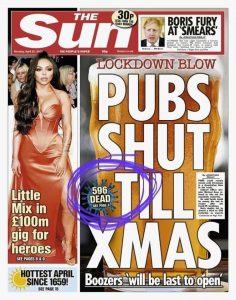
    To add insult to fatal injury, the headline that dominates the front page isn’t even true.

  • Being led by donkeys would be an improvement

    There’s a cartoon I love by Stephen Collins about Michael Gove. It riffs on the film Independence Day, and features the MP volunteering to fly a plane to defeat an alien invasion.

    When quizzed about his unsuitability – “you’ve never flown a fighter plane in your life!” – Gove is adamant that he’s the right man for the job.

    “I used to be a journalist,” the fictional Gove says. “for The Times. I wrote two articles about planes [and] I’ve got strong opinions about aliens.”

    The cartoon’s ending is one of my very favourite things.

    Unfortunately it’s not so funny when the threat isn’t fictional and the strong opinions are about ventilators for coronavirus patients.

    Earlier today, Financial Times public policy editor Peter Foster wrote about the “Ventilator Challenge”, where the UK government decided to specify a whole bunch of ventilators that aren’t suitable for coronavirus patients. His Twitter thread tells the story. It isn’t a happy one.

    The short version, as Foster puts it:

    What this speaks to is the deeply worrying tendency of this crop of politicians to think they know best.

    The ‘cut-the-crap’ ‘how-hard-can-it-be?’ attitudes that leads to headless decision making. It’s embarrassing.

    …Expert people TEARING their hair out at the willful numbskullery of the people at the top.

    If it weren’t for a combination of medical skill and sheer good luck, this fiasco would have killed people.

  • Make America Sick Again

    I fear that this extraordinary photo will become a tragedy in hindsight. It’s of protesters in Michigan, many of them armed, demanding the government lifts lockdown because “we’re tired of not being able to buy the things that we need, go to the hairdressers.” Some protesters’ cars blocked the entrances to a hospital, preventing ambulances from getting through.

    This potentially lethal idiocy is being inflamed by – of course – Fox News. Earlier this week, Fox’s Bill Bennet told Americans once again that the coronavirus isn’t a pandemic and that social distancing isn’t necessary. Protesters’ claims that the virus was less dangerous than the flu are just echoing what Fox has been telling them, and their president, for the last five weeks.

  • Getting through today is enough of an achievement

    Laura Waddell has written a typically incisive and witty column about the mindset that sees police officers hassling people for sitting down and social media influencers shaming people for not doing 13 million sit-ups and writing a novel every day.

    Going into lockdown, and especially for the furloughed, many of us thought we would use the time productively. To work on a novel. To learn a language. A daily yoga practise. Crafting. But many have found it harder than they expected, distracted and made despondent by the bad news flowing each day. Are we putting pressure on ourselves to do these things because we want to, or because under a Capitalist society, endless productivity is demanded of us? In finishing that book with haste, are we responding to an artistic drive, or a marketing schedule? It is easy to internalise the pace of work, reenacting it even in downtime, particularly in those with insecure, freelance jobs, always hustling for the next gig.

  • Shifting the narrative

    The Conservatives are working on their exit strategy. Not how we’ll exit the lockdown; how they’ll shift the blame for their failures onto others, such as the NHS. For example:

    Care homes are not run by the NHS.

    Care homes used to be run by councils, but years of funding cuts have seen that provision almost disappear. Today, care homes are primarily for-profit private businesses.

    84% of English care home beds are owned and operated by private companies, 13% are run by voluntary organisations and 3% are run by councils. As the authors of a recent report into the sector put it:

    The state has abdicated its responsibility for providing care over recent decades. The private sector may have filled this gap but it consistently puts profits before people.

    …The fact that private equity-backed firms have taken over a significant share of the UK’s care provision, fuelled by debt and driven by the prospect of rising property prices and ever-lower care costs, puts our vital social care system at ever-increasing risk.

    One of my best friends is a care home worker. Like many in the sector they are on a zero hours contract and paid a pittance by a private and very profitable company; they have not been given PPE because the company doesn’t want to pay for PPE. Care homes can do, or in this case not do, whatever they want. Which is why so many people are dying in them.

    The government doesn’t want to be on the hook for those deaths, or for the growing death toll among front-line NHS staff. Hence the emerging narrative that it’s all the NHS’s fault. But it isn’t. The lack of PPE for front-line workers and other key equipment is the result of government decisions and indecision going back to January.

    The dread hand of news management has already kicked in: the allegation is now that key workers aren’t getting PPE because the lumbering, inefficient NHS isn’t allocating resources properly, not that the resources weren’t there in the first place. There are a lot of carefully worded claims doing the rounds, so for example the government is keen to talk about the overall number of items of PPE that have been distributed rather than the details of which items have gone where and in what quantities: there’s a big difference between a gown (which is inappropriate for aerosol-generating procedures) and an FFP2 surgical mask. If there were enough PPE, everyone in the country with a 3D printer wouldn’t be making making visors for NHS staff and nurses wouldn’t be making their own PPE from bin bags.

    Still, we can count on our fearless, non-partisan press ensuring they don’t get away with it. Can’t we?

    Image by Liz Gerard on Twitter. It shows the Sun’s reporting of the COVID-19 death toll last week.
  • Lethal stupidity on a truly horrific scale

    The Sun’s front page after nearly 1,000 people died in a single day.

    The official UK coronavirus death toll will crack 10,000 today. The real death toll, which unlike the official figures includes those who died in care homes, those who died at home and those who had not already been tested positive for COVID-19, is much higher.

    The Centre for Evidence Based Medicine has published a good explanation of why the official figures are inaccurate, complete with spreadsheets so you can see for yourself. The figures we’re given in the daily briefings do not tell us how many people died on a particular day. They tell us how many deaths in hospitals were reported that day. There is often a delay between the death occurring and the death being reported.

    Here’s an example. The figure for 8 April was 828 deaths, but none of the 828 deaths happened on the 8th of April. They happened on the 4th of March, and the 5th of March, and the 31st of March, and the 4th of April, up to the 7th of April. Some of the people who died on the 8th will be reported in the figures for the 9th, and the 10th, and so on.

    What that means is that there’s a big lag between people dying and their deaths being counted, and that lag can be dramatic: the officially announced death toll for 31 March was 679, but NHS England’s statistics now say it was 1,710. The difference isn’t usually that dramatic, but it does mean that the figures are at best a guide to what’s been happening rather than an accurate picture.

    [Update: that means you should prepare for very bad news in the early part of next week: there will be a lag due to the Easter holiday, so we’re likely to see a spike in numbers when those reports come in.]

    However you count it, we’re now on track to have the highest death toll of any country in Western Europe, despite having had more time to prepare than the rest of Western Europe.

    If you can bear to read it, there’s a timeline of the lethal arrogance that’s already killed thousands of people here.

    Nesrine Malik in The Guardian:

    It is a jarring experience to wake up to a British death toll that is almost a thousand a day, and not see that number on every front page, being put to every politician in every single interview, with a demand for an explanation. It is as if those who should be asking these questions, from the media to opposition politicians, have been subjected to a mass memory-erasing exercise. Every report showing the scale of the crisis should be framed in the language of accountability and anchored in the premise of preventability. With all the benefits of hindsight, the government dragged its feet, wasted precious time and infused the issue with a sense of British exceptionalism: drastic measures need not be taken because in the UK things will somehow be different.

    … It’s hard, as we lock down, to nurture an outrage that is based on decisions in the past when the loss of life is happening today – more so when the government has stealthily removed itself from the picture and shifted the responsibility entirely on to the public

    …Relocate the pain and recall that this need not have happened. Ten thousand people, in UK hospitals alone, have now died.

  • Beware bored police officers

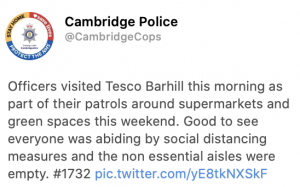
    Here’s Cambridge Police on Twitter this morning.

    Let’s play a little game. It’s called “show us which specific part of the emergency coronavirus legislation details which supermarket aisles are essential and which ones are non-essential”.

    There isn’t one, of course. Shops are allowed to sell anything they have in stock, and you are allowed to buy it.

    And it’s not just the Cambridge plod. Yesterday we had suggestions that police would check the contents of people’s shopping carts to make sure they weren’t buying anything frivolous. Last week, police were deciding that cigarettes and alcohol weren’t permitted.

    So far at least this is a fairly innocuous example of something much more serious: whenever new powers are made available to people, some of those people will deliberately or accidentally overestimate the powers they have.

    Whenever new powers are being considered, even in an emergency, one question should always be paramount: what could the worst person in the world do with those powers? Because once the powers have been made available, you’ll find out.