Category: Bullshit

Pernicious nonsense and other irritants

  • Blasts from the past

    I’m currently reading Transgender History by Susan Stryker, and one of the saddening things about it is how little the arguments of anti-trans people have changed – not least the tendency to accuse us of believing things we don’t believe.

    This is doing the rounds on Twitter at the moment.

    If a vagina doesn’t make you a woman, how come lipstick, high heels and a handbag do?

    Nobody’s claiming having heels or a handbag makes you a woman. Nobody. It’s a straw man, a made-up claim designed to reinforce the idea that trans women are unserious people who are merely playing dress-up, and anti-trans activists have been using it for over 40 years now.

    “Man” and “woman” are genders, not sexes, and while they generally correspond to people’s observable birth sex that is not always the case. We’re much more complex than that.

    Many cultures understand this and have long classified people into not just two genders, but many; they understand that the genitals you are born with do not necessarily dictate the gender you are or the way you will live your life.

    One of the reasons we conflate sex and gender is because for many people they match. But they don’t always, and it’s often gender – how closely you conform to stereotypical ideas of what men and women should look like and behave like – that is used to classify you.

    I’ve written about this before, because I find it bleakly funny: when I began presenting as me full-time the change was dramatic. Literally overnight I went from being a valued member of one project team to a person whose opinions were only worthwhile when repeated by one of the men; from being someone who could read a book in a bar without interruptions to someone who couldn’t; from being respected as an expert to being dismissed as a “silly little girl”. My genitals didn’t change, but people’s perception of my gender did.

    And part of that perception is based on the presence or absence of lipstick, heels and handbags. It’s not that those things make me a woman; of course they don’t, any more than sitting without makeup in a t-shirt covered in bits of fried egg makes me any less of one. It’s that they make other people less likely to be difficult.

    The closer I conform to stereotypical gender presentation, the less shit I have to deal with – so while my presentation doesn’t change my gender identity, it does change how some other people treat me.

    Here’s an example. The other morning I went to my own bank to pay my own money into my own bank account. I was dressed like I normally am: skinny jeans, animal print tunic, a bit of makeup and a bit of jewellery. And normally I’m greeted without incident or misgendering. But this time out I was wearing a mask that hid most of my immaculately made-up face, and when the teller heard my voice and compared it to what was on her screen – a female pronoun, a female name – she asked me: “are you sure this is your account, sir?”

    Most of the time I present stereotypically female because it makes life easier: I’d rather not be treated with suspicion when I’m paying money into my own bank account.

    Biological sex is what you begin with, but gender is the space in the culture that you inhabit – and the former does not necessarily dictate the latter. You can be born with a vagina and be a man; you can be born without one and be a woman; and you can be born with any configuration and be non-binary. Other cultures have known this for millennia. It’s just taken us a bit longer to catch up.
  • “Those with money, power, and influence have the advantage”

    A personal and powerful essay by Katelyn Burns who, like me, is a late transitioning trans woman.

    As a child, I could not see positive examples of trans women having meaningful lives, so I could not be a trans woman who had a meaningful life.

    I’m a bit older than Katelyn so I didn’t discover the internet until later: she was a teen and I was in my twenties. But this is nevertheless very familiar.

    I had trouble finding helpful information. Search engines weren’t really a thing and most of the AOL chatrooms I found were just forums for “tranny chasers” to have cybersex with trans women. Not a healthy environment for a scared 14 year old closeted trans girl.

    I dove further into the closet.

    There’s a phrase I like: we cannot be what we cannot see. One of the reasons it seems that there are suddenly more trans people in the world is that there are more visible trans people in the world. Earlier today I saw one anti-trans Twitter user express her disbelief that trans women were around before she was born: “But I’m 42,” she harrumphed.

    We were always here. But for a long time we didn’t know there were others like us.

    Despite the transphobes’ best efforts, there is now more representation, more visibility and more information for trans, non-binary and gender non-conforming people who would previously believe that there was nobody else on Earth who felt the way they feel.

    To those who aren’t trans, it may feel like trans people and issues are everywhere. And that’s true. We have trans actors and actresses playing leading roles on TV, even on those over-the-air channels I received as a youngster. Our issues are debated in national publications. Books written by trans people are more available than ever.

    If I was a child now, even in the mountain-hill house with no cable, there’s just no way I wouldn’t have had access to positive trans content.

    …It’s pretty clear that the dramatic increase in child referrals to youth gender clinics has grown out of the increased positive media exposure of trans people in general. Looking at the numbers, it appears that the children of the past, like me, who didn’t have any idea that you could even be trans, are learning about trans identities at younger and younger ages.

    If you go by the most common estimate for the percentage of trans adults as a share of the general population, currently about 0.6 percent, the number of children being referred for gender services in the UK remains below that number as percent of all children. In other words, it’s the same people who previously would have waited into adulthood to transition just deciding to come out earlier in life.

    Many of us grew up unaware that there were other people just like us, and that people just like us could be happy and loved. And that, at last, is changing.

    There are some very vocal people who don’t want us to have any information, who don’t want us to have any support, who don’t even want us to have any healthcare. Just today, they’re using the hashtag #OnlyFemalesGetCervicalCancer on social media to punch down on trans men and non-binary people, people who already encounter discrimination and gatekeeping in medicine. I know a few trans men whose experience of screening services is horrific. The message is clear: we’d rather see trans men and non-binary people die of cancer than get screening.

    These are people whose attitudes towards the “genuine” trans people they pretend to care about was summed up in this tweet by a non-binary mum on Twitter:

    trans kids – “you’re too young to know!”

    trans teens – “you just need to go through puberty first to be sure!”

    trans adults – “why is this just coming up now?”

    every step of the way there’s an excuse to try and keep trans people from living an authentic life and its all fkn bs

    The justification changes but the core belief – that trans people do not know their own minds, that what they experience is not real, that they are fakes and frauds who do not deserve acceptance, support, healthcare or even basic human rights – is constant. It is the same world view as the climate change deniers, the anti-vaxxers, the anti-maskers, and every other kind of conspiracy theorist: I know what I believe, and the world should conform to my beliefs.

    These people and the people who amplify them have power that trans and non-binary people do not.

    For example, today The Scotsman ran its second consecutive opinion column in two days supporting JK Rowling against those terrible trans “activists” (never “people”. That’s reserved for transphobes). Today’s columnist notes that the author is a “dear friend” of his.

    That one was pretty mild. The day before, in the same newspaper, another columnist slammed trans people as misogynists, said trans women could never have any insight into being women and should not talk about feminism, and namechecked a whole bunch of demonstrably anti-trans activists including the head of the anti-trans hate group LGB Alliance, the anti-trans hate group For Women Scotland (whose founder called trans women “sick fucks… fucking blackface actors” and peddled antisemitic conspiracy theories) and an anti-trans extremist whose demands for the legal right to bully trans people at work were memorably described by a tribunal judge as “not worthy of respect in a democratic society”.

    This is the norm in the newspaper industry, and with the wider media ecosystem it so often sets the agenda for. There are no trans equivalents of Nick Cohen, Suzanne Moore, Julie Bindel, Janice Turner, Douglas Murray, Brendan O’Neill, Toby Young, James Kirkup, Kevin McKenna or any of the very many other high profile figures who regularly use their platforms to misrepresent trans people or to falsely claim that trans people’s rights (as Janice Turner would put it, “trans activists’ demands“, because all trans people are activists and rights are only for cisgender people) conflict with women’s rights.

    Burns:

    To those unaffected, all is seen is words against words in the abstract, surely something worth cheering for. But for folks at the bottom, with enough time and encouragement from those at the top, those words metastasize into violence. Examples abound. In a different context, hilarious memes exchanged on white nationalist message boards about driving cars into crowds of protestors turn into actual terror attacks. Intellectual debates over whether trans women are women lead to mobs of men beating up trans women. Concerned parents take their children’s internet away.

    …In our world, debate is a one way street.


  • “Facts don’t fit our narrative”

    There were two newsworthy trans-related stories in the last 24 hours. In one, a YouGov poll reported that most people, especially women, are in favour of gender recognition reform. This is quite important, given that Liz Truss is expected to announce her plans to kill gender recognition reform later this month.

    In the other, the BBC has suggested to its staff that, if they want to, it might be quite nice if they included their pronouns in their email signatures. But, y’know, it’s okay if you don’t want to!

    Only one of them made it into the newspapers*. You’ll never guess which one.

    The Times even ran a damning editorial about the BBC’s “well-intentioned but mistaken” policy, and the Mail published a rewrite so it could get its army of simpletons to talk about the P.C. Gone Mad Biased Broadcasting Corporation.

    Meanwhile PinkNews, which commissioned the poll in the first story, tried and failed to get any newspaper to run it. “It doesn’t fit the narrative,” they were told.

    I didn’t realise The Times had also written an editorial when someone asked me this morning what I thought of the pronoun story. But the fact that it did just proves the point I made in my reply:

    On the face of it it’s a nice gesture by the BBC, not just for trans and non-binary people but for anybody whose name doesn’t necessarily indicate their gender or whose name is from a different part of the world. Ten years from now it’ll be the norm because it’s simple politeness that doesn’t harm anybody.

    But as a news story it’s a distraction, and it’s probably not a coincidence this is in the Times. It has the potential to combine two of The Times’ favourite themes: “The BBC Has Gone Mad”, and “These Days, If You Say You Want To Stab Trans People They’ll Arrest You And Put You In Jail.”

    This is an example of what I blogged about earlier: the deliberate focus on non-stories and culture war bullshit.

    As far as the BBC goes, I’d much rather it stopped giving uncritical coverage of anti-trans misinformation and scaremongering; when some programmes appear to have a very anti-trans agenda, knowing the producer’s pronouns is rather like the fire brigade sending you a “sorry your house is on fire” card instead of a fire engine.

    I don’t care what Huw Edwards signs off his emails with.

    I care very much that people with no expertise are allowed to present themselves as experts about people they know nothing of and in some cases are clearly prejudiced against.

    And I care very much that multiple national newspapers won’t run stories about trans people if those stories conflict with the “narrative” they push in their pages.

    * Update, 14 July: The Independent ran the story yesterday, so clearly some newspapers consider it newsworthy. Just not the ones with an agenda. 

  • Subtext and context

    In an excellent Twitter thread, Slate writer Lili Loofbourow explains why it’s pretty much impossible to have a debate on the internet.

    “Why would you refuse to debate someone who’s simply saying that All Lives Matter?” is the kind of question an Enlightenment subject longing for a robust exchange of ideas might ask. Well, the reason is that most of us know, through bitter experience, that it’s a waste of time.

    It wouldn’t be a true exchange. We know by now what “All Lives Matter” signals and that what it signals is orthogonal to what it says. Your fluency in this garbage means you take shortcuts: you don’t have to refute the text to leap to the subtext, which is the real issue.

    Loofbourow gives the example of a man being condemned for wearing a Hawaiian shirt at a protest.

    It might indeed look like cancel culture gone mad. He’s just standing there! Civilly! Offering support to Black Lives Matter protesters, of all things! Can’t we all, whatever our disagreements, come together in support of a good cause?

    Sounds reasonable. But the Hawaiian shirt is the adopted uniform of far-right thugs who want to start a second US Civil War, and in this context that’s the message it is being used to send. If you’re not aware of the existence of those thugs, let alone their signifiers, you won’t see it.

    The phrase “All Lives Matter” is similar. It seems perfectly reasonable, doesn’t it? But the message is that Black Lives Don’t Matter. Imagine phoning up the fire brigade when your house is burning and being told All Houses Matter.

    We like to think that in online discussions, both sides are approaching the subject in good faith. That both sides are approaching the discussion with sincerity, with openness and with a genuine desire to find the truth, even if that means they have to change their views. And of course, that’s not how it works.

    Bad actors take advantage of that.

    There are three elements to a message such as a social media post: text, subtext and context. The text is the content of the post, such as “All Lives Matter”. The subtext is the message those words are intended to convey, such as “Black Lives Don’t Matter”. And the context is where the text comes from: the culture, the assumptions, the wider story.

    To stick with “All Lives Matter”, the context of that phrase is that it is almost exclusively used to dismiss the Black Lives Matter movement and to try and silence Black people.

    The equivalent for me is “What rights don’t trans people have?” The text seems like a perfectly reasonable question but online, it is very rarely asked in good faith.

    In this case, the context is that in almost every case the questioner knows exactly which rights trans people don’t have (the right to healthcare, the right to family life, the right to a private life, the right to protection from discrimination and violence, etc) but doesn’t care. They are not coming to learn; they are coming to fight.

    There are certain terms that bad actors use again and again (a deliberate strategy of normalisation) that indicate a bad faith argument. In trans-related discourse they include “gender ideology”, which was coined by the Catholic Church to battle LGBT+ equality, and “women’s sex-based rights”, which was coined by the US religious right to exclude trans women from discussions of women’s legal and human rights. Both terms are used almost exclusively by people who are anti-trans and often anti-LGBT+ and anti-women’s reproductive freedom too.

    The text is designed to seem reasonable. But it’s the Hawaiian shirt at the Black Lives Matter rally.

    Loofbourow:

    …there’s a history here: platforms got flooded by devil’s advocates who wasted the time of people with real investments–cruelly, for sport. That tends to weed out good faith engagement.

    Add to this that most arguments worth having have been had and witnessed 1000x already on these platforms, in several permutations. We know their tired choreographies, the moves and countermoves. At this point we mostly enjoy the style of whichever dunk we happen to agree with.

    This isn’t great. People talk past each other, assume bad faith. But it’s not the fault of “illiberalism” that good faith is in short supply. And if that’s where your analysis begins, I can’t actually tell whether you’re naive or trolling. And I’m no longer sure which is worse.


  • Everything you need to know about “cancel culture” in one sentence

    The Times published an article today about so-called “cancel culture”, aka powerful people being criticised by marginalised people, and gave examples of the kind of wonderful humans whose careers have supposedly suffered as a result of it. The list includes some truly awful people.

    For example:

    The singer R Kelly’s career was damaged hugely after he was cancelled for allegations of sexual misconduct

    R Kelly is in prison facing 22 criminal charges relating to the abuse of 11 girls and women over the course of more than two decades in what prosecutors describe as an organised crime ring. He also faces separate charges for sexual assault and abuse, and multiple civil suits from other women.

    The piece is a spectacular own goal because it says the quiet bit out loud: some of the loudest voices against “cancel culture” believe that we should care more about the reputations and careers of celebrities than the marginalised people they harm.

  • I don’t want to talk about her either

    …but Rowling is trolling again, and she’s moving into very dangerous territory. The government is considering whether to ban conversion therapy, which is discredited and dangerous. Rowling is trying to convince people that trans-affirming healthcare is also conversion therapy.

    Here’s The Trevor Project:

    Conversion therapists use a variety of shaming, emotionally traumatic or physically painful stimuli to make their victims associate those stimuli with their LGBTQ identities. According to studies by the UCLA Williams Institute, more than 700,000 LGBTQ people have been subjected to the horrors of conversion therapy, and an estimated 80,000 LGBTQ youth will experience this unprofessional conduct in coming years, often at the insistence of well-intentioned but misinformed parents or caretakers.

    Conversion therapy is the attempt to force people to change their sexual orientation or gender identity. It is almost always done against the person’s will and instigated by somebody with authority over them, such as a parent or religious leader.

    It ruins lives.

    NBC News:

    Exposure to “conversion therapy” — efforts by a secular or religious professional to change a transgender person’s gender identity — is associated with thoughts of and attempts at suicide, according to a study published Wednesday in the journal JAMA Psychiatry.

    …“What this new study shows is that transgender people who are exposed to conversion efforts anytime in their lives have more than double the odds of attempting suicide compared with those who have never experienced efforts by professionals to convert their gender identity, he said.

    Turban said one of the most alarming findings from the study was the even higher risk of psychological distress for those who reported exposure to conversion therapy during childhood. Those who were subjected to the practice before age 10 were four times more likely to report lifetime suicide attempts than the general transgender population, according to the findings.

    Teen Vogue published an exposé on the “Gender Critical” parents who actively seek conversion therapy for their children.

    These parents don’t view “non-affirming therapists” as conversion therapists, but the connections are clear: “gender-critical therapy” is the newest cover of a song that’s been playing for the past 50 years. And while the methods aren’t perfectly aligned, the harm that can be caused by these kinds of practices can be as severe. The desired outcome — rejection of transgender identity — is a message that’s been broadcast by a network of quasi-medical organizations, the evangelical anti-LGBTQ right, and the old guard of conversion therapists who’ve been defending their harmful actions for decades.

    …As NCLR puts it: “While these contemporary versions of conversion therapy are less shocking and extreme than some of those more frequently used in the past, they are equally devoid of scientific validity and pose serious dangers to patients — especially to minors, who are often forced to undergo them by their parents or legal guardians, and who are at especially high risk of being harmed.”

    But what anti-trans bigots claim is that the real conversion therapy is when parents are not putting trans kids through conversion therapy. In their minds there are no trans teenagers; just gay teenagers who are forced, often by an international Jewish conspiracy, to become trans because it’s much easier than being gay.

    I don’t know where to start with this, I really don’t. The idea that it’s somehow easier to be trans or that homophobic parents would rather have a trans kid than a gay one is so deranged it’d be funny if it weren’t about something so serious.

    You cannot talk somebody into being trans any more than you can talk them into being gay. If you could, there would be no trans people and no gay people, because the world is very cruel to trans people and gay people.

    Conversion therapy does not work. You won’t turn a straight kid gay or a cis kid trans with any amount of propaganda. And you won’t turn a gay kid straight or a trans kid cis by torturing them. We know this, because many people have tried to do it.

    Gender-affirming healthcare operates from the approach of “do as little as possible”. In most cases it is no more than using a child’s preferred name and pronouns. In the teenage years, after many months or years of assessment, it may involve puberty blockers to delay puberty in order to give them more time. And then, years later, it may involve transition, a process with an exceptionally high success rate and a very low regret rate.

    Nobody goes into this lightly, and they definitely don’t go into it at high speed. There are tons of reputable studies that show that this approach is effective, that it leads to improved mental health outcomes, and it saves lives.

    So of course some bigots want to get rid of it. Better a dead kid than a trans kid.

    The people Rowling is amplifying want to remove all support, all healthcare and all affirmation from trans teenagers. They want trans teens to be deprived of any help and bullied until they break down and say they’re not trans.

    Let’s call it what it is. Torture.

    As the journalist Katelyn Burns put it, JK Rowling’s message to trans teens is simple.

    Your body. My choice.

  • “The culture war is an incredibly cheap way of getting votes”

    This is a fascinating post on voters and “culture war” messaging.

    Right-wing politicians love a good culture war. It’s no coincidence that the terms ‘political correctness’ and ‘woke’, both originating on the American left, have been eagerly seized by the right. They know it is an ideal way of stirring up indignation and deflecting attention from things they’d rather not discuss.

    …A few left-wing activists can usually be relied upon to give the right-wing press the ammunition it needs by doing or saying something silly. Even a poorly considered comment or rebuttal can lead to stories that run for years, like Baa Baa Green Sheep and Winterval. On the basis of one person writing ‘racist’ on Winston Churchill’s statue, Boris Johnson has been able to cast himself as the defender of a monument that is not under any serious threat. He was at it again yesterday, attempting to spice up his lacklustre speech with a promises to defend the “statue of our greatest wartime leader” from, well, no-one really.

    The problem for the left is that some of this stuff lands. It makes otherwise quite reasonable people cross. And it doesn’t need to make many of them cross… All it needs is enough people in the right places.

  • Manufacturing dissent

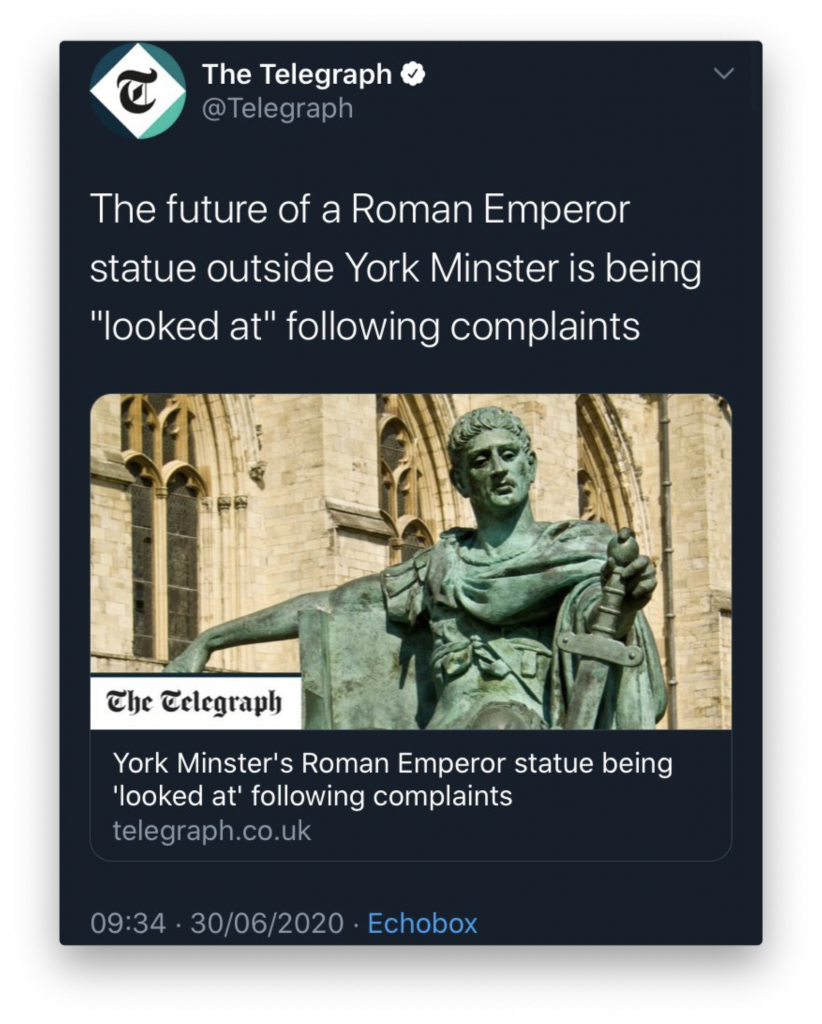
    The Telegraph:

    York Minster, on Twitter:

    We have not received any formal complaints and at present the statue is not under threat from removal.

    When challenged on Twitter by the story’s author, Gabriella Swerling (“If you haven’t received any complaints about the statue, perhaps refrain from telling journalists that you have”), York Minster replied:

    We clearly stated over the phone that we have received no complaints (directly via tags here, emails, letter or phone calls etc) and that [we] were not reviewing the statue’s status. This has been quoted correctly in other media outlets.

  • These days, if you say you’re a bigot, you’re arrested and thrown in jail

    Former comedy writer Graham Linehan’s Twitter account was finally closed this weekend. The move came a week after another nasty troll, Katie Hopkins, lost her account for the same reason: repeated violations of Twitter’s hateful conduct policy.

    The stories are almost identical, but the reporting isn’t. And the best way to demonstrate that is to show you the way the same outlets reported the stories in their headlines.

    Sky News:
    – Katie Hopkins permanently banned by Twitter for breaking ‘abuse and hate’ rules
    – Father Ted co-creator Graham Linehan banned from Twitter after trans comment

    RT.com:
    – Katie Hopkins permanently suspended from Twitter to keep platform ‘safe’ from ‘hateful conduct’
    – Twitter permanently suspends ‘Father Ted’ writer after he replies ‘men aren’t women’ to pro-trans tweet

    Guardian:
    – Katie Hopkins permanently removed from Twitter
    – Twitter closes Graham Linehan account after trans comment

    Daily Mail:
    – Katie Hopkins is BANNED from Twitter for breaking rules on hate speech
    – Father Ted creator Graham Linehan is suspended from Twitter after stating ‘men aren’t women’

    As you can see, each publication has framed the two stories very differently, and that’s apparent in many more publications than the ones I’ve quoted here. When Hopkins’ tweets have been referenced in headlines, if they were mentioned at all, they were usually prefixed with words like “vile” and “hateful”. There’s no such context in the headlines about Linehan.

    Maybe that’s because all of those publications have run anti-trans story after anti-trans story, anti-trans column after anti-trans column.

    Quick question: who claims that trans rights advocates are a front for a sinister cult sacrificing your children: the washed-up comedy writer or the award-winning newspaper columnist?

    Trick question. It’s both.

  • Super Size Media

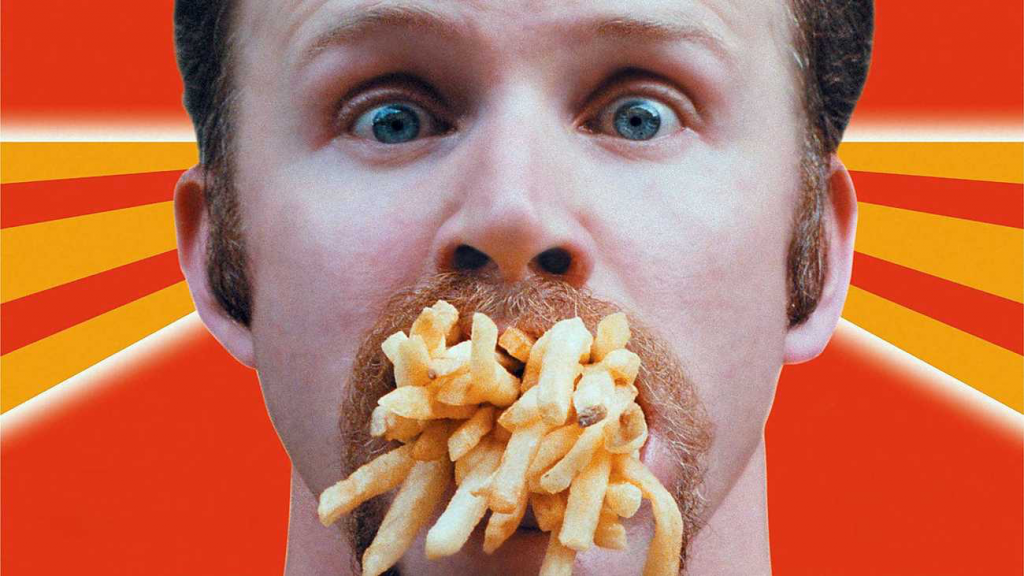
    Morgan Spurlock in a promotional image for Super Size Me (2004)

    Have you ever wondered why so much news output is junk?

    It’s because of the big board.

    As journalist Mic Wright explains, the big board was popularised by Nick Denton of Gawker media. It’s a big screen that everybody in the newsroom can see, and it shows you in real time which stories are getting the most attention.

    What Gawker did a decade ago is commonplace in newsrooms now, because most media outlets have become dependent on traffic-based advertising revenue. As a result every significant media outlet pays close attention to its traffic: “which reporters/writers/columnists are killing it and whose stuff is absolutely eating dirt,” as Wright puts it.

    And sadly, it’s usually the lowest-quality content that’s killing it.  You can see that for yourself: while media outlets don’t let you see their big board, many of them do show you what content is the most read (and often, most shared and/or most commented on).

    In 2011, Nick Denton explained that this system worked really well for everything but “the worthy topics”: “Nobody wants to eat the boring vegetables. Nor [do advertisers] want to pay to encourage people to eat their vegetables.”

    He was right, and the food comparison is a good one: many of us would much rather eat Big Macs than broccoli, and the stats show that we are similarly drawn to unhealthy news output: the dogwhistling columnists, the manufactured outrage, the reinforcement of prejudice, idiocy rather than analysis.

    But the downside is the same too. As Morgan Spurlock demonstrated in Super Size Me just before the big board became a newsroom staple, there are terrible consequences to consuming a diet made mainly of junk.