Category: Books

Stuff I’ve read or helped to write

  • Twice as nice

    I’ll be doing not one but two events at this year’s Edinburgh Book Festival on the 10th and 11th of August.

    First of all there’s 1995: Grrrls Aloud where I’ll be joining Emma Pollock, Cora Bissett and Chitra Ramaswamy, with a soundtrack by Hen Hoose’s Cariss Crosbie. We’re going to be talking about the other 1995: not the Oasis one, but the one where Garbage released their debut album and the Delgados and Chemikal Underground did amazing things.

    And the following day, I’ll be in conversation with Gary West as we celebrate Scots music in the brilliantly titled God Save The Scene. Gary’s book, Brave New World, is a biography of the late, great Martyn Bennett.

    I’m really looking forward to both events. I think they’ll be lots of fun.

  • It’s oh so Quietus

    I’m absolutely delighted to be featured in The Quietus, courtesy of excellent interviewer Claire Sawers.

    And so it was that Marshall embarked upon a two and a half year project to research queer music in Scotland. Small Town Joy: From glam rock to hyperpop: how queer music changed the sound of Scotland is her wonderful, trivia packed, often fascinating and fangirling look at the LGBTQ+ artists that have shaped Scotland’s cultural landscape. She’s deliberately not aiming solely for a nostalgic, retromania style read either. After tracing historic lines, the second half of the book is a rich collection of her interviews and essays exploring current queer scenes, sometimes ones thriving in places where she least expects. (See her interviews with queer Scots trad folk musicians for example, or conversely, a notable lack of interviews with gay male rappers.)

  • Time for a Snack

    I’m a big fan of Snack magazine, the independent Scots arts, entertainment and culture magazine, so I’m really delighted to be in its pages this month talking about Small Town Joy. You can read this month’s magazine online for free here.

  • Small Town Joy in Scots Whay Hae!

    I was absolutely delighted to chat with Alistair Braidwood for the Scots Whay Hae! podcast about Small Town Joy. Here’s the video.

    Our chat is also available as an audio podcast. More details and listening links are here.

  • Here comes Joy

    It’s publication day for Small Town Joy, my book about how queer musicians changed the sound of Scotland. It’s based on two years of interviews with musicians, music fans, grassroots groups and other fascinating folks, and I hope it’ll make you excited about the music it describes and the musicians who’ve been so generous with their time.

    As my friend, the writer and crafter Karie Westermann, put it: “Queer people creating joy, crafting resilience, and finding community through music. It could not have been published at a better time.”

    The book is available online from my publisher, from Bookshop.org and from good bookshops everywhere.

  • I’m book of the month

    The excellent literary magazine Gutter has made Small Town Joy its book of the month for March 2025, and given it a really nice review.

    “An absolute treat to read… This whole book feels like a mixtape lovingly assembled by a friend’s cool, knowledgeable older sister.”

  • Joy as an act of resistance

    The cover of the book Small Town Joy by Carrie Marshall

    I’m very pleased to reveal the cover of my new book, Small Town Joy, designed by Kara McHale. The book will be available in April and you can pre-order it from my publisher or local bookshop right now. Please do, pre-orders are a huge help for small publishing houses and indie bookshops alike.

    After writing and promoting Carrie Kills A Man I made a conscious decision to look for, and to write about, joy. And this book is the result: it’s a history of how queer music and musicians changed the sound of Scotland, and in its pages you’ll hear from some incredibly talented and interesting people.

    I’ll be talking much more about the book nearer the time but I had to share the cover. Isn’t it gorgeous?

  • A cover girl again

    Fierce Salvage book cover

    I’m proud and delighted to be one of the contributors to, and one of the mentors involved in, the new Queer Words anthology Fierce Salvage. It’ll be published in January 2025 and features a dizzying array of LGBTQ+ talent. And me.

    I haven’t had the opportunity to read the other contributions just yet bar one, a story by Colin McGuire that I helped polish a little bit. Colin’s great and his story is touching, funny and vividly told. I can’t wait for you to read it.

    Pre-orders for Fierce Salvage are now open and you can order your copy here.

  • An announcement

    Bless my cotton socks, I’m in the news: the announcement of my new book is in today’s Bookseller. It’s been *so* hard to keep this quiet so I’m really delighted to say we’re putting the band back together for another 404ink book, this time celebrating Scots music of all kinds.

    The book is called Small Town Joy: From Glam Rock to Hyperpop, How Queer Music Changed The Sound of Scotland and it follows queer musicians and influences in Scots music from the 1970s to the present. I’m having tons of fun researching, interviewing for and writing it and I’m really looking forward to sharing it with you in March 2025.

    As I told the Bookseller:

    “I’m delighted to be getting the band back together again for my second 404 Ink book. Small Town Joy follows Scots musicians from bedrooms to the Barras and beyond, tracing the glittery threads that link punk and pop, folk and funk, rave and rock. It’s a provocation and a celebration, a mixtape dedicated to the tunes and talent that’s crossed genres, genders and generations to change the sound of Scotland.” 

  • Death should be the end

    There’s a joke I like about technology companies, first posted by Alex Blechman:

    Sci-Fi Author: In my book I invented the Torment Nexus as a cautionary tale

    Tech Company: At long last, we have created the Torment Nexus from classic sci-fi novel Don’t Create The Torment Nexus

    Like the best jokes it’s funny because it’s true: all too often, tech firms care about whether they could do something rather than whether they should. Which is how a supposedly AI-generated comedy routine by George Carlin, who died in 2008, came to be made.

    I say “supposedly” because the whole thing seems awfully fishy. But what’s definitely true is that some people have created a Carlin sound-a-like, and it’s awful. Ed Zitron:

    AI-Carlin’s jokes feel like they were generated by feeding transcripts of his real work into a generative AI, with the resulting CarlinGPT bot prompted by Sasso and Kultgen and its outputs heavily edited. 

    If this was entirely written by humans, it is even more shameful, both in how terribly unfunny it is and how little they understand Carlin’s work.

    Finding bad examples of AI isn’t difficult: significant parts of the internet seem to be using it to create overly bright images of improbably breasted young women with waists so tiny that if they were real women, they’d snap. But I think there’s one example that is so bad you’d think I’d invented it, and it’s about this painting by Keith Haring.
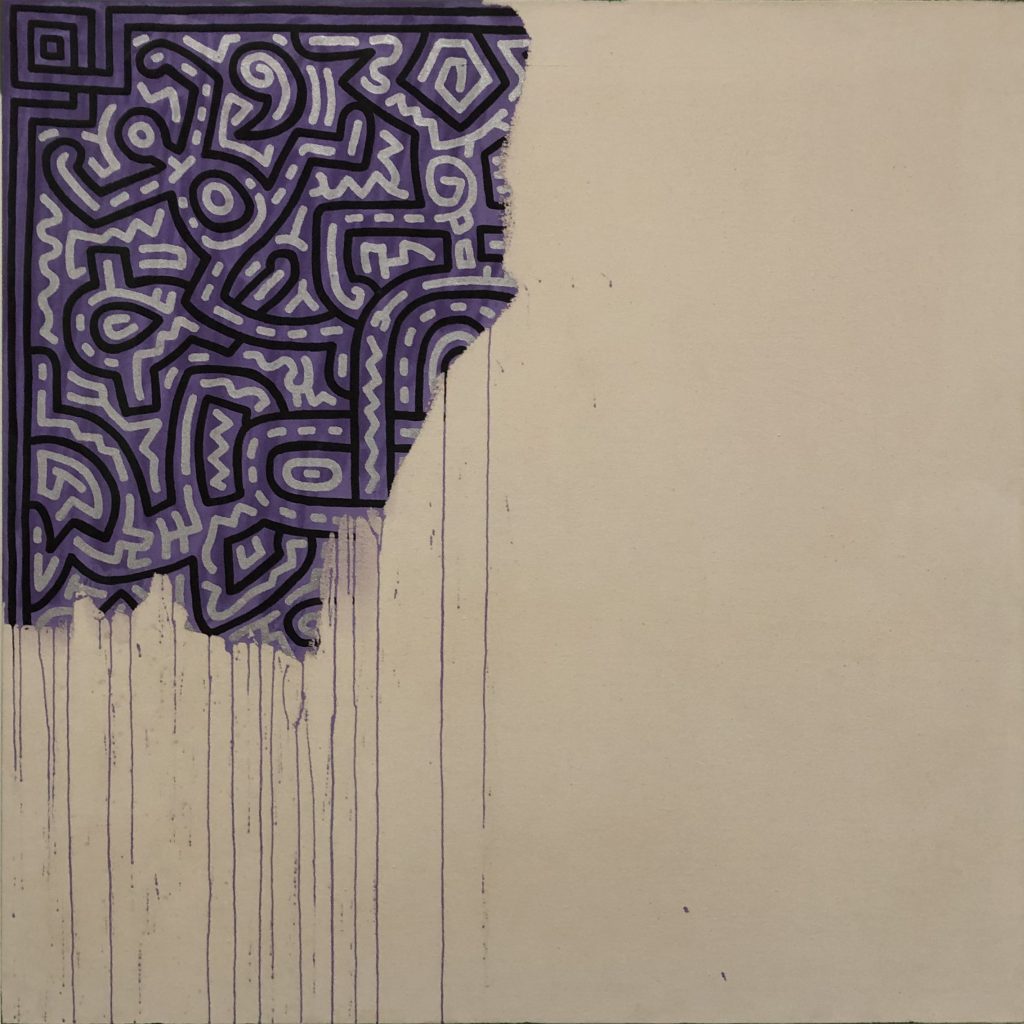
    The painting is called Unfinished because, as you can see, it’s unfinished. That’s deliberate, because it was the final painting of Haring’s life: the unpainted section represents the many lives lost to AIDS. He died the following year.

    A few days ago, an AI user finished it.

    I thought it was a joke, but it doesn’t appear to be. Somebody has used generative AI to complete the painting, to fill in the space and to remove  the very thing that makes it so meaningful and so powerful. The fact that the AI has produced shoddy work is almost irrelevant, because of course it did. The whole exercise is a classic example of someone who could do something, but who should not do it.

    In electronic publishing, a plague of crap AI-generated content is an unintentionally ironic echo of Orwell’s 1984, in which a key character works “in the Fiction Department [in] some mechanical job on one of the fiction-writing machines.”

    She enjoyed her work, which consisted chiefly in running and servicing a powerful but tricky electric motor… She could describe the whole process of composing a novel, from the general directive issued by the Planning Committee down to the final touching-up by the Rewrite Squad. But she was not interested in the final product. She “didn’t much care for reading,” she said. Books were just a commodity that had to be produced, like jam or bootlaces.

    And it’s not just art. Serious people are spending serious money to create AI versions of people, so that in the not too distant future you’ll be able to converse with an AI chatbot that mimics the voice and the speaking mannerisms of your favourite dead loved ones so that you can attempt to cheat the Grim Reaper – something we’ve seen described many times over in literature, rarely with a happy ending attached.

    Rather than building machines to simulate storytellers, tech evangelists might be better off reading some of them. They might want to start with W W Jacobs’ story The Monkey’s Paw.