Author: Carrie

  • “The out-group must be crushed”

    There’s a really good piece about QAnon in The New Republic.

    The “nocturnal ritual fantasy”—a term coined by the historian Norman Cohn in his landmark study of European witch trials, Europe’s Inner Demons—is a recurring trope in Western history. And it is often a politically useful one. Deployed by the Romans against early Christians, by Christians against Jews, by Christians against witches, by Catholics against “heretics,” it is a malleable set of accusations that posit that a social out-group is engaged in perverse, ritualistic behaviors that target innocents—and that the out-group and all its enablers must be crushed.

    …Q adherents are perfervid Trump supporters by necessity, as Trump’s valiant battle against ultimate evil forms the spine from which the many limbs of the conspiracy grow. But a recent wave of émigrés into the Q landscape consists of New Age moms and influencers with previously vaguer politics, whose interests, during the strained days of the Covid-19 pandemic, have migrated from crystals and wellness to taking down a world-straddling cabal of demonic pedophiles.

    The section on the “satanic panic” of the 1980s is particularly apt.

    It was gospel belief in the media and among ordinary citizens that rings of sex abusers were everywhere. Satan and his blood-drinking minions were peripheral players, but the panic is usually referred to now, through the mocking lens of self-assurance, as the “Satanic Panic.” We in the twenty-first century could never be so naïve.

  • Celebs speak out

    Minor celebrities: We must write an open letter to protest against online abuse of women!

    LGBT+ folks: Like the vicious abuse some of your co-signatories and many supporters of your multi-millionaire pal have spent years dishing out to trans women, to the mothers of trans children, to cisgender women who say they support trans rights and to cisgender women who work in rape crisis centres and other trans-inclusive organisations?

    Minor celebs: Not like that!

    PinkNews:

    More than 50 public figures and anti-trans campaigners signed the letter published in The Sunday Times, which condemns the “insidious, authoritarian and misogynistic” opposition to Rowling on social media.

    …the letter claims that Rowling “has consistently shown herself to be an honourable and compassionate person” – just days after the Harry Potter author promoted a website selling “f**k your pronouns” and “sorry about your d**k bro” badges mocking the trans community.

    One of the signatories has been banned from social media for a years-long campaign of hate speech against trans women and any cisgender women who dared disagree with him, a campaign that cost him his career and his marriage; others have been criticised for making transphobic statements that were at best tone-deaf and at worst actively malicious. One of the signatories previously accused a gay journalist who supports trans people of being a “sucker of Satan’s cock”.

    As Judith Butler said in her New Statesman interview the other day:

    if we are going to object to harassment and threats, as we surely should, we should also make sure we have a large picture of where that is happening, who is most profoundly affected, and whether it is tolerated by those who should be opposing it. It won’t do to say that threats against some people are tolerable but against others are intolerable.

  • Trans freedom fighters: a series

    The US edition of The Guardian continues to show how pathetic the UK edition’s coverage of trans people and trans-related issues has become. While the UK edition is still unsure about whether we actually deserve human rights, the US edition is running series telling stories like this one: ‘Our love is radical’: why trans activists lead the way in protest movements.

    Though their legacies have often been overlooked, trans Americans have been central to the country’s battles for justice, from racial equality to anti-fascism.

  • History reheated

    The Sun, 1984. Three decades later and it’s still singing the same song.

  • How social media makes people evil

    There’s an interesting piece in The Walrus about the radicalisation of “incels”, celibate men who increasingly turn to violence. Frustratingly the reporting of these men as mentally ill lone wolves disguises the fact that there’s something much more serious going on: the online radicalisation of angry young men on a very large scale.

    There are three pillars of radicalisation: needs, narratives and networks.  These are the critical drivers that can turn perfectly nice, normal people into something much more dangerous. And social media brings them together more effectively than ever before.

    Needs are people’s motivations: what drives them. That could be a need to feel special, or a need to feel part of something, or it could be a negative such as having experienced trauma.

    Narratives are the stories these people can become part of, and many of those narratives are conspiracy theories. They’re incredibly appealing because they tell you that you’re special, that you have knowledge that the wider population is too stupid, too brainwashed or too evil to see.

    And finally there are networks, which are the people who will give you the approval and status you crave and who will constantly reinforce the narrative of your particular group. These networks have always existed to some extent but social media has supercharged them and brought them into every home. As a result the time between someone, say, expressing doubts about the government’s COVID strategy and attending anti-mask, anti-5G marches because the Coronavirus is a global conspiracy can be measured in weeks.

    The Guardian:

    “QAnon feeds on widespread conspiracy theories, new age, and occult belief systems,”said Chamila Liyanage of the Centre for the Analysis of the Radical Right. “QAnon will not be able to influence UK politics right away, but it will first gain a foothold among the enthusiasts of fringe belief systems and conspiracy theories. This is metapolitics, changing minds, then cultures can be changed in the long run.”

    QAnon is still relatively small in the UK, but we shouldn’t be complacent. In a few years we’ve gone from laughing at American cranks to waving QAnon banners outside Buckingham Palace. From incels to anti-trans conspiracy theories to QAnon, social media is radicalising people like never before. It’s truly terrifying.

  • Breaking the news

    You’ve got to feel sorry for ageing conservative men who believe, despite all evidence to the contrary, that while they have all the power in this country they are nevertheless an oppressed minority. The latest media outlet pandering to their victim narrative is the soon to be launched GB News, which has poached the loathsome Andrew Neil from the BBC to broadcast to people who feel “underserved and unheard by their media.”

    Not people who are unheard; people who feel unheard. People whose only representation is in The Times, The Telegraph, The Daily Mail, The Express, The Spectator, The Sun, The Economist, Spiked, LBC, The Herald, The Scotsman, most of the BBC’s current affairs output, every bloody phone-in in the country, all the right-wing US news sites that dominate news sharing on Facebook and so on.

    I think it’s safe to predict that the dominant skin colour on GB News will be white and that its representation of minorities will largely be Eton alumni talking about how these days, right, if you say you’re English, they’ll arrest you and put you in jail.

    The New York Times famously promised “All The News That’s Fit To Print”. Perhaps GB News should adapt it: all the news that’s fit for pricks.

    GB News is the latest attempt to bring more Fox News-style partisan bullshit to UK broadcasting, and in a sane world OFCOM would make that very difficult. But this isn’t a sane world and the UK government has told The Sunday Times that it’s going to make Paul Dacre the chair of OFCOM. That’s Dacre of Daily Mail fame. If you haven’t already read it, this foul-mouthed evisceration of him in the London Review of Books by Andrew O’Hagan is masterful.

    As many people on Twitter have noted, putting Dacre at the top of OFCOM is like appointing Harold Shipman as chair of Help The Aged.

    But there’s more. The government also apparently intends to appoint former Telegraph and Spectator editor Charles Moore as head of the BBC. Moore is another loathsome figure with right-wing views; he has claimed for a long time that the BBC is packed to the gills with leftie agitators and he was famously fined in 2010 for not paying his BBC licence fee. It’s hard to imagine a worse candidate for the job except perhaps Paul Dacre.

    It’s possible that with these leaks the UK government is throwing two dead cats on the table to distract us from its woeful performance over COVID and the increasing evidence of corruption and incompetence on a truly epic scale; maybe the leak is to soften us up so when two slightly less appalling people are put in place we’ll feel we dodged a bullet. But it does seem to fit with the wider movement within the UK government to take us further to the right.

    For example, just this week it announced new guidance for schools that prohibited the use of resources “produced by organisations that take extreme political stances on matters”. One such stance is a desire to overthrow capitalism, something a certain Jesus of Nazareth had a few opinions on.

    The most chilling bit for me was in the section on knowing the importance of respecting others “even when they are very different… for example physically, in character, personality or background), or make different choices or have different preferences or beliefs”. That’s clearly intended to foster a climate of mutual respect for people of other religions and none, of people of different backgrounds, genders and sexual orientation, but the UK government has turned it into a Spectator editorial.

    Here’s the new guidance:
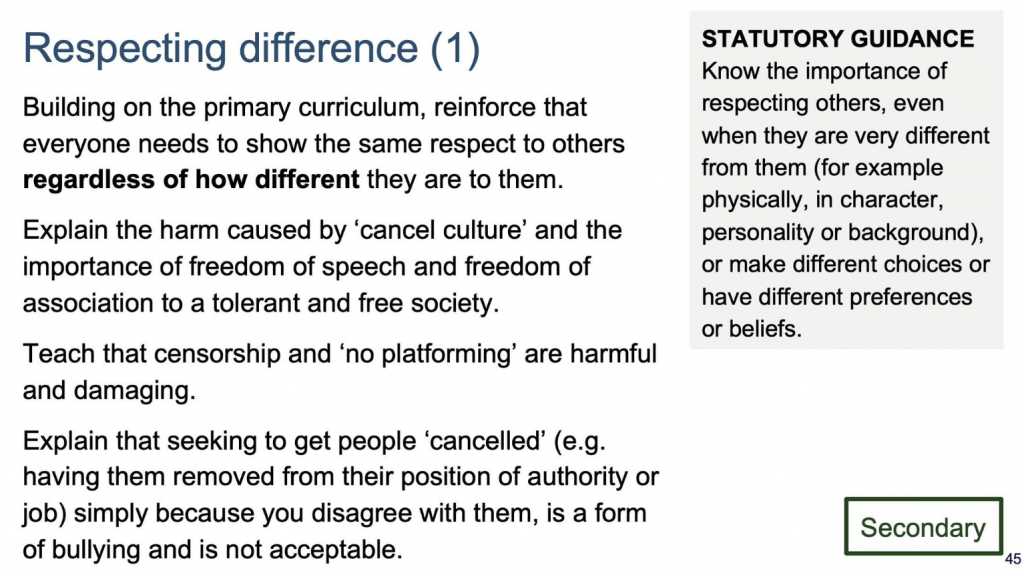
    Our entire democracy is based on seeking to have people removed from their position of authority because we disagree with them. It’s called voting.

    In that context, I’m disinclined to believe that Dacre and Moore are dead cats; I worry that instead, they’re dead certs.

  • Right body, wrong configuration

    How often have you heard the phrase “born in the wrong body” about trans people? And how many times have you heard it said by trans people?

    Chances are the first number is much, much higher than the second. That’s because the BITWB trope is primarily used by cisgender people who are writing or talking about transgender people; the few trans people who do use it are typically people who have just come out, have just started making sense of things and are trying to explain something very big and complicated in as simple a way as possible.

    Mallory Moore has put together a good overview of this. As Moore points out, the vast majority of “trans people think you can be born in the wrong body” stuff online is written by anti-trans activists. Whenever I’ve seen it discussed by trans people, it’s to criticise the trope, not to perpetuate it. I don’t think I’ve encountered a single instance of the BITWB trope being used by anybody who’s come out as trans and begun any kind of transition.

    Moore quotes a poem by Elena Rose from 2007:

    I am not a woman trapped in a man’s body. This body is no man’s; it is mine, it is me, and there is no man in that equation. And I am not trapped in it. There are a million and one ways out of this body, and I have clung to it, tooth and claw, despite an endless line of people and institutions who would rather I vacate the premises, and have sometimes been willing to make me bleed to convince me they’re right.

    The trope does have a history, though. When trans healthcare suffered from even more gatekeeping than it does now, trans people knew exactly what was expected from them if they wanted access to any form of transition: if they didn’t turn up looking stereotypically feminine and telling the doc they were trapped in the wrong body, they wouldn’t get any treatment.

    It’s a story we were told to tell gatekeepers in order to qualify for essential treatment and a story early transitioners told the papers, setting a framework that journalists still use today.

    As Janet Mock put it:

    Trapped in the wrong body” is a convenient, lazy explanation but it fails to describe #trans people & our bodies every time… it makes our lives and struggles more palatable to the cis masses, but it is lazy media ‘reporting’.

    Update: The Mermaids charity has posted a blog asking trans and non-binary people whether they use the phrase; some used to and feel it isn’t right; others are perfectly fine with it. It’s an interesting piece. 

  • Some numbers

    18,400

    The number of one-click, template-based responses the UK’s main anti-trans group managed to get its supporters to send to the UK government’s gender recognition act consultation in a three-month period through constant social media activity, expensive full-page print adverts and the support of almost all the UK media.

    125,089 and counting

    Number of signatories in two days to a petition asking the UK government to deliver GRA reform, a petition that hasn’t had any press coverage or advertising support. That’s more people than buy the UK edition of The Guardian.

  • Murdoch papers in “bullshit” shocker

    I don’t want to go on too much about the UK government’s pathetic response to its gender recognition consultation, but I thought it was worth drawing attention to The Times and Sunday Times’ assertions that the consultation was “skewed” by an “avalanche” of responses by “trans rights groups” who twisted the consultation to say 70% of people were in favour of self-ID.

    Here’s a blog by the GRA consultation analysis team.

    We spent a long time with the data and employed a number of advanced analytical techniques to investigate the influence of potential campaigns on the consultation responses. However, we have seen little evidence that supports the view that the results were “skewed” by an “avalanche” of responses from trans rights groups. Furthermore, we are not sure where the reported figure of 70% in favour of self-identification has come from. This question was not directly asked in the consultation and this figure does not arise from our analysis.

    What they did find, however, was that one anti-trans group was responsible for nearly one-fifth of all responses – and unlike the majority of responses from other sources, particularly trans rights groups, these were identical posts created by a one-click online form “which had a pre-populated set of answers”.

    We would like to acknowledge the amount of care, attention and often depth of feeling that went into the submissions that we read, from people and organisations taking a range of positions. There were some long submissions – some over 5000 words -  in response to one individual question, and it was apparent that a large percentage of those who completed the consultation spent a long time writing their answers. We were struck by many of the accounts that people provided detailing their personal experiences or those of loved ones. It is sometimes easy to lose sight, in the arguments that surround GRA reform, that at the centre of this are real people living real and often difficult lives. Due to the need to be brief in order to write a succinct report and the confidentiality required for ethical reasons, the specific stories that were contained within many individual submissions cannot be published. However, reading them, as we have been able to as a team, paints a nuanced and complex picture of the lived experience of people working through these issues in their own lives and the lives of their loved ones.

  • Gender Trouble trouble

    Interviewing isn’t always easy: if you’re poorly prepared or if you’re trying to lead the subject down a road they don’t want to go down, you can easily find yourself getting your arse handed to you on a plate. It happened to me once with Terry Pratchett, a brilliant author who taught me a valuable lesson about the importance of preparation for even the most trivial interview.

    That was mortifying enough, so imagine how it must feel to be publicly owned by an interviewee when you’re interviewing a major figure for a popular current affairs magazine. That appears to be the case in this New Statesman interview with Judith Butler, in which the interviewer attempts to tell Butler what her own work is about. It’s the kind of interview that, as a writer, you read from behind your fingers.

    It’s also really interesting in what it says about coverage of gender:  Butler is a key figure in third wave feminism and her 1990 book Gender Trouble: Feminism and the Subversion of Identity is considered a key text in feminist and queer scholarship. She has a lot of interesting things to say and a body of work going back very many years, but the interviewer seems determined to force her into the JK Rowling vs Evil Trans Activists dialogue so beloved of so much of the UK and US press right now. And Butler is having none of it.

    Butler:

    Let us be clear that the debate here is not between feminists and trans activists… So one clear problem is the framing that acts as if the debate is between feminists and trans people. It is not.

    …It is a sad day when some feminists promote the anti-gender ideology position of the most reactionary forces in our society.

    Interviewer: But people have been nasty to JK Rowling on the internet!

    Butler:

    I confess to being perplexed by the fact that you point out the abuse levelled against JK Rowling, but you do not cite the abuse against trans people and their allies that happens online and in person.

    I disagree with JK Rowling’s view on trans people, but I do not think she should suffer harassment and threats. Let us also remember, though, the threats against trans people in places like Brazil, the harassment of trans people in the streets and on the job in places like Poland and Romania – or indeed right here in the US.

    So if we are going to object to harassment and threats, as we surely should, we should also make sure we have a large picture of where that is happening, who is most profoundly affected, and whether it is tolerated by those who should be opposing it. It won’t do to say that threats against some people are tolerable but against others are intolerable.

    As Max Morgan put it on Twitter:

    If I was this interviewer I would have told my editor that the dog ate the emails and they’d have to run something else.