Author: Carrie

  • Heckled by a chicken

    I was interviewed on camera for a BBC thing today, and it was filmed on an outdoor bit near my flat. As we filmed the interview we had to stop because a small dog was yapping. We looked up to see its owner, a really unpleasant old woman who’s previously yelled at my kids for playing quietly, beaming at us. She was clearly delighted to have disrupted what we’re doing.

    We resumed filming.

    Things escalated.

    She grabbed the squeakiest dog toy she could find and squeaked it like she’d never squeaked it before.

    SQUEAK SQUEAK SQUEAK! It went. SQUEAK SQUEAK SQUEAK SQUEAK SQUEAK SQUEAK!

    “So, Carrie, can you explain what –” SQUEAK SQUEAK SQUEAK SQUEAK SQUEAK SQUEAK!

    “Well, Katie,” I replied. “The thing is –” SQUEAK SQUEAK SQUEAK SQUEAK SQUEAK SQUEAK!

    Despite her best efforts we still got the piece done. And now I can add “heckled by a rubber chicken” to my list of dubious career achievements.

  • Some people never learn

    One of the reasons so many left-leaning people were shocked by the election of Donald Trump was because to much of the left-leaning media, Trump was simply a figure of fun; not somebody worth taking seriously, let alone doing anything to try and stop.

    I think they’re taking him a lot more seriously now. But they haven’t learnt their lesson. Boris Johnson was a national joke; now he’s a disastrous PM. Nigel Farage was a national joke who became one of the most significant political figures of recent times despite being almost unelectable. And now we have a new national joke, the deeply loathsome Lawrence Fox. The left-leaning press’s dismissal of him as a figure of fun is arguably just as dangerous as the right-wing press’s lionising of him. He may be a ludicrous, pathetic twat, but he’s a ludicrous, pathetic twat with influential backers and an increasingly large platform.

    Journalist Mic Wright:

    The right-wing media channels — not just papers but their talk radio counterparts and forthcoming TV channels — will give Fox acres and hours of coverage. He will be heard and he will be heard seriously by those outlets and the people who consume their output.

    I take Fox seriously because he is a narcissist who wants desperately to keep getting the attention that acting has brought him and he will say anything to keep that spotlight on him. Fox, in the same way that mouthpieces like Darren Grimes have done, is allowing himself to be used as a megaphone by more publicity-shy bastards. In interviews, he has referred to his ‘policy people’… I wonder who they might be?

    Fox is ludicrous and ludicrously stupid, but he has money, he has support, and he has a platform. That combination is a dangerous one.

  • Political differences

    Petra De Sutter

    The photo above is of Petra De Sutter, the newly appointed Deputy Prime Minister of Belgium. She’s also Minister for Public Enterprises. Oh, and she’s transgender.

    As the Brussels Time notes, that bit “went almost unremarked upon by Belgian media… [other than] when remarking on the diverse make up of the new government – which consists of 50% women, includes several ministers with a migration background, and is relatively young.”

    Meanwhile in Scotland:

    The First Minister stepped in to defend one Holyrood hopeful – Rhiannon Spear – after she was targeted with horrified misogynistic abuse from trolls having previously defended transgender rights.

    I’ve written about Spear before; she’s a dedicated and impressive young politician who’s been the subject of an ongoing hate campaign simply because she believes in human rights for trans people. And she is not alone. In the UK, women who defend trans rights are subjected to sustained, vicious, misogynistic abuse that’s much more serious than a celebrity being called a bigot on Twitter; any trans person considering political office will receive even worse. So it’s hardly surprising that while Belgium has a trans Deputy Prime Minister, the UK has no openly trans MPs, MSPs or MEPs at all.

    De Sutter:

  • Nine questions you might have about trans stuff

    Katelyn Burns has written an excellent piece for Vox: 9 questions about trans issues you were too embarrassed to ask.

    The questions are:

    1. What does it mean to be trans?
    2. Why should I care about trans issues?
    3. What about the pronouns thing?
    4. What issues are trans people fighting for?
    5. Why are we always talking about trans issues?
    6. What’s the deal with bathrooms?
    7. What’s with the panic over trans women with penises and trans men who menstruate?
    8. What about trans women playing women’s sports?
    9. What about trans kids?

    I think the question “why are we always talking about trans issues” is particularly apt today because it’s Sunday, when the right-wing press likes to run its anti-trans hit pieces and scaremonger about trans kids, trans women and trans athletes.

    “The right has worked to make it an electoral issue…  We see this across the board — they try to posture trans rights as extreme and a danger particularly to children,” Brennan Suen, LGBTQ program director at Media Matters, told Vox. This is why, he said, conservatives have focused so much on legislation regarding transition care for trans minors, bathrooms, and trans athletes in sports. “They are able to reach those voters who might not know a trans person and give them misinformation and bigoted information that honestly scares them.”

    …as trans people have really been more visible in the media … we’ve seen the right really ramp up their attacks.”

  • Most people are good people

    This, from Gogglebox, is lovely: it’s people watching an episode of First Dates featuring a trans man.

  • A calorific arms race

    This, by MM Carrigan in Eater, is a great bit of writing. It’s about the semi-mythical fast food buffets that are unimaginable now, “an arms race in maximizing caloric intake.”

    In the age of COVID-19, the fast-food buffet feels like more of a dream than ever. How positively whimsical it would be to stand shoulder to shoulder, hovering over sneeze guards, sharing soup ladles to scoop an odd assortment of pudding, three grapes, a heap of rotini pasta, and a drumstick onto a plate. Maybe we can reach this place again. But to find it, we must follow the landmarks, searching our memory as the map.

  • The bookshops battling bigotry

    There’s a good piece in Bookriot by Alice Nuttall about the bigoted bullshit many independent bookshops experience; it’s usually because they’re supportive of LGBT+ rights and trans people specifically.

    Despite the fact that the shop promotes women’s writing and has made huge strides in ensuring that little-read women authors are given the prominence and acclaim that they deserve, The Second Shelf was deemed anti-feminist for its decision to include all women, rather than solely cis women, on its shelves. The abuse faced by The Second Shelf mostly took place online, with transphobes writing negative reviews despite having never visited the store, or bombarding the shop’s Twitter account with hundreds of hateful messages.

    As ever, the people doing it are usually supporters of, and often tacitly supported by, supposed champions of free speech and critics of “cancel culture”.

  • “Ctrl-F for ‘cancel culture’ to get to the worst part”

    I do love it when writers have some fun. This, by Drew Magary, is in defence of skimming articles on the internet.

    skimming is a way to help me glean the thrust of a story without having to eat my vegetables in the process. EVERYONE WINS. If I read a movie or album review, I skim right past the intro and hunt for the graf that tells me if the thing is good or not. If I read a recipe, I skip right past the storybook intro like everyone else does. If I’m hate-reading a bad column, I’ll Ctrl-F for “cancel culture” to get right to the worst part. I have s—t to do, man. I can’t go humoring the rest of you by reading all of your tedious bulls—t.

    And this, by R Eric Thomas, is about US politician Katie Porter’s whiteboard.

    My friend, if you ever find yourself sitting in front of the House Oversight Committee and Rep. Katie Porter pulls out her Whiteboard of Justice, please know that it is truly and deeply over for you. My friend, the truth is it never began. The minute her staff put that portable Porter board onto the little hand truck they use to cart Instruments of Truth through the halls of justice it was a wrap on you, those you associate with, and everything you’ve ever done. As the Good Book says, “And lo, a pale board! And the name of your overpriced prescription drug was upon it. And hell followed.”

    It’s a really fun piece.

  • “The world is better for having you in it”

    Over 200 1,512 writers and publishing professionals have written an open letter in support of trans and non-binary people.

    This is a message of love and solidarity for the trans and non-binary community. Culture is, and should always be, at the forefront of societal change, and as writers, editors, agents, journalists, and publishing professionals, we recognise the vital role our industry has in advancing and supporting the wellbeing and rights of trans and non-binary people. We stand with you, we hear you, we see you, we accept you, we love you. The world is better for having you in it.

  • Hating for ratings

    How’s this for a TV show? We get a racist – a proper racist, ideally a knuckle-dragger from a really racist organisation such as the EDL or Britain First, someone who’s really loudly and proudly racist and spends loads of time being really racist to people on Twitter – and we pair him up with a nice middle-class Black woman. Then we get the two of them to sit down for a nice dinner and a chat and we film the whole thing.

    Good, right? It’s a social experiment!

    I haven’t even got to the best bit yet. It’s not just a chat. We give the racist guy a script of really racist things to say to the Black woman over dinner and we film her response. Maybe she’ll cry!  Maybe she’ll walk out! Maybe it’ll go viral!

    No? How about we pair a neo-nazi with a nice Jewish lady?

    Of course not. Trying to get a fight for ratings is disgusting, as we saw with the Jerry Springer and Jeremy Kyle shows. But that doesn’t mean TV production companies don’t keep trying to bring back the formula, which is essentially hating for ratings. For example, an Irish TV company is currently sending this to various trans women (and to other marginalised groups, such as members of the travelling community).
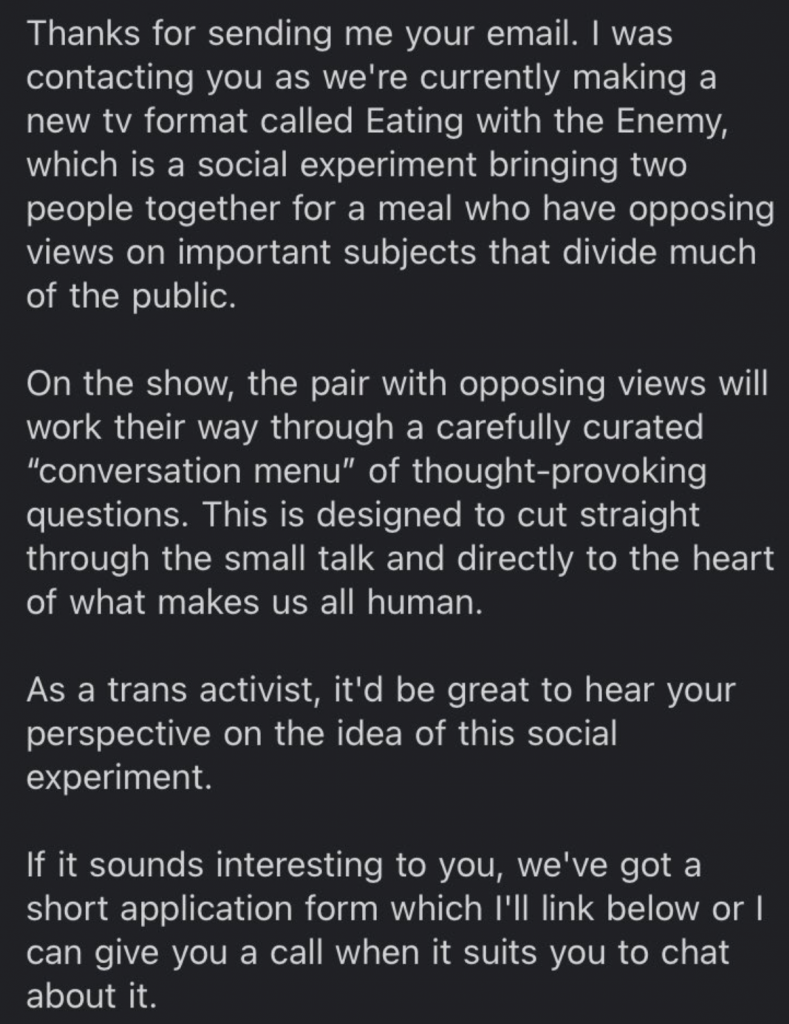
    As one commenter on Twitter translated: “We’re making a show where we have members of marginalised groups sit down with people who think they shouldn’t exist, for entertainment purposes. Also we’re suggesting that marginalised people are the enemy, in the title.”

    Earlier this year Evgeny Shtorn wrote about the importance of storytelling in regards to minority and marginalised people.

    Considering how powerful storytelling is, we cannot pretend that the infrastructure built around it by media and researchers is always ethical and respectful towards those who constitute those stories… journalists were rude to me, disrespectful and abusive. Using my words or ideas without quotes, giving erroneous interpretations and false promises. Trans and non-binary people, homeless people, other migrants, people of colour, people with disabilities and a lot of others who I shared my concerns with, told me that they often experienced similar treatment from journalists, but also from artists, researchers and other ‘supporters’. It is called ‘cognitive exploitation’, and this is exactly the opposite to the idea of the empowerment of the community through storytelling.

    …The problem is that after such an interaction most people retreat into their closet and don’t want to tell their stories anymore, despite those stories being so important to tell.

    There was an example of this in England the other day: trans person and poet Jay Hulme was invited on BBC TV to discuss the government’s response to GRA reform.

    I was going to be on the BBC today having a chat about the GRA – but I pulled out yesterday, having been informed that it’s BBC policy to have a cis woman invited to speak on any segment about trans ppl – I’m not going on TV to be yelled at by a transphobe from the Daily Mail.

    By “cis woman” the policy doesn’t mean a cisgender woman who’s supportive of trans people, even though such women are the majority (and were the majority in the GRA reform consultation too). It means the kind of woman trans commentator Shon Faye was expected to go on air with this week. Faye was one of several trans people invited on BBC Woman’s Hour to discuss gender recognition. At the last minute, the panel was expanded to include an anti-trans activist who has taken great delight in publicly misgendering her and who Faye says even shared a now-deleted defamatory petition implying she groomed children. Faye declined the invitation.

    I have some experience of this. I’ve refused to go on multiple programmes because the approach was clearly going to be gladiatorial, not editorial; other contributors were not people with concerns about specific bits of legalese but members of groups who peddle hatred on social media. Taking part is therefore a trap for marginalised people: if you don’t robustly challenge the other contributors they get to lie, lie and lie some more; if you do, and worse still if you also dare correct the presenter, you’re dismissed as unreasonable and aggressive. And even the most innocuous appearance will have bigots descending on your social media.

    It’s clear that the people commissioning and structuring these programmes are thinking about ratings, not the damage these narratives can do to marginalised groups. And they are doing damage. By presenting extreme views as mainstream, such as perpetuating the myth that the two sides of the trans debate are “trans activists vs feminists” rather than “most of the country vs a few well-connected bigots”, they’re fanning the flames of intolerance and positioning extreme views as if they’re mainstream. We’ve seen this before with the platforming of far-right views, of anti-vaxxers and of climate change denial.

    The problem yet again is that the people making these programmes have no skin in the game. Their human rights are not under attack. Their safety is not threatened by the rise in hate crimes. Their ability to participate in society is not something producers think should be up for debate. To them, it’s just another item. To marginalised and demonised minorities, it’s our lives.