Author: Carrie

  • Crime fiction and series fatigue

    This post is sponsored by Grammarly, the free online plagiarism checker.

    I’m a big fan of crime series. There’s something particularly enjoyable about opening the pages of a brand new book and encountering a familiar face, a familiar world, a familiar cast of characters. Take John Rebus, for example: while Ian Rankin’s non-Rebus thrillers are perfectly well written and exciting bits of crime fiction, there’s a Rebus-shaped hole all the way through them (he’s back in Rankin’s latest, Saints of the Shadow Bible, and there’s a delicious bit in it where Rankin’s clearly spotted a way to keep him around the police: Rebus was written in real time, and was forced to retire just like real policemen).

    It’s not just Rankin. There’s a tingle of anticipation when I’m about to start a new Tim Dorsey and discover what Serge A Storms has got up to now. I’m really excited about the third in Malcolm McKay’s superb Glasgow Trilogy featuring hitman Calum MacLean. I was sad to see the end of Ray Banks’ Cal Innes novels, and I’m always a bit disappointed when Michael Connelly brings out a legal thriller instead of a Harry Bosch one. But sometimes familiarity brings not delight, but disappointment.

    I’ve just given up on the latest Peter Robinson book, Children of the Revolution. It’s one of his DCI Banks books, and it suffers badly from two related problems: the crime and its investigation isn’t very interesting, and the hero’s a bit of an arse. I’d noticed the arse thing in previous books – like many fictional detectives, Banks appears to be at least partly an exercise in authorial wish fulfilment: he’s the super-smart man who all the laydees want to have sexy time with because he has an awesome record collection and an interesting car – but I’m usually enjoying the ride too much to get too irritated by it. This time out the ride wasn’t much of a ride.

    I suspect publishing may be rather like the music business used to be: there’s a certain timetable to follow, a treadmill of write/release/tour/write/release/tour that can mean product must be produced even if the product isn’t quite there yet. That often resulted in dreadful albums – the famous “difficult second album” written on tour about how horrible it was to be on tour – and I’m sure it’s the cause of dreadful books too. That, and the other danger of success, which is of course ego. If you’re going around the world, playing to packed rooms – rooms where people are actually paying to see you – that’s bound to mess with your head a little. “The little people lap this shit up!” the author might cry as he bashes out another bestseller.

    I wonder how authors avoid it. Ian Rankin seems to have managed it – the books are still superb and he appears to remain one of the nicest, most well-liked people in publishing – and there are countless other examples, I’m sure. Any names spring to mind – and if they do, any explanation for why they didn’t go off the boil?
  • You’re brilliant, and everyone else is an arse

    I wrote a wee piece about impostor syndrome for .net, and it’s made its way online.

    The satirical website The Daily Mash has a great slogan on one of its T-shirts. “I’m brilliant,” it says, “and everyone else is an arse.” It’s the perfect motto for anyone working in a creative industry, because there’s a very good chance that they feel the exact opposite.


  • Don’t upgrade to Apple’s Pages 5.0…

    …until you’ve checked that features you depend upon haven’t been removed.

    Apple’s done its software thing again: it’s released what’s supposed to be a brand new version of an existing program, but really it’s a brand new program using a familiar name. As this support discussion shows, upgrading to Pages 5.0 means losing a lot of features. And by “a lot”, I mean A LOT.

    The ones I’ve noticed so far are the removal of the ability to see a character count including spaces (something I need when I write for MacFormat), the removal of the status bar and its persistent word count (something I need in almost every document I do), the removal of the ability to change the default zoom level (again, something I need on each document), the ability to select non-contiguous blocks of text. It doesn’t remember if you close the formatting panel, the Autocorrect preferences are gone, the two-page view is gone, the… you get the idea.

  • Sometimes workshops work

    I’ve been pretty quiet about my fiction writing lately, and there’s been a good reason for that: I haven’t been doing any fiction writing.

    The sequel to Coffin Dodgers has stalled because the central crime I came up with was too horrible for a fairly light-hearted read, and the other, more serious book I was doing stalled too. That latter one stalled for various reasons: motivation, confidence, plotting issues, worrying what the hell I’d write after it was finished, obsessing over Breaking Bad, making music, jumping around the room shouting “this is shit! I am shit! Everything is shit!” and so on.

    Hurrah, then, for the Bloody Scotland crime writing festival. I dropped £80 on a day of writing workshops, and over the course of the day the events – a workshop by Liam Murray Bell, another by Alex Gray, a panel featuring agent Jenny Brown and a keynote by Val McDermid – unlocked various book problems in my head. The best way I can describe it is like picking a lock: each bit of the day picked another tumbler until the entire lock was picked.

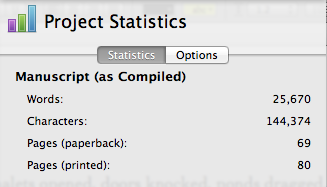
    I’ve spent the last year looking at this word count menu, which has been stalled at 13,000 words. Since Bloody Scotland:

    screenshot_01

    Still a long way to go, but progress at last. I’m excited about it again.

    It’s worth noting that I hate workshops, being in a room with other people, having to act like a responsible adult and so on – so if a miserable sod like me can get something out of a writing workshop, then more normal people might benefit even more.


  • A horrible guitar

    fender-telecoustic-34118I have a weakness for odd guitars I can’t play very well, and while I can’t really indulge it like I used to – purchases such as my much-missed 12-string Fender Strat were in the days of carefree credit card abuse, and I’m more responsible / have less available credit now – I’ll still find the odd irresistible thing on eBay.

    My most recent daft purchase was a Fender Telecoustic, which looks very much like the one on the right.

    The Telecoustic is a very odd guitar. It takes everything that’s great about a Fender Telecaster – the solid body electric guitar bit – and replaces it with a fibre glass-y electro-acoustic body. As a result it sounds quite tinny and it’s desperately nose-heavy. But it’s still a fun wee guitar, especially for songwriting: sometimes you want something that’s a little louder than an electric, but that isn’t as loud as a proper acoustic. It plays more like an electric than an acoustic too, so it’s nice and quick.

    This one was horrible to play, though. The strings were far too heavy and old, the action so high up you had to stand on the fretboard to play a note. But thanks to a few online tutorials and some guitar discussion groups I’ve found better strings and lowered the action to make it playable. It’s still horrible, but it’s less horrible than before.

    I suspect the Telecoustic is going to be rather like my much-loved million-mile Saab estate: absolutely terrible by any objective standard, and oddly lovable as a result.

  • I’ll stop going on about music after this post

    Last one, I promise. It’s just to let you know that the album is now available for free streaming on Soundcloud, free download / pay-what-you-want on Bandcamp, and paid-for downloads on iTunes, Amazon, Google Play and CD Baby.

    According to CD Baby, which distributes the music for us, the list of sites and services includes Spotify, Omnifone, Rdio, Muve, Bloom.fm, Slacker Radio, Rhapsody, Xbox Music, Last.fm, 24-7, Shazam, MediaNet, Tradebit, GreatIndieMusic, Emusic, Simfy, Samsung Music Hub, Beyond Oblivion, Mondia Media, 7digital and Yandex.

    Thanks to everybody who’s bought the album so far and/or spread the word. We appreciate it.

  • Free music (that you can pay for) #13: Youth Is Wasted On The Young

    I wrote this one at the same time as Don’t Let Me Lose Tonight, fully expecting to finish it in 2007. I missed that deadline a little bit, but the version you can hear now isn’t dramatically different from the version I had then: the mix is better, but I found that I couldn’t better the original performances. The vocal has a nice time capsule feel to it, I think: recording a new vocal just feels wrong. The only real difference between the new version and the old one is that the old one had a very long and boring bit of sub-U2 bollocks at the end. Sniiiiiiiip!

    I’ve just realised that I haven’t mentioned the cover. That’s David’s work, and I really love it: I like the juxtaposition of the heart with the alleyway, the idea of something beautiful in the most ordinary of places.

    So that’s it. I hope you’ve enjoyed these posts and the songs. They’ve been fun to do. I’ll post again when the music finally appears on the various streaming services and in the online music stores.

  • Free music (that you can pay for) #12: You Don’t Have To Be Alone

    This is the second of the two Kasino songs we’ve rebooted. The original dates back to 2000, 2001, and it sounded awfully like Snow Patrol’s Run; Snow Patrol hadn’t actually written Run back then, and their singer saw us play this one live several times before they did. Ho hum. That’s not just me being bitchy and bitter, though: while we love the song we knew that if we redid it, people would go “oh man you’re just totally copying Run by Snow Patrol”, and if that happened we’d end up killing somebody.

    The reboot happened when David started messing around with it. “Kraftwerk!” I yelled, donning a red jumper and writing lyrics about motorways and the Tour De France.

    That last bit isn’t strictly true, but I did get excited about the Kraftwerk bit: I hear Computer Love every Monday when I do my BBC gadget stuff, and it never gets old: it’s just a wonderful piece of music, so when David played our riff in a Kraftwerk style I was sold. I’m really pleased with the result: like Goddamn, You’ve Got To Be Kind it has that electric melancholy I love so much.

  • Free music (that you can pay for) #11: Five Fingers a Fist

    The lyric seems pretty obvious to me but maybe it isn’t all that obvious to anybody else: the two fingers in the lyric mean two shots of alcohol. It’s about someone getting drunk quickly and looking for a fight, something you’ll see in pubs every weekend.

    Musically this one’s had a bit of a journey. I demoed it on a 4-track – a 4-track! – and that means it dates to my late teens or early twenties. It was called Malicious Lies back then, and the verse was a fairly pedestrian U2 stomp with chiming harmonics, a der-der bassline and a Larry Mullen beat. All that remains of that is the chorus bassline and riff, which David describes as the Ice Cream Van from Hell and which is deliberately too loud. The obvious autotune on the chorus vocal is deliberate too: there’s a fantastic effect on the “you know” bit that I just love.

  • Free music (that you can pay for) #10: Good Times, High Times and Hard Times

    In the last song I was trying to be Michael Stipe. In this one, I’m Rihanna.

    I’ll pause a moment to let you get over the horror of that mental image.

    David wrote this one, his riff really reminding me of the Rihanna/Calvin Harris collaboration We Found Love. It doesn’t sound anything like it, but hey. That’s how my brain works. Resisting the temptation to chuck in some canned applause and rave horns, I grabbed the bass guitar instead. The result has nods to The Cure (the bass sound in the closing section), Arab Strap (the spoken vocals in the chorus) and Adam Clayton (the bass sound in the main song), and I managed to get some cowbell in there too because everybody likes cowbells.

    I’m joking about rave horns but they would have fitted with the lyric: it’s about someone who’s done all the hedonistic things, had all the drugs, and is putting it all behind them.