Category: Media

Journalism, radio and stuff like that

  • All the right friends

    I’d like to introduce you to my friends Laura, Amy and Steven. I don’t understand why Laura loves incredibly derivative and often idiotic punk rock, and she thinks that my beloved REM are one of the worst bands in human history. Other than that, we get on brilliantly. I don’t share Amy’s veganism, and she obviously doesn’t share my love of barbecuing steaks. Other than that, we get on brilliantly. I don’t share Steven’s love of country music, and he believes that my book should be banned and that I am a predatory paedophile who should be tarred, feathered and hung from a lamppost. Other than that…

    Steven isn’t real, of course, although there are many people who believe exactly what I’ve described. But of course, I’m not friends with those people any more than I would be friends with animal torturers, wife beaters or any other horrific humans. And this apparently makes me a bad person.

    One of the most annoying topics in the current awfulness of everything is the trope that the woke censorious left won’t be friends with people who don’t share their political views. That trope is bollocks, and AR Moxon has written an excellent explanation of why.

    It’s a very common lament: that there is no civility left these days, as compared to earlier days, and the main reason appears to be that those on the “left” refuse to be friends with those on the “right,” shunning them simply because of their political views.

    This implies something rather startling: American conservatives want to be friends with the rest of us. Had you realized? You’d never know it to listen to them, but apparently it is so, and the notion that some of us don’t want to be friends with them is one of the most pressing matters to be found in the opinion sections of our nation’s great newspapers and magazines and newsfortainment television programs.

    Moxon argues that the supposed polarity of left/right isn’t accurate, and suggests humanist/supremacist instead. The supremacist political view is that “other types of humans do not matter, and shouldn’t have space to exist and thrive as themselves, and should are abused and punished for any refusal to be dominated.” And yet “they feel strongly that friendship is something they still deserve, though it feels like something they actually want, and more like something they believe they’re owed.”

    I think Moxon makes a very important point about the discourse around this.

    Something I’ve noticed about professional civility mourners is that when they mourn the divisions over political views, they rarely mention what those views are, or what effect they have.

    That’s very true of the reporting around this, which frames “views” as some kind of abstract thing without any actual consequences. So for example the “view” that there are too many trans people and that their numbers should be reduced, which is genocidal, is presented as if it were an opinion about wallpaper or a TV show. All too often, “views” are considered more important than the actual people those views are about and targeted towards.

    There is not a debate if one side believes that all Black people, all Jewish people or all LGBTQ+ people should be killed and the other side is the Black people, the Jewish people or the LGBTQ+ people that the other side want to kill. And yet all too often that’s exactly how these things are presented, and have been for a very long time. The BBC famously used the headline “Should homosexuals face execution?” in a piece about Uganda’s anti-gay persecution just over ten years ago. The “should” turns what should be absolute horror into a nice dinner party chat.

    Of course, not all views are so extreme. But many supremacist ones are, no matter how politely they’re expressed. And there is not an equally hateful and violent other side.

    Moxon:

    nobody is trying to strip supremacists of their vote, or ensure that they will go bankrupt over medical care, or force them to give birth to their rapist’s baby, or murder them at the border, or take away their children, or frame the continuance of their lives as a cost rather than a value, as something that must be earned, as something that is undeserved. In fact, these are things that the humanist spirit is trying to ensure even they will be safe from, which actually seems like the friendliest posture a person can take, toward somebody who has decided to be their enemy.

    And yet we’re expected to be friends with people who want those things for us. Moxon uses the analogy of schoolyard bullies who want us to sit at their lunch table as sycophants: “If you want to be friends, why don’t you ever come sit with us? Why is the demand that we come sit with you instead? Why do you want so badly for only some of us to sit over with you, and why aren’t the rest of our friends ever welcome at your table?”

    If you want friends, why aren’t you willing to be friendly?

    Do you want to be friends? Is friends what is desired here?

    I don’t think so, actually.

    I think what’s being sought is accomplices.

    And I think that’s true. It’s freedom of speech as a demand for freedom of consequences all over again: some of the world’s worst people demanding that the world conforms to what they want, and never the other way around. It’s portrayed as a basic human right when it’s nothing of the sort. Friendship is a contract, and the terms of that contract is that if you turn out to be an arsehole, the deal is off.

    In a previous piece, Moxon talked about the abuse of freedom of speech in more detail.

    It’s almost gotten to be boring, the degree to which people believe that what they refer to as “free speech” should not only allow them to say whatever they want (which it does), but should also prevent other people from understanding them to be the sort of person who says those things.

    Moxon believes, as I do, that it’s perfectly appropriate for awful people to be shunned because of the things they say and do.

    There are worse things than shunning. There are shelves empty of books. There are people dying from deliberately manufactured medical policy. There are actual attacks upon freedom and speech. There is supremacy. There is genocide.

    …At a certain point, it seems to me that we have to conclude that what such people are actually advocating for is not to use sunlight to expose and disinfect our society of bigotry, but simply to have a society in which bigotry is free to dance in the sun.

  • Erasure

    It’s very hard to write about the grifters, bigots and assorted arseholes waging war on trans people and make it entertaining, let alone funny, but Liz Crash manages it with great aplomb in her piece about the supposed “erasure” of lesbian women by trans women, a claim beloved of far-right goons and their useful idiots. It’s as wise and well-informed as it is funny.

    Now, I’m something of a lesbian myself, and from my perspective—putting aside for a minute the housing crisis, COVID-19, the cost of living, psychiatrist fees, Sarina Russo, fentanyl in the pingers, climate change, and global fascism—there’s never been a better time to be a lesbian.

  • The Sun sinks lower

    If you thought The Sun newspaper had changed its spots since the days of demonising AIDS sufferers and pissing on the Hillsborough dead, it would like to show you otherwise. Here’s its Sun Says column:

    Yes, it’s using dead babies as cannon fodder in its war on LGBTQ people. Those babies were not murdered by someone who was LGBTQ, and the lack of action was nothing to do with “wokeness”; quite the opposite, as it appears that racism played a significant part in the difficulty whistleblowers had in getting management to listen to them.

    Even by the Sun’s terribly low standards, to blame a murder committed by a straight, cisgender white woman and covered up by straight, cisgender white people on the LGBTQ community is utterly disgusting – and no different from the internet bigots calling LGBTQ people child abusers to try and incite violence against them. If you buy or work for any Murdoch property, you’re helping to pay for this.


  • We are trickster gods

    This superb piece by Niko Stratis is a must-read about the no-point-in-reading news stories telling you that some old rich guy or other thinks trans women are icky and probably murderous.

    We are trickster gods, barbed and poisonous, waiting to rip the seams of the tender fabric of this gentle world. But we are never the interviewer, never the storyteller, rarely the writer and seldom real.

    …After the run of Cooper news, it was announced that legendary guitar player and songwriter Carlos Santana went on a baffling on-stage tirade about trans people. This wasn’t the result of a poorly planned question, by all accounts this was unprompted. When I saw the news first, it was in Billboard, and it was in their “Pride” section.

    I ask you, what “Pride” do we take away from this knowledge? There is no value gained here certainly, and I am not surprised that Santana doesn’t like trans people because I am rarely surprised by such facts anymore. There is no easier path to a headline than making baseless comments about trans people into whatever microphone will have you.

    Stratis’s piece makes the well-worn but still important point that right now, trans people are among the most talked about and least listened to group in society: publication after publication uses us for outrage marketing by asking famous people whether they hate trans people and love JK Rowling, or the famous people do it themselves because they have a product to push. But the voices you never hear over the shouts of the supposedly silenced are those of trans people. Far too much media is about us, without us.

  • A century of “contagion”

    I’ve written many times about the entirely fictional phenomenon of “rapid onset gender dysphoria” which, despite not existing, is being used by right-wing politicians to justify their hateful assaults on trans healthcare as well as by UK culture warriors online and in newspaper columns and comments sections. This, in Scientific American, is yet more evidence that there’s no evidence.

    If ROGD is new to you, the short version is that it’s pseudoscience based solely on interviews with furious anti-trans bigots whose children don’t speak to them any more. And the longer version is that it’s the same old shit that bigots have been churning out for nearly a century now.

    Like most anti-trans bullshit, ROGD is a rebranded version of anti-gay bullshit: the belief that gay people were turned gay by “social contagion”. That’s a confection by the religious right, who want you to believe that being gay is not natural, not normal and not innate; it’s a deliberate choice, an immoral, unhealthy and freely chosen sin.

    They’ve been banging on like that for nearly a hundred years now. As this paper by Nancy J Knauer notes, the outcry over the 1928 novel The Well Of Loneliness, aka The Well, in which a lesbian character’s sexuality was “depicted as an innate, God-given and potentially noble characteristic” was greeted with “a hostile counter-narrative of homosexuality as contagion, resulting in sensational obscenity trials on both sides of the Atlantic Ocean.”

    Those trials even enshrined the idea of social contagion in law:

    Courts in New York and London adjudged The Well obscene under the prevailing “Hicklin rule,” finding that it had the tendency “to deprave and corrupt those whose minds are open to such immoral influences, and into whose hands a publication of this sort might fall.”‘” Although the New York decision was overturned on appeal, The Well remained banned in Great Britain until 1949.

    As Knauer notes:

    The arguments used to suppress The Well are strikingly similar to those used today to silence positive images of same-sex desire, relationships, and identities in a wide variety of contexts including education, public employment, and 6 government-funded programs.

    The outcry over The Well established the six principles of the “contagion” argument. See how many you recognise from the anti-trans movement:

    1. Being gay is a freely chosen vice, not a medical or scientific category; nobody was “born this way”;
    2. Gays prey on innocent victims, particularly children;
    3. Gays have no shame and insist on flaunting their sexuality in public, infringing on the rights of others;
    4. Gays demand special rights, not just tolerance;
    5. This is a battle for the future of society, a war between good and evil (with gay people as evil, of course);
    6. Because homosexuality is so contagious, especially for children, any public image of homosexuality that is not negative or the presence of an openly gay person such as a teacher could transmit the contagion and therefore must be forbidden.

    Every time you read about rapid onset gender dysphoria you’re reading 100-year-old bullshit reported by people who either don’t know history or do know and simply don’t care.

  • Bottom of the barrel

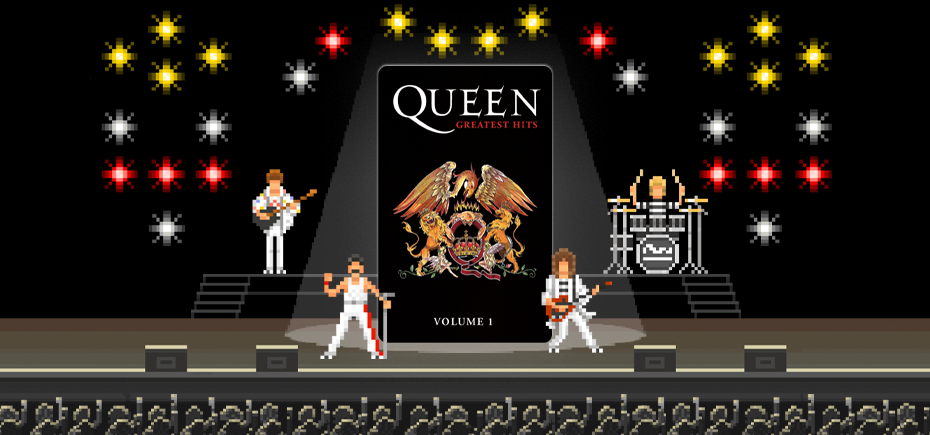
    Queen graphic from the Yoto music player website

    Following in the ridiculous footsteps of the Daily Mail and Daily Telegraph, The Spectator is the latest publication to get in on the manufactured outrage over the supposed censorship of Queen’s Fat Bottomed Girls. According to the article by noted thought leader Richard Madeley, what we’re seeing is “neopuritanical cultural censorship”.

    For the benefit of people whose mouths don’t move when they read, the background to this story is that Queen licensed its music to Yoto, a music player for toddlers. Yoto makes its target audience very clear: it describes itself as “Yoto, the screen-free music player for children”. And Yoto has decided not to include the song, which is quite clearly about having sex with fat women, in its child-friendly version of Queen’s music. I imagine it probably wouldn’t include NWA’s Fuck Tha Police, Cardi B’s WAP or The Sex Pistols’ Belsen Was A Gas either.

    As much as I like to imagine Richard Madeley playing the entirety of Flux of Pink Indians’ The Fucking Cunts Treat Us Like Pricks to soundtrack a four-year-old’s birthday party, I don’t believe for a moment that he doesn’t think there are some forms of media that are not appropriate for children – and I’m pretty sure that if Fat Bottomed Girls were Fat Bottomed Boys, he’d be leading the charge to ban it for adults and children alike.

    I honestly don’t know whether these outrage farmers really believe the shit that they write and publish, but it doesn’t really matter: it’s just more grist to the grievance mill, a machine powered by bullshit whose only product is spluttering bile and whose job is to make its solipsistic readers red-faced with rage.

  • Words as weapons

    A new study from Germany adds more evidence that violent online speech leads to violent attacks in the streets. The Economist:

    A paper by Karsten Müller and Carlo Schwarz of the University of Warwick finds a strong association between right-wing, anti-refugee sentiment on German social-media sites and violent crimes against refugees.

    For every four anti-refugee posts on Facebook, there was one additional anti-refugee incident. According to the Economist, “This relationship appears to be driven by violent crimes such as arson and assault, and cannot be explained by local social-media usage or demography.”

    Correlation is not causation, I know. But we’re well aware of the power of propaganda and its association with violence. So it’s hardly surprising that the same connection is apparent in other forms of hateful speech. For example, if you plot the number of anti-trans articles in the UK press and the number of anti-trans hate crimes reported to the police in the same period, the curves are strikingly similar.

    This, by Joshua Foust back in 2019, is very relevant today.

    While I do think we still don’t understand the precise mechanism by which someone shifts from believing abhorrent ideas to acting on them, there is copious research demonstrating that abhorrent beliefs do lead to increases in ethnic violence. If a belief system is encouraging of violence and dehumanization then it has to be considered alongside the violent actors who say it inspires them.

    Foust begins by writing about Anders Breivik, whose manifesto famously referenced Daily Mail writer Melanie Phillips multiple times, but expands his article more widely:

    I think we need to take a few moments to understand how, as the debate over hate speech is manipulated in profoundly bad faith by right wing public intellectuals, the proliferation of hate speech is having a measurably bad effect on us as a society. And, realizing that, I’ll also discuss why placing faith in internet companies to fix the problem absolves everyone else of the need to act… we have to take responsibility for the sort of language we will tolerate, whether online or in more traditional media.

  • Red flags

    On Friday, 27-year-old Travis Ikeguchi murdered a 66-year-old mother of nine, Lauri Carleton, because he took exception to her shop’s Pride flag. According to US police he tore down the flag and hurled homophobic slurs before killing her in cold blood.

    Ikeguchi’s social media is still available to view, and it’s interesting to see how much he has in common with the leading lights of the UK anti-trans movement: he’s clearly a big fan of self-proclaimed theocratic fascist Matt Walsh, who JK Rowling recently praised on Twitter, and some of his posts share the same inflammatory rhetoric as the “groomer” posts by everybody’s favourite failed comedy writer. “We need to STOP COMPROMISING on this LGBT dictatorship” is fairly typical.

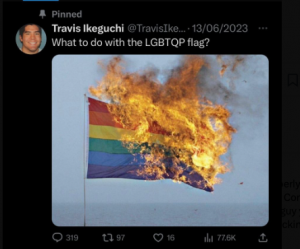
    Travis Ikeguchi's pinned Tweet from June 2023 showing a pride flag burning and describing it as the LGBTQP flag
    Travis Ikeguchi’s pinned Tweet from June 2023

    What’s also clear is that this killer was radicalised online, and that social networks didn’t do anything to stop it. On Twitter, Ikeguchi posted an image of a burning Pride flag with the caption “What do to with the LGBTQP flag?”. The addition of the letter P to denote paedophiles is a right-wing slur like the “groomer” slur, and burning or defaced Pride flags are a trademark of the “anti-woke” and so-called gender critical movements. When @medic_russell reported Ikeguchi’s post as hate speech, Twitter told him that “there were no violations of the Twitter rules in the content you reported”.

    That’s not a surprise. Travis Ikeguchi’s anti-Pride rhetoric is not significantly different from the anti-Pride rhetoric espoused by respected members of the so-called gender critical movement, so for example on his Twitter feed he reposted Jordan Peterson, who was sharing a baseless Daily Telegraph article about schoolchildren identifying as cats. Twitter generally doesn’t have a problem with abusive rhetoric around the Pride flag: for example, a tweet implying that trans women are violent men, demanding the removal of the “TQ” from the Pride flag and captioned “GET YOUR SHIT OFF OUR FLAG” apparently didn’t break the rules and was proudly shared by JK Rowling, not previously believed to be a member of the community “OUR FLAG” belongs to.

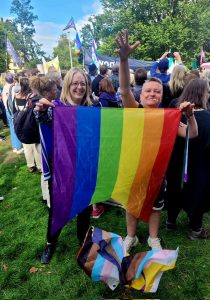
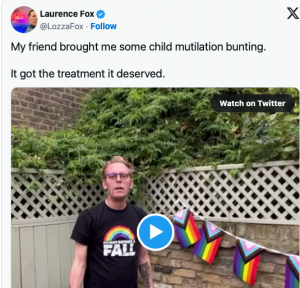
    Similarly when Helen Joyce posed with a pride flag from which the arrows representing trans people and people of colour had been cut out and trodden upon, Twitter didn’t think that was against the rules either. When minor actor turned anti-woke arse Lawrence Fox burned Pride flags in his back garden, flags he called “child mutilation bunting” before adding that “[Pride] isn’t pride. It’s just a celebration of the mutilation of children”, Twitter felt that was just fine. The post is still up.

    Anti-trans tweet reposted by JK Rowling in March 2023
    Author Helen Joyce poses proudly with a vandalised pride flag in 2022
    Photo shared by Helen Joyce on Twitter in 2022
    Actor turned culture war goon Laurence Fox burns pride flags in his back garden
    Laurence Fox on Twitter, June 2023

    Violent imagery and violent rhetoric begets violence. And while we don’t have the US gun culture that led in part to Lauri Carleton’s death, we do have the violent homophobia and transphobia that helped radicalise her murderer. And that leads to violence here too. Just last week two men were stabbed outside a London gay bar in what appears to be a hate crime; we’re awaiting the trial of the murderers of teenage trans girl Brianna Ghey, whose death also appears to be a hate crime. In March a gay man was beaten by a gang of youths in Bournemouth because he was holding hands with his husband;  in July a Birmingham estate agent was jailed for a similar attack in which he attacked a gay couple with a glass bottle and a metal pipe.

    There’s not a single day that passes where my news feed doesn’t contain stories of hate crimes perpetrated against members of the LGBTQ+ community, usually by straight men, usually because they have convinced themselves – or more likely, been convinced by others – that LGBTQ+ people are evil, perverted and dangerous. The people who push this rhetoric are not typically the ones who act on it. But they have blood on their hands just the same.

  • “Oh, you know the ones…”

    Graham Linehan, the comedy writer who sacrificed his marriage and his career so he could hurl abuse at trans people and their allies on the internet all day, has been all over the press in recent days. But the only piece worth reading is this one, by Caitlin Logan in The National.

    Some of the explanations for the ­cancellation offered in mainstream news publications include: “concern about Mr Linehan’s views on transgender issues”; his “views on sex and gender”; and his “gender critical beliefs”. This just in: wolf banned from cottage for “Little Red ­Riding Hood critical beliefs”.

    I’m reminded of Andrew Lawrence’s joke about the conservative who claims they’ve been cancelled for their “conservative views”.

    Con: I have been censored for my conservative views!
    Me: Holy shit! You were censored for wanting lower taxes?
    Con: LOL no… no, not those views
    Me: So… deregulation?
    Con: Haha! No, not those views either
    Me: So, which views, exactly?
    Con: Oh, you know the ones

  • To know me is to love me

    One of the things I write about in my book is that transphobia largely relies on people not knowing, or not thinking they know, any trans people. I make a very good joke about it that you’ll need to buy the book to read. And the same point is made in this report from LGBT Nation, which talks about polling that demonstrates intergroup contact theory. The short version is that if you know trans people, you’re much more likely to oppose hateful anti-trans legislation.

    This is why they want to ban books about or by us, and why they want to erase us from public life. Because as the cliché goes, to know us is to love us.

    Transphobia is classic fascism: we are the out-group against whom the in-group is mobilised, the outsiders the insiders are told to hate and fear. And to maintain that, you need to maintain the fiction that we are a dangerous, sinister “other”. Knowing us, hearing our stories, seeing us do ordinary things… that’s something to be prevented at all costs.

    This week’s right-wing shitefest (or at least, the loudest one so far; I’m writing this on Tuesday) is over the inclusion of Hari Nef (above), a very beautiful trans actress, in the Barbie movie. Her transness isn’t referenced in the movie at all, and there’s no indication as to whether her character – which, it’s important to note, is a plastic doll – is cis or trans. These giant babies are throwing tantrums purely because a trans woman has a job.

    It’s very telling that in the photos many of these ludicrous attention-seeking bigots are sharing in their outrage, they frequently point to a completely different, cisgender, actress as they cry “we can always tell!” So far I’ve seen almost all of the film’s cast identified as trans women or trans men, including the very famous and very cisgender actors Margot Robbie and Ryan Gosling.