Category: LGBTQ+

  • The Times on trial

    Imagine if the BBC had been taken to a tribunal over allegations of bullying, bias and malpractice so serious the entire management team were made to appear as witnesses. Newspapers would be all over the story, with good reason.

    As award-winning journalist Liz Gerard points out on Twitter, if you swap the BBC for The Times and Sunday Times, you get no coverage at all.

    As she puts it:

    Journalism is on trial here. Times editor John Witherow has been accused in open court of being a prejudiced bully who intimidates staff who disagree with him. An editor who sets an agenda and then tasks staff with proving his hypotheses. An editor “allergic” to facts.

    An editor who brushed aside an award-winning journalist’s “significant misgivings” and insisted that he write a story about a child being “forced into Muslim foster care” whose source was an oligarch friend connected to the case.

    His newspaper has been accused in open court – by two separate witnesses – of running a vendetta against transgender people. Of conjuring up and championing moral panic. Of distorting and corrupting journalistic values in pursuit of an agenda that pandered to the editor’s apparent dislike of various minority groups, including Muslims and transgender people.

    As Gerard rightly says, these allegations may yet be proven incorrect. But the lack of coverage is quite remarkable. Imagine if the same things were being said about the BBC and this was their defence witness list.

    • The editor
    • The deputy editor
    • The former deputy editor
    • The executive editor
    • The group managing editor
    • The assistant managing editor
    • The former assistant managing editor
    • The director of HR editorial
    • The HR manager Scotland
    • The chief night editor
    • The former chief night editor
    • The Scotland editor
    • The deputy Scotland editor
    • The former deputy Scotland editor
    • The executive editor of the Sunday edition

    One respondent, Jo Shaw, suggests one explanation for the lack of coverage:

    if case law is established that toxic editorial positions can lead to prosecutions if they create a discriminatory environment for an employee, then this is a disaster for them. Other titles will equally be terrified… they do not want to pump oxygen into the story and risk a slew of legal actions against them by employees (LGBT+, Muslim, possibly even EU nationals) which might damage their ‘right’ to print any old discriminatory rubbish they want.


  • “Extreme right wing fundamentalists with a history of abuse are being given the red carpet treatment at Holyrood”

    Scotland’s only openly transgender elected official has resigned over “institutionalised transphobia” in the SNP. Dundee councillor Gregor Murray has repeatedly clashed with senior SNP figures including Joanna Cherry and Joan McAlpine.

    Murray:

    The SNP has a major institutional problem with transphobia, and is doing nothing to rectify this.

    While they rightfully condemn Labour for anti-semitism, and the Tories for anti-Islamic sentiment, they remain silent on anti-trans sentiment at all levels within the party. Councillors, MSPs and MPs have been openly transphobic for months, and the party hierarchy has done nothing to stop them. Nicola Sturgeon’s words on these matters have been perfect – but we do not need any more words, we need action.

    There are two main issues that Holyrood are considering right now that affect the trans community – the census, and the Gender Recognition Act (GRA).

    “Both of these policies are going through committees with transphobic conveners. Extreme right wing fundamentalists with a history of abuse are being given the red carpet treatment at Holyrood in the party’s name.

    SNP MSPs and MPs are attacking trans people, misgendering us and supporting further attacks.

    It’s easy to read this as a someone with an axe to grind – Murray says they’ve faced “scurrilous” and “vexatious” allegations and that the party has effectively left them to face those allegations alone – but there does appear to be a problem with some MPs and MSPs. For example, Cherry and McAlpine have clearly allied themselves with some of the worst anti-trans organisations and sentiment.

    I hope my MP is different. After writing to him about GRA reform and trans rights generally, I’ve been invited to come and meet him for a chat.

  • “A level sufficient to qualify as a vendetta”

    One of the witnesses in Katherine O’Donnell’s employment tribunal against her former employer The Times  is Christine Burns MBE. Burns played a key part in the creation of UK equality legislation, and she’s been monitoring and reporting on the press coverage of trans issues for very many years. In her submission to the tribunal, she describes the Times’ recent coverage of trans issues.

    During the course of 2016 the Times and Sunday Times featured approximately half a dozen trans-related stories, led by writers such as Rod Liddle. This did not appear at the time to be a departure from business as usual. Certainly, for Liddle, the opinions voiced about trans children and adolescents (as an example) seemed to be in keeping with his brand of polemic. The level of coverage in the whole year did not raise eyebrows, except in exasperation at the one-sidedness.

    That pattern changed markedly in 2017, however — and it changed uniquely for the Times.

    Burns describes how the Times and Sunday Times coverage of trans issues went into overdrive, essentially demonising trans people at every opportunity.

    This wasn’t business as usual. It hadn’t happened in the run-up to the introduction of the Gender Recognition Bill in 2004, or of the Equality Act in 2010. The recent focus on and demonisation of trans people appears to be a deliberate change in editorial strategy.

    As Burns also points out, “the other notable factor about this tsunami of negative coverage, beginning in 2017, was the degree to which editorial standards appeared to be abandoned.”

    I’m not a news journalist, but I when I wrote tech news it was drilled into me that a single-source story wasn’t good enough; “person claims thing” is not news until it’s been fact-checked and experts consulted.

    Many of the people writing for these newspapers are members of the National Union of Journalists, whose code of conduct compels journalists to “strive to ensure that information disseminated is honestly conveyed, accurate and fair” and “differentiates between fact and opinion.” It also says that a journalist “produces no material likely to lead to hatred or discrimination on the grounds of a person’s age, gender, race, colour, creed, legal status, disability, marital status, or sexual orientation.”

    Burns agues that the two papers appeared to decide that editorial standards, that the basic journalistic principles outlined in the NUJ code of conduct, no longer applied if the stories were about trans people. The views of failed sculptors were prized above those of experts. Baseless claims were printed without fact-checking, and often rescinded after intervention by Ofcom. Anti-semitic tropes of child sacrifice and sinister Jewish lobbies made it into print.

    The two titles were standing up their pieces with largely one-sided opinion from personalities with no genuine qualifications in the subject matter and an axe to grind. By comparison, clinical or legal experts in the subject matter did not feature highly and trans views appeared to be treated as suspect, driven by (hinted) ulterior motives and fit for condemnation. The paper’s line of topics seemed to reflect the talking points of a small cohort of commentators who had appeared as if from nowhere to be interviewed as authorities on a regular basis. Trans people and the charities working in this area were presented as ‘powerful’ (the implication being ‘too powerful’). Conspiracy theories about the involvement of jewish billionaires and ‘big pharma’ were aired without challenge.

    …What shocked trans observers in 2017 was that editorial standards appeared to have been suspended in this sphere. This is underlined when the basis for many stories was later established to be false. False interpretation of statistics about trans prisoners and offending. Unbalanced reporting of the nature of the proposed changes to the Gender Recognition Act, presenting only a one-sided pejorative view of the implications. False insinuation about the leadership of the trans charity Mermaids — even after the Heritage Lottery Fund had reexamined plans to award a grant to them in 2018.

    The tribunal continues.

  • “I didn’t notice” doesn’t mean “it didn’t happen”.

    In Scotland, one of the most pernicious bits of anti-trans bullshit is the claim that gender recognition reform is a sudden development, something the Scottish Government is doing in secret and trying to rush through so that women’s groups can’t object.

    Not only does that overlook the extensive, well publicised public consultation on gender recognition that ran from November 2017 to March 2018, that received formal submissions from all the key women’s groups in Scotland and whose responses were overwhelmingly in favour of reform. It also ignores the fact that gender recognition reform was a manifesto commitment of every major Scottish political party in 2016.

    Here, courtesy of @scottishtrans, is what the parties had to say in their 2016 manifestos.

    The SNP: “We will review and reform gender recognition law, so it’s in line with international best practice.” International best practice means self-certification.

    Scottish Labour would “provide legal recognition for people who do not identify as men or women and remove the psychiatric diagnosis…Scotland’s young people…would be entitled to do so from the age of 16”.

    The Scottish Liberal Democrats would bring gender recognition “into line with international good practice…including consideration of the medical requirements placed on applicants, and recognise the gender identity of nonbinary people.”

    The Scottish Greens: “We will back the campaign to reform gender recognition law in line with international best practice.”

    And the Scottish Conservatives: “areas that we believe require review are…the Gender Recognition Act.”

    Just because some anti-trans activists didn’t notice – a claim I doubt given the formal submissions by various anti-trans and religious groups during the 2017 consultation, all of whom made their supporters very much aware of the issue – doesn’t mean it was a secret.

    The reason gender recognition reform didn’t hit the headlines back in 2016 is because it was, and is, a slight reduction in bureaucracy that is of no relevance to the vast majority of people.

  • “We are now living through the biggest anti-trans backlash since the 1970s.”

    I’m not the only one to notice the growing links between anti-trans groups, religious extremists and reactionary conservatives. Writing in Jezebel, Esther Wang explores “The Unholy Alliance of Trans-Exclusionary Radical Feminists and the Right Wing.”

    In a sign of how their thinking mirrors one another, it can be remarkably difficult to distinguish between the talking points of the Christian right and the language of trans-exclusionary radical feminists.

    As the piece points out, it’s more than just language. Organisations such as the Hands Across The Aisle foundation exist specifically to bring anti-trans activists and evangelicals together. Their members, previously listed on their website but now deleted, include Transgender Trend, one of the most visible and vocal anti-trans groups in the UK, as well as prominent UK feminists.

    As I’ve noted before, most of the media panics over trans people follow a script set out by US evangelicals in 2017 that urged activists to:

    Explain that gender identity rights only come at the expense of others: women, sexual assault survivors, female athletes forced to compete against men and boys, ethnic minorities who culturally value modesty, economically challenged children who face many barriers to educational success and don’t need another level of chaos in their lives, children with anxiety disorders and the list goes on and on and on.

    This activism leads to attacks not just on trans people, but attacks on legislation designed to help women and minorities.

    Walsh describes the anti-trans activists’ opposition to the US Equality Act, where angry women have been useful idiots for the republicans who want to discriminate against all LGBT people and who have learned to couch their bigotry in faux-feminist concerns.

    In their opposition, they have aligned with conservative, largely Christian rightwing activists and elected officials, who have their separate, reactionary reasons for wanting to maintain the notion that there is a strict dividing line between man and woman and who have, similarly, reframed the debate about trans rights as one about “safety for women and girls.”

    None of this is new, but it’s getting more dangerous.

    As Mara Keisling, executive director of the National Center for Transgender Equality, said to Walsh:

    “I don’t understand how you can hate so much that you go out of your way to sell your soul to politicians and extremist organizations who have fought women’s rights and women’s welfare every step of the way. It’s really astounding and sad and pathetic.”

  • On bathroom abuse

    While commentators whip up hysteria over the imagined threat of trans people in toilets, here’s the reality.

    Reuters:

    Transgender youth, along with those who do not identify as male or female, are at increased risk of sexual violence in schools that force them to use bathrooms and locker rooms based on their gender assigned at birth, a study published on Monday said.

    Correlation is not necessarily causation; it’s possible that the policies reflect an environment where anti-trans sentiment is more widespread, and it’s that culture rather than the bathroom policies that lead to the abuse. But whatever the reason, it’s clear that columnists and social media trolls are perpetuating lurid anti-trans fantasies while ignoring genuine and widespread abuse of trans teenagers.

    There’s another well documented effect of this: trans people trying to avoid using toilets altogether. I do this: in an unfamiliar place I’ll avoid drinking so I don’t have to go, or wait well beyond the point of physical discomfort until I don’t have a choice. In schools, many trans kids contract urinary infections as a result.

    We’re much more scared of you than you should be of us.

  • Katherine O’Donnell could change UK media

    This case could be very significant. Former Times night editor Katherine O’Donnell’s employment tribunal raises an interesting question: does the content that newspapers publish fall under their duty of care to their employees?

    O’Donnell alleges multiple counts of illegal behaviour towards her after she transitioned to female, and her claims lift the rock to show a “boy’s club” of entrenched sexism, bordering on misogyny. But the case also introduces something that hasn’t previously been tested. Buzzfeed:

    O’Donnell and her lawyer… allege that it wasn’t just what happened in the newsroom but also what those inside it published in the newspaper about trans people that constituted a hostile, transphobic place to work.

    If O’Donnell wins, newspapers and other media outlets would have to reconsider their reporting of all minorities – not just gender and sexual minorities such as LGBT people, but anybody with a protected characteristic under the Equality Act 2010. Content that bullies and demonises groups would be considered workplace bullying.

    Should O’Donnell be successful, therefore, it would mean a newsroom’s output could be deemed an internal, employment issue too. News outlets may in future have to consider how their coverage of trans people and other minority groups could be in breach of employment laws that protect members of these communities on their own staff from discrimination and bullying.

    That doesn’t mean the titles couldn’t report accurately on minority groups or feature a range of opinion. But it could mean that the more vicious stuff would have to stop. It would be a welcome development in a climate where the press regulator IPSO won’t even rule that an invented quote was never said by anybody.

    I’ve been following O’Donnell on Twitter for a long time and she strikes me as a newspaperwoman of the old school, someone who really cares about her profession but who’s been treated despicably by her employer. The Times may come to regret that.

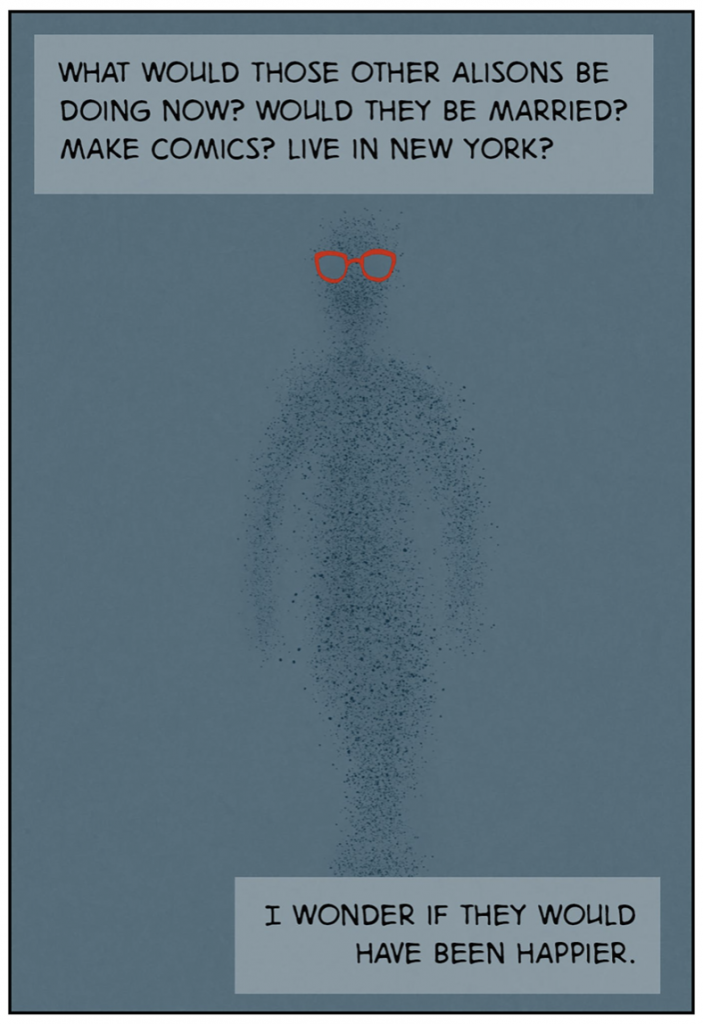
  • “Grieving for all those Alisons who never were”

    This, by artist Alison Wilgus, is wonderful and terribly sad at the same time. It’s a comic about “mourning the versions of ourselves that will never exist.”

    There’s a narrative you hear a lot about people who come out: they always knew. And that’s true for many, but not all. Some of us take a terribly long time to realise who we are, partly because it’s not always so obvious and mainly because we actively fight against it. And that means when we do finally put it all together and finally become ourselves, we do so late in life.

    That’s hard. It’s hard practically – coming out often means throwing a hand grenade into a life you’ve spent many years constructing, causing all kinds of devastation, and of course there are physical aspects too: it’s a lot harder to transition if you’re old, overweight and baggy than when you’re young and slim with great skin.

    But it’s harder emotionally. You find yourself looking backwards with a mix of sadness and sometimes anger, mourning the you you never were. It’s hard not to focus on what Wilgus describes as “the opportunities I’m never going to get back. The doors that feel like they’re closed to me.” There will always be huge gaps in your experience because you wasted so many years trying to live the wrong life.


  • “Basic facts have not been apparent in much of the media coverage”

    Writing in Bella Caledonia, Caitlin Logan describes the current backlash against trans people as evidence of widespread media failure.

    In Scotland, the conversation on trans rights started out as distinctly civil in comparison to our counterparts in England. Women’s organisations stood alongside LGBT campaigners in explaining why trans people can and should be included in their joint efforts for a more equal, safer and socially just Scotland. MSPs from across the political spectrum were photographed with ‘Equal Recognition’ campaign signs, demonstrating their support for reforms which seemed a fairly simple extension of progress which had already taken place with limited fanfare.

    It was as the public – media-driven – debate in England intensified that the Scottish media began to follow suit.

    … the news media has always been driven by competition to be the “most interesting”, but I fear that its decline in the digital age has spawned a whole new impetus to shock, to incite debate, and even to anger.

    …We are now witnessing, on multiple different issues, the political and personal consequences of a media strategy centred more on generating heat than shedding light, coupled with a disregard for clarifying whether the controversial opinions it platforms are even based in fact.

    It’s hard to express just how draining this poison is. Writer and activist Julia Serano is as sick of it as the rest of us are.

    We are now living through the biggest anti-#trans backlash since the 1970s. it’s been going on since at least 2016. it’s not just Republicans or evangelicals – it’s coming from numerous fronts. & most cis people seem entirely oblivious to it…

    …anyway, my point is, these cis people – often people very close to me – seem surprised that lots of people are still very much anti-trans. because they (the haters) have all since learned to couch their bigotry via buzz words about “biological sex” & “women’s safety” and “the science is still out on that” & so on.

    Logan:

    The media is not merely a mirror, reflecting society back at itself – it is part of society, and to ignore its own power in shaping the social and political dynamics it reports on is a dereliction of duty which can no longer stand.

  • Why I block

    Yesterday, the anti-trans group For Women Scotland accused publisher Laura Waddell of running a “misogynist blocklist” to prevent Twitter users from reading and replying to her posts. Like other claims the group makes – this is the same organisation that accused a cat of sectarianism a few weeks back – it wasn’t true. Like many people on Twitter, Waddell manually blocks individual accounts when she can no longer be arsed with their bullshit. Their account was one of them after previous interactions on the social network.

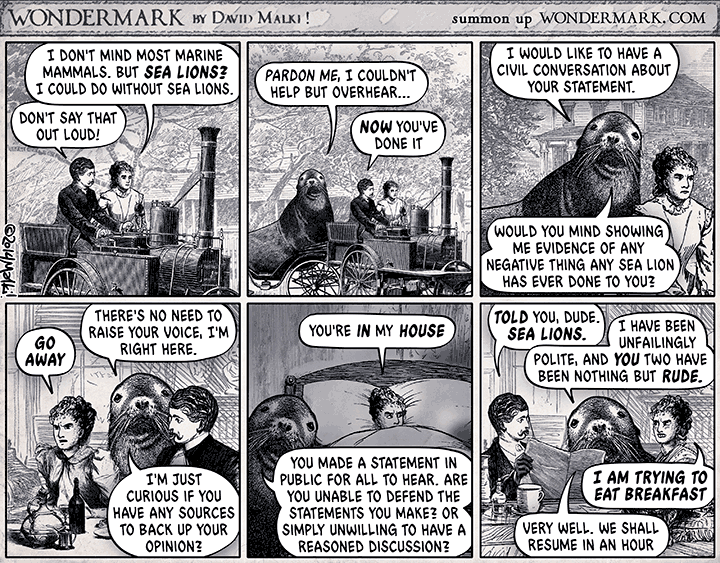
    Blocking people can be crucial on Twitter. If you don’t do it, your feed can quickly fill with awful people trying to ruin your day. I block thousands of people, bigots and trolls of all stripes, using an automated list of known offenders – racist abusers, anti-trans bigots, sea lions (people who pretend to be arguing in good faith but just waste enormous amounts of time) and so on.

    Sea lions are among the worst, because they’re the midges of social media: individually insignificant but hugely annoying in groups. Here’s a good cartoon about them.
    I’m sure some perfectly nice people are also blocked by accident but I have neither the time nor the inclination to manually go through a list of thousands of people. Unfortunately accidental blocks are the collateral damage caused by bigots and trolls’ online abuse. If Twitter actually enforced its own rules against abuse, hate speech and harassment there’d be no need for a block feature at all.

    Yesterday the Equality Network posted a tweet about gender recognition and was quickly piled on by the anti-trans crowd. As the organisation posted today:

    We firmly believe that the proposed reform of the Gender Recognition Act can be done without affecting the rights of women or others, and we are happy to see that genuinely discussed and to engage. However some of the responses to our tweet [yesterday] illustrate a different agenda…

    The important word here is “genuinely”. Many of the people who pile on trans people and trans allies online are not looking for a genuine discussion; they are coming with a script of pre-decided talking points and have absolutely no interest in the answers. They aren’t coming for a debate. They believe they are waging a war.

    This graphic has been doing the rounds on Twitter lately. It’s the “I don’t hate minority X, but…” bingo card, designed to show the patterns that appear again and again and again online. “I don’t hate black/trans/gay people, but we need to protect our children from predators”. “Asian/Trans/women are just too easily offended.” “Black/trans/gay people are erasing us”. “I believe in equality but this lot have gone too far”.
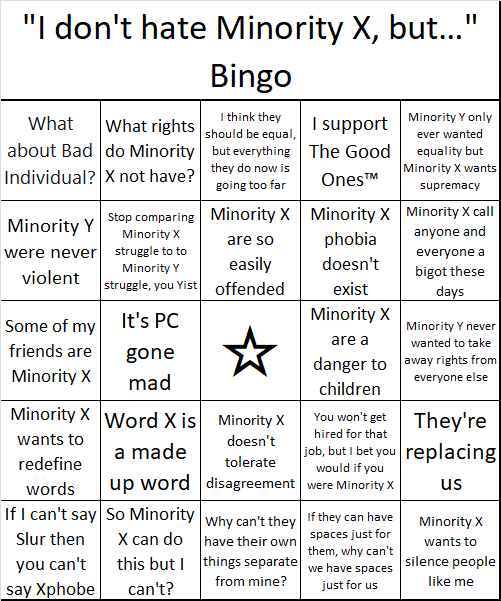
    Bear in mind that these aren’t just the odd tweet. People from minority groups and their allies can be on the receiving end of dozens, sometimes hundreds of messages all saying the same thing: I AM RIGHT AND YOU ARE WRONG DEBATE ME NOW COWARD.

    What’s a girl to do?
    To take the current example over gender recognition reform, many people are completely wrong about the law. They conflate the Gender Recognition Act with the Equality Act, are unaware of the context within human rights legislation, have no understanding of what self-ID actually means, are unaware of the medical, scientific and legal status of trans people and so on.

    Some people believe things that aren’t true because they’ve been misled by bad actors. They think trans children are given surgery (they aren’t), that they’re fast-tracked and forced to identify as trans (nope), that puberty blockers are new, experimental drugs (nope) or that children are prescribed cross-sex hormones (nope again).

    If they are willing to discuss these things, to look at the evidence, then of course you can have a worthwhile debate. But if they’re just going to shout “fake news”, accuse trans women of being predatory, violent men and call you a handmaiden of the patriarchy (or worse) because someone on the internet told them to, they’re a complete waste of your time, energy and oxygen. You cannot have a legitimate, constructive or useful debate with somebody who is acting in bad faith.

    Some people on the internet are stupid. Some are wicked. Some are both. You have no obligation to put up with their bullshit.

    Unless you’re operating it on behalf of an organisation, your Twitter feed (or any other social media presence) is yours, and you decide what you want in it. Think of it as a table in a pub: you’re there talking to your pals. If a bunch of people were to come over and loudly demand you debate them right here, right now, you’d tell them to fuck off. And that’s pretty much what blocking does. It doesn’t censor people. It just stops them from being able to annoy you.

    In the case of trans issues, if someone refuses to accept that trans people are not mentally ill, they are no different from flat-earthers. If they refuse to accept that biology is more complicated than they learned in primary school, they are no different from climate change deniers. If they claim that protecting trans people from discrimination will erase women, they are no different from the racists who peddle the “white genocide” conspiracy theory. If they claim trans people are being funded by George Soros, they are no different from any other anti-semite.

    These people may deserve your pity, but they do not deserve your attention.