Category: LGBTQ+

  • Fun with official application forms

    I sent off my application for my Gender Recognition Certificate this week. So far it’s cost me £140 for the application, £48 to get a statutory declaration notarised, £30 for medical reports and £7.40 in postage; they’ve asked for additional evidence so that’s another trip to the Post Office today. It’s good to finally set the wheels in motion; I’ve had to wait more than two years to do so because I need to provide documentary evidence that I’ve been living as me for that period.

    Under the proposed reforms to the Gender Recognition Act I’d still have to provide most of the things I’ve had to provide, but I wouldn’t have had to wait three extra months for a psychological report and I wouldn’t have had to pay £140. The postage bill might be a bit lower too.

    That’s pretty much the only difference between the system we’ve had in place for sixteen years and the proposed reforms to it.

    Here’s what my GRC will enable me to do in everyday life:

    • Nothing.

    GRCs have nothing to do with everyday life. They’re about changing your birth certificate’s gender marker and nothing else. That is relevant to me should I remarry, and it changes what it says on HMRC’s computer and may impact my eligibility for certain benefits in the future. It used to affect the state pension but I’m too old for it to have any effect on mine.

    Here’s what impact my GRC will have on the toilets I use and the single-sex spaces I access:

    • None.

    It’s got nothing to do with any of that. That’s all covered by the Equality Act, which is not going to change.

    Whether it’s reformed or not, the Gender Recognition Act has no connection with what toilet I use, which spaces I’m permitted to access or the legal definition of men, women or anything else. Anyone who tells you otherwise is either misinformed or malicious.

    Unfortunately the misinformed and the malicious are currently flooding the Scottish government with submissions demanding a halt to any reform of the Gender Recognition Act. It’s an odd thing to target, but it’s enabled them to flood mainstream and social media with increasingly outlandish claims about the supposed dangers of trans women (never trans men) as part of a wedge strategy to weaken the wider LGBT+ community.

    You can help battle the bigots by completing the gender recognition consultation. Feminist group Sisters Scotland have produced a really good guide for anybody who wants to be an ally to trans people, and you’ll find it here.

    Trans and non-binary people are being targeted in mainstream and social media with inaccurate information and campaigns to deny their human rights.  In solidarity with our trans and non-binary siblings, we urge trans allies to respond to this consultation.

    …the main Scottish feminist charities already implement policies that are inclusive of trans women and they agree with the joint declaration of support for GRA reform issued by several Scottish women’s charities.

    It’s a good guide to what the current law actually is, and what minor changes are being proposed.

    Incidentally, if you’re wondering why I’m not waiting for reform before applying for my own GRC, it’s because I’m not confident that any reform is going to happen any time soon. In England, the government ran a consultation on GRA reform in 2018 and still hasn’t published the results; in Scotland, we’re now in the middle of the second consultation on the same issue because a bunch of bigots didn’t get the result they wanted. With pretty much the entire mainstream media happily demonising trans people and demonstrating complete ignorance of the law, I’m not feeling very optimistic right now.
  • This is the future bastards want

    And so it begins. South Dakota has made the first step towards making evidence-based medicine illegal. Doctors who try to help trans teenagers face a year in prison. Another seven US states are set to follow suit; anti-trans groups in the UK want similar bans here.

    As Christine Burns MBE put it:

    Can we all agree now that trans people and our allies aren’t “overreacting”, “misunderstanding” or “making stuff up” about the true intentions of those ranged against us? Making laws to prohibit doctors from providing evidence-based treatment is not normal and people will die.

  • They are coming for your children

    Katelyn Burns reports on the coordinated assault on trans kids’ healthcare by right-wing US lawmakers.

    eight state legislatures — including Missouri, Florida, Illinois, Oklahoma, Colorado, South Carolina, Kentucky, and South Dakota — have already introduced bills this year that would criminally punish doctors who follow best practices for treating adolescents with gender dysphoria. In South Dakota, for example, doctors who prescribe puberty blockers or cross-sex hormones could face a $2,000 fine and a year in prison under the proposed law. South Dakota’s version of the bill was even prioritized and became the very first bill of the decade to pass out of committee… should any of the bills become law, they would effectively cut off many adolescents from medically necessary and, often, life-saving treatment for gender dysphoria.

    …Bills banning trans care for kids are the new bathroom bills, part of conservatives’ larger culture war against trans people. Conservative media and politicians have been fanning the flames for this fight for years in hopes of rallying the base over a non-existent threat — a threat that only puts trans lives in danger.

    Whenever the religious right realises a tactic isn’t working, it finds a new one. When it lost its war on equal marriage, it changed tactics and started attacking trans people – it’s no coincidence that the current media obsession with trans people began after 2017, when various evangelical groups agreed and began to implement their new focus on demonising trans women.

    At first, they tried to make people scared of trans women in public places, but the public is well aware that you’re more likely to be sexually assaulted by a Republican politician or evangelical rabble-rouser than a trans person. So they refined that one and started to say that predatory men would pretend to be trans so that they could start acting like Republican politicians.

    That didn’t fly either, so it’s time to kill some kids.

    Puberty blockers are rarely prescribed. When they are, they save lives.

    Study after study have shown that affirming trans and gender-diverse kids in their self-exploration improves mental health and lowers suicide risk. The affirming model, which allows children to explore their own gender identities at their own pace and can include puberty blockers, has been recommended by nearly every major American medical association, including the American Academy of Pediatrics, the American Medical Association, the American Psychological Association, the Endocrine Society, the World Professional Association for Transgender Health, the American College of Obstetricians and Gynecologists, and many others.

    But of course, bigots don’t really do facts – especially when there are votes to be won.  “Your children are under threat from minority X and only I can protect them” may be one of the oldest and most despicable political tactics in the book, but it works so it’s being rolled out again. Under the pretence of protecting children, these yahoos are quite happy at the prospect of killing quite a few of them. What’s a few more dead trans kids to people who wish trans people didn’t exist at all?

    We’re starting to see exactly the same thing shift in strategy happening here in the UK, although not from openly evangelical and/or right-wing groups: from the same anti-trans activists who previously parroted the evangelical right’s previous attack lines and whose suspiciously well funded pressure groups didn’t exist before the evangelicals started their war on trans people in 2017. Many of those groups have overt or covert links to the US evangelical group The Heritage Foundation, which plays a key role in the US bills.

    What conservative lawmakers are doing with their legislation is removing parents’ and kids’ choices altogether, forcing their own political ideology on the medical choices of private citizens.

    This is a murderous ideology that chants “think of the children!” while trying to ban healthcare that keeps some of them alive.

  • “If I don’t stand up for the rights of others, how can my own rights ever be defended?”

    There’s a really good interview in today’s Guardian with Michael Cashman, whose many achievements include founding the Stonewall charity.

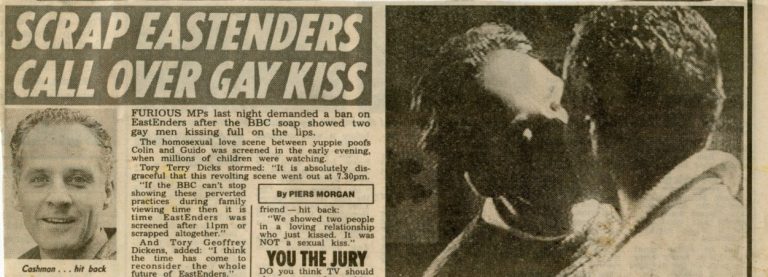
    Remember the tabloid outrage about the first gay kiss in EastEnders? Cashman was the man they were demonising. The clipping above, incidentally, is by Piers Morgan. Morgan would also write article such as “the poofs of pop”, a regular feature speculating on whether particular pop stars were gay in which he called up stars’ agents and demanded to know what their sexual orientation was.

    Cashman was nervous at the thought of the press scrutiny that could follow, but agreed. Even before his character was announced, the Sun ran a story about the role under the headline “Eastbenders”.

    “What made it worse,” says Cashman, now 69 and sitting in his fourth-floor Limehouse apartment overlooking the Thames, “was the information was leaked from inside.” The Sunday Mirror, meanwhile, claimed that he had had an HIV test in the US and was dying. The News of the World ran a double-page spread, headlined “Secret Gay Love of Aids Scare EastEnder”, which outed his partner and printed the couple’s photos and address.

    There was even an attempt to orchestrate “sinister” stories about him.

    …When news broke that Cashman’s character would share the first gay kiss in a British soap (a peck on the forehead), the backlash only intensified. Campaigners such as Mary Whitehouse railed against it; the BBC was besieged by angry letters and phone calls; on more than one occasion a brick was thrown through Cashman’s window.

    It’s a fascinating read and I’m sure Cashman’s autobiography is even more so. It’s a powerful reminder of how far we’ve come in a relatively short period of time as well as a shocking story of how badly and sometimes violently gay men have been treated in this country.

    Stonewall, the charity Cashman founded, was created in response to the hateful Section 28 legislation and the lack of action to battle HIV, then routinely described as a “gay plague” and dismissed as a fiction by the Sunday Times under the editorship of Andrew Neil. The Sun ran one editorial claiming that “Straight Sex Cannot Give You AIDS – Official”.

    Stonewall didn’t initially include trans people in its campaigning – that changed in 2015 when then-chief Ruth Hunt described that lack of inclusion as a mistake – but Cashman can see the parallels between how trans people are treated now and how gay men and women were treated in Stonewall’s early days.

    “To bring in section 28 against a group of people who should have been supported and nurtured and loved. To do that was viciousness beyond imagining.”

    Throughout the 80s and 90s, gay people were often portrayed as predators by media organisations supportive of section 28. Cashman sees similarities in the way the trans community is treated today. And he is concerned that some lesbian, gay and bisexual people are joining in.

    “If I don’t stand up for the rights of others, how can my own rights ever be defended?” he says. “The fact that lesbian and gay people are willing to sacrifice trans people …we’re rolling back the clock.”

    Cashman’s autobiography, One of Them, will be published in February.

  • “Who is this all for?”

    Yomi Adegoke writes about the increasing use of polarised, gladiatorial “debates” to try and get social media attention.

    The BBC has said it will no longer have climate change deniers in debate with climate change activists, as it’s a “false balance”. Yet the topic of racism is handled in the same way a TV programme might treat the topic of extraterrestrials; punctuated with a large question mark.

    Lecturers, authors and professors for whom this is their life’s work and personal experience, are pit against talking-heads whose qualifications to discuss racism appear to be the fact that they’re white, pissed off, and more often than not, perpetrators of the very racism they’re discussing.

    It’s not just race. I can very much relate to this:

    as the conversation surrounding race in the UK becomes more toxic, I’ve received more requests to partake in this type of debate on TV more than ever. And like several other black journalists I know, I have been immediately sceptical about the motivation behind this newfound eagerness to debate topics the media has historically sidelined.

    The UK media had absolutely no interest in trans people until 2017. We’ve had so-called self-ID in law since the 1970s and in practice since the 1940s. The original Gender Recognition Act, which enables us to change our birth certificates and HMRC details, passed without fuss in 2004. The Equality Act, which gives us protection from discrimination and legislates about access to single-sex spaces, has been law for a decade.

    And yet again and again we’re seeing trans people and allies being put up against people who are the gender equivalents of anti-vaxxers or climate change deniers: denying science, demonstrating profound ignorance of the law, claiming that the medical establishment is part of a conspiracy and that trans people are some kind of sinister lobby hell-bent on destroying civilisation and stealing your children. Repeatedly platforming them is either due to incompetence – there’s a distinct lack of fact-checking around these so-called debates, with complete fabrications often being aired unchallenged – cynical traffic-chasing or malice.

    There are not always two sides to a story; differing positions do not always have equal weight. To pretend otherwise in the hope of generating social media traffic is despicable and dangerous.

  • What life is like for LGBT+ people in Scotland

    NHS Greater Glasgow and NHS Lothian have teamed up to research the experiences and health needs of LGBT+ people in Scotland. The full report is here. It’s part of a wider study that includes a literature review and that will help inform future planning.

    It’s a long and often very saddening report, with people sharing some often very traumatic experiences.

    A couple of bits that jumped out for me:

    A common theme in the interviews and group discussions was the change in recent years to society in general becoming more accepting of LGBT+ people, particularly people with gay and lesbian identities. This was in part attributed to equality legislation. Societal attitudes towards trans, non-binary and bisexual people were felt not to have become as accepting to the same degree. Indeed, many felt that attitudes towards trans people, particularly trans women, had taken a ‘backward step’ in recent times, largely attributed to a very negative narrative around trans identities widely reported in the media and particularly social media, often in reference to the campaign around the Gender Reform Act. Many felt that inflammatory media reporting had a measurable impact on how trans and non-binary people were treated in public.

    Despite the progress, almost every participant had experienced homophobia, biphobia or transphobia in a wide variety of settings.

    Many LGBT+ people who participated in the research recounted incidents where they had been threatened or intimidated because of their identity – but they rarely viewed incidents such as being shouted at in the street or name calling as ‘hate crime’, and did not report them to the police.

    …Exposure to negative opinions and stories in the media, particularly social media had an effect particularly on how safe trans women felt. Many trans women spoke about how media reports affected their anxiety and feelings of safety.

    …There was much discussion from all LGBT+ groups about the current discourse on social media against trans people, particularly trans women.

    Depression and isolation were common.

    A common theme for all LGBT+ identities was the struggle to work out their sexual orientation and/or their gender identity, and the toll which their period preceding their self-discovery took on their mental health. Usually, there was a period where they fought against their identity or did not want to accept it. This was more pronounced in environments and circumstances where having an LGBT+ identity would be more difficult (e.g. more deprived areas, rural areas, certain faith and cultural groups), and could lead to internalised homophobia/transphobia which could prevail after coming out.

    …Trans men and women and non- binary people were particularly likely to speak about suicidal thoughts, although these tended to subside after transition.

    LGBT+ people of all kinds reported being unable to take part in certain forms of physical activity. Trans men and women reported no longer being comfortable in swimming pools or gyms, while gay men often felt excluded by the “laddish culture” in many sports.

    Many trans and non-binary people spoke about doing exercises such as yoga alone at home rather than in a class setting because they did not feel they could participate with others. One trans woman described how she went to the gym at 2am because the gym was almost empty at that time and she was also able to use the disabled changing cubicle. A trans man said he could only use the gym if he changed at home.

    There is much, much more – GPs lacking crucial knowledge, lesbian and bisexual women being treated terribly by healthcare providers, horrific waiting lists for pretty much everything, people being scared to talk about mental health issues for fear it would be used against them. The report also explores the experiences of people of various faiths, of people with disabilities and of asylum seekers.

    The research isn’t entirely negative, but the picture that emerges again and again is of LGBT+ people struggling against multiple issues including severely underfunded health provision, social isolation and other people’s prejudices – and of social and mainstream media actively fuelling those prejudices.

  • LGB people: the LGB Alliance do not speak for us

    (Click for full size version)

    This week, various outlets gave yet more publicity to the LGB Alliance, a single-issue anti-trans hate group that purports to be about LGB people’s rights but has no policies about, er, LGB people’s rights. This hasn’t stopped Scotland’s press and BBC Radio Scotland giving them uncritical coverage and endless opportunities to scaremonger about trans people.

    It’s incredibly one-sided. The LGB Alliance’s co-founder and director got to rabbit on about supposedly dangerous trans people all week – BBC Radio Scotland’s John Beattie programme even had him on as an expert in biology to question whether trans women were “women or (merely) trans women”, because who better to talk about the complexity of biology than a film director? – but when he also claimed that predatory gay teachers would show children gay pornography and prey on them in LGBT school groups not a single mainstream news outlet picked up on it. They don’t seem interested in the LGB Alliance’s full-page newspaper ads promoting organisations that are against life-saving treatment for gay men and organisations that were founded by anti-semitic conspiracy theorists, or the fact that they are linked to the US right-wing heritage foundation which campaigns against women’s rights and LGB people’s rights.

    As far as the Scottish media is concerned, if the LGB Alliance says they represent the views of the LGB community, then they must clearly represent the views of the LGB community.

    They don’t, and Scotland’s LGB people are getting pretty sick of it. So today, over 70 Scots LGBT groups large and small and their allies have published an open letter stating their support for trans people and gender recognition reform.

    The letter has been published in today’s Herald newspaper:

    Signed by sports groups, health charities, independence-supporting groups, Pride organisations and police-affiliated LGBT groups, the letter goes on: “We have been concerned by attempts by some to isolate the trans community from the wider LGBT community; this goes against everything we stand for. Trans people are the women, men, and non-binary people that they say they are.”

    I don’t expect this to change the uncritical support our press is giving the LGB Alliance. Our press continues to pretend gender recognition reform is not supported by women’s groups, even though every major women’s group in Scotland supports GRA reform; they continue to misrepresent anti-trans hate groups as representative of feminists or women generally.

    But it’s important to realise that when the LGB Alliance claim to be speaking on behalf of LGB people, the Aberdeen LGBTQ+ Forum, Amazing Gracies, Auld Reekie Roller Derby, Ayrshire LGBT+ Education Network, Ayrshire LGBTQ, Ayrshire Pride, Bute LGBT+, Bute Pride, Caledonian Thebans RFC, Colinton Squashers, ConnexONS Fife, Dumfries & Galloway LGBT Plus, Dundee Frontrunners, Dundee Pride, Dundee University LGBT+ Society, Dunoon Pride, Edinburgh Frontrunners, Edinburgh Racqueteers, Edinburgh STRIDE, Edinburgh University Staff Pride Network, Equality Network, Four Pillars, Free Pride Glasgow, Glasgow Alphas RFC, Grampian Pride, Hebridean Pride, Highland LGBT Forum, Highland Pride, HIV Scotland, HotScots FC, LEAP Sports Scotland, LGBT Health and Wellbeing, LGBT Unity, LGBT Youth Scotland, LGBT+ Conservatives, LGBT+ Labour Scotland, Moray LGBT, NetworQ Orkney, Oban Pride, Orkney Pride, Out for Independence, Out On Sundays, PCS Proud, Perth Parrots Floorball Club, Perthshire Pride, Pink Saltire, Pride East Kilbride, Pride Edinburgh, Pride Glasgow, Pride in the Borders, Pride Proms Project, Pride Saltire – East Lothian, Queer Ephemera, Queer Napier, Rainbow Glasgaroos, Rainbow Greens, Saltire Thistle FC, Scene Alba Magazine, Scene Radio, Scottish Borders LGBT Equality, Scottish LGBTI Police Association, Sisters Scotland, SQIFF, Stirling University LGBTQ+ Society, Stonewall Scotland, SX Health, Terrence Higgins Trust Scotland, Time For Inclusive Education, Vale Pride, Waverley Care, West Lothian Pride and Winter Pride Scotland have made it very clear that they do not.

  • My life story

    After a lot of delays, I’ve finally received the psychologist’s report I need in order to apply for my Gender Recognition Certificate. Unfortunately I can’t actually afford the application fee for said certificate because why should anything be easy – I’ve also had to halt my weekly electrolysis sessions because paying the equivalent of some people’s mortgages isn’t easy when you also have actual rent to pay – but at least I’ve got the paperwork for when I can.

    It’s a very strange thing to receive. I hadn’t really thought about it, but the evidence the doctor needs to provide includes all the documentation of my initial assessments and subsequent appointments. As a result I’ve got copies of the doctor-to-doctor letters detailing my entire life story. Spoiler alert: it turns out I’m trans.

    Obviously I know what the letters contain, but it’s still a bit disconcerting to read your own life story when somebody else is telling it. It’s bittersweet, too: despite the dispassionate, clinical language the story it tells isn’t a happy one. It’s a story about somebody who tried very, very hard to be somebody they weren’t for a very long time.

  • More evidence for the tabloids to ignore

    An important new survey from the US has investigated the effectiveness and risks of puberty blockers in trans teens. The short version: they’re safe, reversible and life-saving.

    The study is significant not just because of what it found, but how it found it. Mostly when you read about puberty blocking in the press it’s based on the evidence-free assertions of anti-trans pressure groups who believe they know better than scientists and doctors, something they share with anti-vaccination cranks. This study is based on interviews with pediatricians and over 20,000 trans people.

    CNN:

    Transgender youth have a much greater risk of suicide, according to the US Centers for Disease Control and Prevention. However, if they have access to a puberty blocker, their chances of suicide and mental health problems in the immediate term and down the road decline significantly, a new study finds.

    It’s important to note, because the press coverage isn’t big on context, that the positive impact of puberty blockers only applies to teens who want to medically transition and who want to pause puberty to give them time to be sure. Not all trans teens do; in fact, most don’t.

    One reason anti-trans groups focus on the number of gender non-conforming teens referred to gender clinics but not the number of teens who have been carefully assessed over time and finally prescribed puberty blockers is because the latter number is vanishingly small. While the number of referrals have soared in recent years, the number of prescriptions for puberty blockers has not.

    I wrote about this a few months back:

    More referrals does not mean more prescriptions. In 2014-2015, the number of under-15s referred to the UK’s only gender clinic for adolescents rose from 46 to 52 – but the number of people prescribed hormone blockers dropped from 41 to 32. Puberty blocking remains exceptionally rare. These drugs aren’t and won’t be handed out like sweets.

    The medical model is based on what’s called “affirmative care”. As trans healthcare expert Ruth Pearce explains on Twitter [emphasis mine]:

    …an affirmative model of care for trans youth means providing space for those who want to transition and those who don’t, those who want physical interventions and those seeking mental health support. Flexibility, individual care and responsiveness, not imposition.

    So yeah, this research (which has an impressively large sample, and aligns with findings from other studies) shows what we already knew – hormone blockers help kids who need hormone blockers. But no-one is pushing them onto young people who aren’t seeking this treatment.

    It’s important to view this in the context of the US, where multiple states are attempting to ban puberty blockers altogether (one state would imprison doctors for prescribing them), and in the UK where anti-LGBT+ groups continue to claim that teenagers are being forced to take medicine that they claim will have terrible long-term effects and where newspapers deliberately and maliciously tell their readers that puberty blockers are “cross-sex hormones”. Yet again the medical evidence is being ignored in favour of ideology.

    As pediatrician Dr Michelle Forcier told CNN:

    “Historically we have known the puberty blockers are safe and effective and this is totally reversible, so the benefits far outweigh any risk.”

  • “On Jan. 6, 2000, I did it.”

    Jennifer Finney Boylan writes in the New York Times about her 20th anniversary of coming out as trans.

    So much has changed since then. In some ways, this country has become safer, as more and more of us step forward to proclaim our realness.

    In other ways, we’re more threatened than ever.

    When I came out, no one had yet been schooled on the finer points of hating me; most bigots in this country didn’t know a trans woman from the Trans-Siberian Railway.

    Because my existence was so far off their radar, few people had bothered to come up with laws to make my life worse.

    She asks herself a question that I’ve been asked too: if you had known what you know now, if you had known the hatred and ignorance that would become part of your everyday reality simply for existing, would you still have come out?

    Would it have deterred me, if I had known for certain that the world would also contain truly heartless and terrible people, at least one of whom would eventually become the president? It would not.

    I would still have gone about the business of becoming myself.

    That would be my answer too.