Category: LGBTQ+

  • Pink shoes for boys

    There’s a nice piece in Huffington Post by Kat Rossi.

    When my son was 3, I made a mistake. We were at a shoe store in New York City, picking out new sneakers for his rapidly growing tiny feet. He was insistent: The next pair of shoes he was going to wear had to be bright pink. I steered him toward red. He pressed for pink, ignoring the usual varieties of blue for little boys. I am ashamed to admit that I eventually lied and told him that pink wasn’t available in his size. We compromised on orange.

    Rossi talks about something many of us have experienced: the way gender roles are policed from a very early age. As I’ve written before, my daughter was informed in nursery school (by a boy, of course) that she wasn’t allowed to be interested in history or dinosaurs because “they’re for boys”; she was also told that her favourite fictional animal, a dragon, was not okay because dragons were for boys. Girls had to have a different fictional animal, a unicorn.

    This bit felt very familiar:

    My son entered preschool in our new home in Barcelona, Spain, and suddenly there were things girls do and things boys do. Girls dance, and boys play soccer ― or at least that’s what we were being told and shown. I took him to a ballet class where he was the only boy, and he took two days to make the decision of whether he wanted to keep going. No, he told me, because ballet is for girls. No number of Alvin Ailey or Fred Astaire videos, although agreeably cool, could convince him otherwise. Another mom at the school told me that her daughter had dropped soccer for the same reason ― it was for boys, she said.

    When my son was a bit younger, he loved nail polish. And then overnight he stopped, because he’d been told that nail polish was for girls. Since then he’s often expressed his horror at the thought of owning anything pink.

    Now it was no longer me, but the other influences in his life ― his classmates, teachers, the images he saw around us ― that told him you’re either A or B, girl or boy, and you’re expected to behave accordingly. Despite my attempts to keep the gender stereotypes out of his life, at age 5, he clearly drew a line in his head: On one side were the boys, and on the other, the girls.

    The policing and reinforcement of gender stereotypes starts young, and the people who don’t conform – the boys who want pink shoes, the girls who don’t want to be sugar and spice and all things nice – are discouraged in all kinds of ways, big and small.

    Asking for pink shoes don’t mean your son is gay, or trans. As Rossi writes:

    just because you like something that’s associated with one gender doesn’t mean that you are that gender or want to identify as that gender, and it certainly doesn’t mean anything about your sexual orientation.

    But there is an association in some people’s minds between how people express themselves and what their sexuality is, what their gender identity is. And some of those people react very negatively to anybody who doesn’t stay in their designated lane.

    That means even if you are an evolved and enlightened human, you can still find yourself in the role of the gender police. You know that shoes or nail polish or anything else that’s been pointlessly gendered doesn’t mean anything, but you also know that other kids – and more to the point, other kids’ parents – often have very different views.

    The truth is, I was mostly guided by fear. I was afraid that somehow if he were to show up at our uptown playground wearing pink sneakers, he would be teased mercilessly. I was afraid that he would be hurt ― because he was different.

    I think that’s a real shame, because what starts in the playground ends up in the pay packet. As kids grow up, gender stereotypes begin to limit much more than the colour of their shoes.
  • Nature, nurture, hormones and brains

    There’s an interesting article in The Scientist, the magazine for life science professionals, that includes a good round-up of the current research into trans people’s brains. There are lots of fascinating questions:

    for people who transition to identifying as a binary gender different from that assigned at birth, “we still also don’t know whether male-to-female and female-to-male transsexualism is actually the same phenomenon, or . . . [whether] you have an analogous outcome in both sexes but you have different mechanisms behind it”…. Other outstanding questions include what, if any, differences there are in the brains of transgender people with different sexual orientations, and between those whose gender dysphoria manifests very early in life and those who begin to feel dysphoric during adolescence or adulthood. [and we don’t know]  whether the brain differences that have been identified between cis and trans people persist after hormone treatment.

    Brains are wonderfully complex things, and the mismatch between the gender we’re assigned at birth and the gender we are is likely to be multifactorial: it’s never been as simple as “being born in the wrong body” (which was always a huge oversimplification in an attempt to help cisgender people understand trans people). As one of the interviewees in the piece says, it’s likely to be “a combination between biological, psychological and social factors.”

    The more we know, the more we know that we don’t know. For example:

    hormone treatments might even affect regions the brain that are not commonly considered to be among those sensitive to sex steroids—specifically, the fusiform gyrus, involved in the recognition of faces and bodies, and the cerebellum, known in part for its role in motor control

    There may also be differences in the mechanisms affecting the brains of trans men and of trans women, because while we both take hormones we take different hormones – testosterone for the men and estrogen for the women.

    The article concludes:

    For now, as is the case for many aspects of human experience, the neural mechanisms underlying gender remain largely mysterious. While researchers have documented some differences between cis- and transgender people’s brains, a definitive neural signature of gender has yet to be found—and perhaps it never will be. But with the availability of an increasingly powerful arsenal of neuroimaging, genomic, and other tools, researchers are bound to gain more insight into this fundamental facet of identity.

  • “However far we slip into the pits of disaster, armies of queer-botherers persevere”

    Eleanor Penny, for Novara Media, on “bathroom bills” and anti-trans scaremongering:

    It seems to matter little that all this has been repeatedly debunked as statistical nonsense or swivel-eyed conspiracism. They aren’t really propositions to be proved true or false – they are ways of telegraphing disgust. Of signalling to those who fall outside normative conceptions of gender: ‘you don’t belong here’. This may be where we empty our bladders – but the real filth is you.

    There are zero confirmed cases of a man pretending to be a trans woman to commit sexual assault. It’s a fever dream of conservative culture war strategists and overly-online obsessives determined to forge a cover story for their own reheated prejudice. There are, however, many cases of cis men assaulting people in women’s bathrooms without such a pretence. As journalist Paris Lees has charted, there are many cases of gender-non-conforming cis women being stopped in public bathrooms on suspicion of existing-while-trans.

  • More important things to worry about

    In my post about transgender day of visibility, I mentioned that some people criticise such awareness days, especially now. Haven’t we got more important things to worry about?

    And we have, but the problem is that politicians use those bigger things as cover to attack us. An admittedly extreme example of that has just happened in Hungary, where the far-right prime minister Viktor Orban has turned the country into a dictatorship. On the very first day of the new powers, his deputy introduced a new bill that would make it impossible for Hungarian trans people* to legally change their gender and which would render previous legal changes invalid. There’s no reason for the legislation; the administration is just happily using its new powers to go after the people it hates.

    Something similar happened in Ohio on the same day, where the Republican governor signed into law two anti-trans bills: one prohibits trans people from amending their birth certificates; the other bans trans girls from participating in sports in their correct gender.

    This isn’t Hungary, of course, or Ohio. But COVID-19 has already had an impact on trans people here (beyond the fact that the entire gender clinic network has been shut down with all assessments, monitoring and surgeries cancelled for the foreseeable future). The Scottish Government has paused its plans for gender recognition reform due to the coronavirus crisis, and while I think such a pause is the right thing to do there is a difference between pausing non-essential legislation and using the pandemic as cover to abandon it. The language surrounding this particular suspension – “kicked into the long grass” – suggests it’s the latter. There are strong echoes of 9/11 being “a good day to bury bad news”: Coronavirus is a good excuse to bury legislation that’s become politically inconvenient.

    But it’s not just trans people who’ll find bad actors using coronavirus as cover. The same Ohio administration that’s targeted trans women during coronavirus is also attacking the rights of all women. The state’s attorney general has ordered abortion clinics to stop performing most procedures; in Texas, the AG went a step further and banned any procedure that is not necessary to save the woman’s life. Other states have followed suit.

    The argument here, and it’s a disingenuous one, is that resources are needed for more pressing tasks – and procedures that are not essential, such as non-urgent dental treatment and elective surgeries, are a waste of such resources. But abortion is not like the knee operations or dental fillings the politicians want to classify it alongside, and they know it: a woman who needs an abortion cannot wait for the coronavirus to pass.

    Ohio and its like-minded states may not seem to have much in common with Orban’s Hungary or Bolsonaro’s Brazil**. But they are united by their determination to control women, whether those women are pregnant women or trans women. And if a crisis gives them an opportunity to do that more easily, they will gladly take it.

    For women and for members of minority groups, times when “there are more important things to worry about” are often the very times when their rights are most threatened.

    * I say “trans people”, but the rhetoric and most of the legislation attacking trans people is focused specifically on trans girls and women.
    ** Although there are strong links between the dictators and the Republicans: for example, Orban hired republican strategist Arthur Finkelstein to revive his flagging electoral prospects; Bolsonaro is friends with Donald Trump and the “darling” of parts of the GOP.

  • We aren’t going anywhere

    It’s international Transgender Day of Visibility today. It’s a day meant to raise awareness of the discrimination trans people face, and to celebrate their contributions to society.
    Some people react to days like this with scorn, especially now: don’t we have more important things to worry about? And that’s exactly why days like this exist.

    In India, a poster campaign is telling people that Coronavirus is spread by trans people. In America, Republican legislators in multiple states have used the pandemic to rush through legislation that discriminates against trans people while making no efforts to protect people from the genuine threat of Covid-19. And here in the UK, the newspapers continue to lie and scaremonger about us and bigots continue to abuse trans people online – in some cases, bullying trans women self-isolating with coronavirus by wishing them and their loved ones dead – and anti-trans groups continue to fundraise and campaign for the right to discriminate against us rather than use their five-figure war chests to help the vulnerable women they claim to represent.

    The title of this post is a sour joke: we’re having a day of visibility when most of us are stuck at home. But even if it’s just online, visibility matters: one of the bigots’ best weapons is the fact that there are relatively few of us, so it’s easy for them to portray us as some sinister “other” instead of the reality: we’re sons and daughters, mums and dads, brothers and sisters, friends and colleagues. The more visible we are, the more people will see through the bigots’ bullshit.

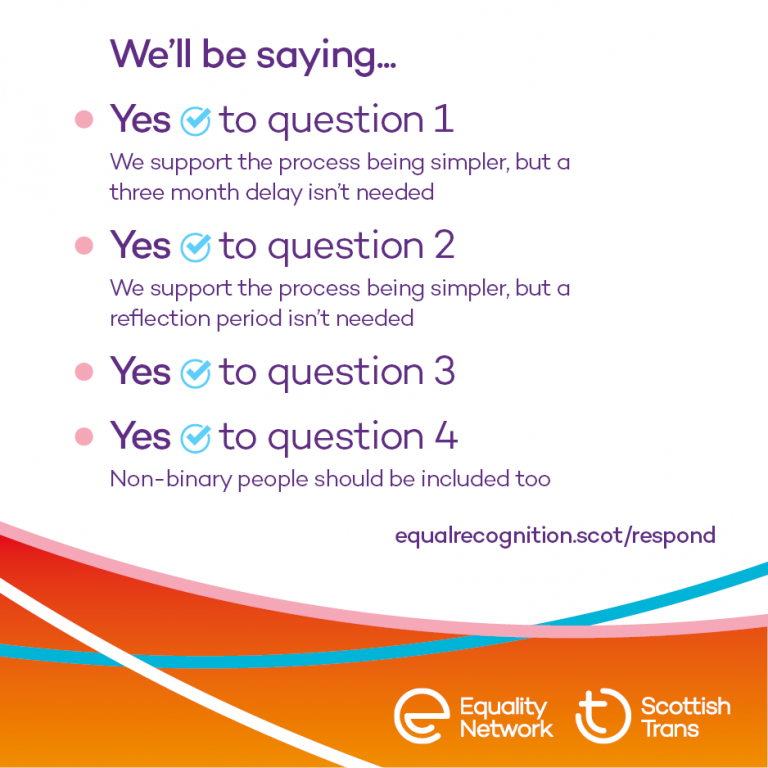
  • Please take part in the Scottish consultation, which closes at midnight today

    I know, I know. I’m sick of it too and there are plenty of other things to worry about. But the Scottish consultation on gender recognition reform closes tonight and you can be certain that the worst people have made their voices heard.

    I know of lots of people who’ve been meaning to do this but haven’t yet; after midnight those good intentions won’t be able to help a very marginalised community.

    Please, take five minutes to complete the consultation. Everything you need to know is on the Equal Recognition website.

    With excellent timing, an important study in The Lancet Public Health describes the importance of accurate documentation for trans and gender non-conforming people: it reduces psychological distress and saves lives.

    the authors’ findings support the need to increase the availability of and streamline the processes to obtain gender congruent IDs. Gaining gender-congruent IDs should be easy, affordable, and quickly completed

  • Some people genuinely want us dead

    One of the most incredible things I’ve seen in recent days is transphobes gleefully predicting that coronavirus will kill lots of trans women. They’re responding to Chinese stats that indicate a higher fatality rate among infected men than women; this, apparently, means those of us assigned male at birth will get our just desserts for whatever perceived injustice they believe we’re perpetrating. And the people doing this aren’t the lunatic fringe of Twitter. They’re the newspaper columnists and college professors who get to set the tone of supposed “legitimate debate”.

    If you’re chuckling about the potential deaths of people, you’ve long abandoned “reasonable concerns”.

    Many of these people and their followers have contributed to the Scottish Government consultation on gender recognition reform, which closes on Tuesday. If you haven’t already done so, please add your experiences; if you contributed to the initial consultation, please contribute to this one too. The first consultation was on whether gender recognition needed reform; this one is about how it should be done.

    This article by Laura Waddell gives the lie to the claim that women’s groups aren’t in favour of the reforms.

    Here’s what various organisations have to say about gender recognition reform in Scotland and what they hope you’ll say in the consultation.

  • “Using minority rights to attack women’s services says it all”

    Another thoughtful column: Laura Waddell on feminism, transphobia and GRA reform.

    …often the cry of “listen to women” comes up. So let’s do that now. Here’s what women’s organisations across Scotland have actually said.

    During the original consultation, Close the Gap, Engender, Equate Scotland, Rape Crisis Scotland, Scottish Women’s Aid, Women 50:50 and Zero Tolerance released a joint statement supporting self-ID. At odds with the inflammatory phrase ‘war on women’, they clearly state: “We do not regard trans equality and women’s equality to contradict or be in competition with each other.”

    …They also stated: “The complexity, restrictions and expense of the current gender recognition process particularly discriminates against trans people who are disabled, migrant, minority ethnic, unemployed, homeless, fleeing domestic abuse, young or non-binary. Enabling trans people to smoothly change their birth certificates at the same time as they change their other identity documents is a much needed positive step forward for society.”

    It’s a great shame that voices like Waddell’s – and of the women she writes about here – are not given the same prominence as pale, male and stale middle-aged newspaper columnists.

  • “We have fought tooth and nail for the rights we have, only to be met with resistance, sabotage and abuse”

    A thoughtful piece on feminism and trans women by Scots author Elaine Gunn:

    I get it – honestly, I understand how protective women feel of their safe spaces. In a world that feels unsafe a lot of the time, where our rights are hard-won and grudged at every step, it’s reasonable to feel nervous and insecure around changes to our habitual experiences of gender. What we must not do, however, is allow that nervousness and insecurity to be redirected by media manipulation towards a group that faces even more hatred and violence for claiming their rights than we do. It’s tempting to cling to the concept of women being right at the bottom of the privilege pile, but it only takes a moment of empathy to understand that while women have good reason to fear men, trans people have good reason to fear both men and women right now.

    On a related note, journalist Vonny LeClerc has recorded an equally thoughtful piece on her journey into “gender-critical” feminism and the realisations that led her to leave it behind.

  • “Strength in numbers, solidarity and, ultimately, love”

    Writing in The Guardian, Zoe Williams takes a very different stance from the majority of Guardian pieces on trans rights. As she points out, it isn’t the anti-trans feminists who are being silenced here.

    All kinds of voices have been excluded. The experience of trans men, for instance, has been more or less erased, because the core issues have been whittled down to such a sharp, conflicted point – do cis women need protected status? – that the very existence of trans men has become too inconvenient to accommodate. The mainstream feminist view, which is trans-inclusive, has been sidelined to maintain the fiction that this is a generational battle between old and young feminists.

    …Women-only space was a realm protected from our Harvey Weinsteins, where we could talk about our Harvey Weinsteins; it was not a hallowed place where we communicated through our ovaries. It was where we came together in unity against people who hated us. I can’t imagine the mindset that would exclude a trans sister from that.

    I’m not going to say anything mean here: I’ve always liked Williams’ writing, and while it’s a drop in a very poisonous ocean of anti-trans pieces the paper has run in recent years it’s still a welcome drop.