Category: LGBTQ+

  • “Fanning the flames of populist hate”

    Labour MP Nadia Whittome has a way with words. Today she said the government’s endless prevarication over gender recognition (GRA) reform was “fanning the flames of populist hate”.

    She’s right.

    We’re now going into the third “silly season” where it’s open season on trans people in the media and on social media. GRA reform is the tenuous justification for it.

    What was only ever a minor administrative change (and a manifesto commitment of all the major political parties) has been blown out of all proportion and used to excuse a multi-year campaign of vicious demonisation of trans people, particularly trans women. And that’s having a demonstrable effect on real-world hate crimes. The government could and should have prevented this.

    Liz Truss responded:

    Let me be absolutely clear. We will not be rolling back the rights of transgender people. It is important that transgender people are able to live their lives as they wish, without fear, and we will be making sure that is the case.

    I don’t believe her, and I certainly don’t trust her.

    I believe she had every intention of announcing a rollback of trans rights today – her government briefed the political editor of The Sunday Times to that effect a few weeks ago – but was prevented from doing so because the government didn’t anticipate tens of thousands of cisgender women contacting them to say “not in my name”.

    And I think she is still trying to find a way to reduce trans people’s rights without changing the underlying legislation, such as changing the current guidance around the Equality Act to make it trans-exclusive rather than trans-inclusive as it currently is. That would enable her to say that she hadn’t changed the letter of the law while undermining both its spirit and its practical application.

    Whatever she decides to do, if she actually decides to do anything, her government is complicit in “fanning the flames of populist hate”.

    Its ill-judged consultation became a referendum on an extremely marginalised group’s basic human rights, and even though the majority of responses were in favour of reform it has repeatedly refused to publish its response, let alone take any action.

    Not only that, but it has refused to correct any of the misinformation and outright falsehoods that now circulate about what GRA reform means and what a GRC entitles the holder to do. It’s not as if accurate information is hard to find. It was in the government’s own consultation documents.

    The longer the government refuses to say what it will do, let alone actually do anything, the longer it leaves a vacuum that bad actors are only too happy to fill.

    Three years ago, the Tories painted targets on trans women’s backs and ran away. Whether by malevolence or incompetence, I don’t know. But I do know that their inaction now looks very much like cowardice.
  • Chanks

    I went to the optician yesterday. It’s a new branch so I’m not known to the staff, and as I had a mask hiding most of my face I wasn’t too surprised to be misgendered on the basis of my voice.

    I was going to trick you by saying “You’ll never guess what happened next! They sure chose the wrong day to mess with ME!” but if you know me, you’re not going to be fooled.

    What happened next is pretty much what you’d expect from me. I had a quick, friendly, quiet word with the person I’d heard misgendering me. I told her that it was no big deal, but with the whole being-a-woman thing I’d prefer it if she could use female pronouns.

    You’ll never guess what happened next!

    What happened next is pretty much what you’d expect too. She said oops, she said of course, I said really it isn’t a big deal, I said it’s just a bit embarrassing, I said I get it a lot because of my voice, and we chatted about other things that were much more interesting. Half an hour later she and a colleague were providing extremely opinionated and often very funny commentary on the various pairs of glasses I was trying on. It was a lot of fun, and there was a lot of laughter.

    Unless it’s intentional, misgendering is no big deal. It happens all the time, often many times a day. Sometimes it gets me down – it’s particularly horrible when it happens on air – but I know that it’s almost always unintentional. People are busy and thinking about other things and tend to work on autopilot. As I’ve written before a lot of the cues we rely on aren’t so clear if you’re not presenting as stereotypically feminine, if you are but half your face is behind a mask, or if you’re just a voice on a telephone.

    And we all have moments when our brain just goes blehhhhhhh and something flops out of our mouths. Last week I tried to thank a helpful guy in a hi-vis vest who gave me directions; torn between saying “cheers” and “thanks” I said “chanks”. I immediately went bright red, hit the window button and drove away in a state of extreme embarrassment, my kids giggling gleefully because they had a new in-joke to torment me with.

    So when misgendering happens it’s no different from someone who hears my name as “Karen” or “Kerry” instead of “Carrie” because of the Irish in my accent, or if they get it wrong because like me they’re absolutely hopeless at remembering people’s names. It’s a tiny, honest mistake that’s the product of, y’know, growing up in a culture with a binary system of gender classification based on observing a handful of biological markers and stereotypes that doesn’t take into account the beautiful variety of human brains and bodies and identity and expression.

    Yeah, that old thing.

    I’m going for comic effect here but there’s still a sensible point in there. If you’ve ever worked in customer service or any kind of customer-facing role (and I have, so this applies to me too) you’ll have had it drummed into you that you call your male customers sir and your female customers madam (and the more difficult the customer, the more important that becomes: for example, the returns desk at M&S is one of the politest places on earth, at least on the till side of the desk). It becomes an ingrained habit: if you hear a male voice, you call him sir as a mark of respect. And that works really well unless the voice’s owner isn’t a him and she really would prefer it if you didn’t call her sir.

    It’s going to take a long time before that’ll change, and in the meantime misgendering is a kind of ambient noise: it’s always there for me, like traffic noise in a city, so most of the time I don’t notice it let alone comment or complain about it.

    Sometimes it’s self-correcting, such as when someone I’ve known for a very long time exclaims “what a guy!” – a term used to indicate grateful thanks for doing something awesome – before immediately adding “Oh! Fuck! Sorry! I didn’t….” I find that kind of thing quite funny, and I just wish my friend didn’t feel bad for saying something that doesn’t bother me.

    Whether or not misgendering bothers me isn’t really the decider for whether I’ll say something or not. It’s more practical than that. If it’s a company or service – a bank teller asking me if my account is really my account, an insurance agent questioning whether I’m really the policyholder, a receptionist asking if Carrie is going to join me in a moment – then I’ll correct the mistake because if I don’t, it’ll happen again.

    It’s the same with people. If I’ve never seen the person before and won’t be spending another moment in their presence, it’s a waste of energy – theirs and mine.

    It’s only if I think I’m going to be misgendered repeatedly by someone that I’ll usually say anything, and I don’t make a big deal of it. I’ll gently correct the error in exactly the same way I would if they kept calling me Kerry – and in the same way I’d expect them to correct me if it was me getting their name wrong.

    I try to treat other people with kindness and consideration, and I would like them to do the same for me.

  • Forever delayed

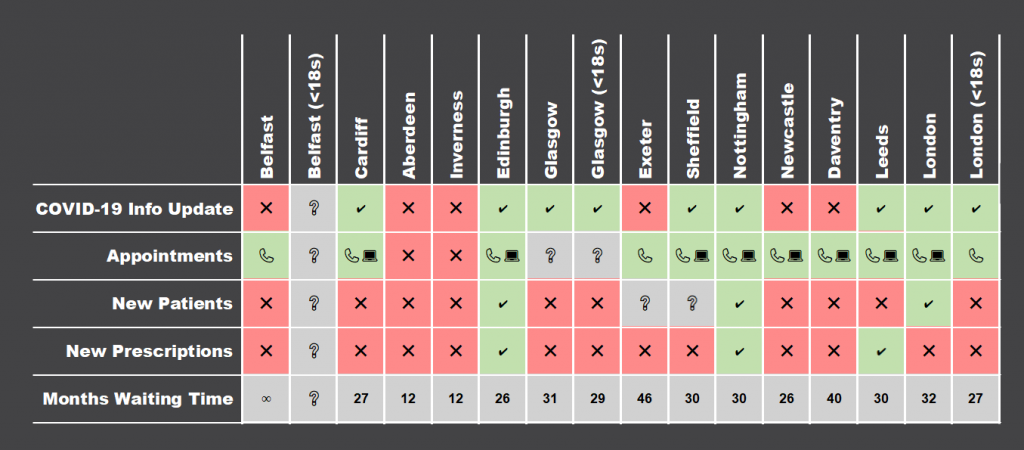
    Trans Health UK has posted an update on the few services gender clinics are currently providing. It’s summarised in this image:

    Look at that bottom row: that’s the current waiting time for a first appointment. Not a prescription or a referral to anything; just a first assessment. The trend was obvious long before COVID-19 came along: trans healthcare is in crisis.

    In Exeter the wait is currently four years; in Belfast the waiting list has grown so long it isn’t accepting any new patients.

    This is the reality of supposed “fast-tracking”, of people being “rushed” through the system. It’s years of waiting for a first appointment, then waiting list after waiting list for any kind of treatment.

    Here’s an example from my own experience. This was when the waiting times for my local gender clinic were 1/3 what they are now.

    Waiting time for initial assessment: 11 months
    Waiting time for second assessment: 4 months
    Waiting time for assessment for counselling: 2 months
    Waiting time for first counselling session: 10 months

    That’s three years for a first counselling appointment – and that first waiting period of 11 months is now 31 months, so God knows how long trans people have to wait for counselling now. I’ve been told that the waiting times for surgery are currently measured not in months but in millennia.

    In a better world this would be a scandal. But in this one, people actively campaign to make trans people’s healthcare even harder to access.

  • Facebook is spreading hate

    Last year, Ofcom found that 49% of the UK population used social media to access news reporting; the Pew Research Center reported a similar figure, 55%, in the US.

    Much of the news people see and share on social media is highly partisan, and it’s often highly inaccurate too. Right-wing bullshit factories have come to dominate the online news sphere.

    A new study by Media Matters shows how that affects people’s knowledge and understanding of trans people.

    NBC News:

    Anti-transgender Facebook content shared by right-wing news sources generated more engagement than content from pro-transgender or neutral sources combined…

    “Facebook users are getting a totally biased and factually inaccurate understanding of the multitude of issues that impact trans people”.

    Sigh.

    Of the top ten sources of trans-related news, seven were avowedly anti-trans; of the 66 million shares, 43 million were of content from anti-trans websites such as the Daily Caller.

    This is an American study but the phenomenon is global: the vast majority of trans-related articles and opinion pieces I see shared by British people on social media, particularly Facebook, are from right-wing publications based either in the US or the UK.

    Gizmodo:

    we know from a 2019 Pew Research poll that Facebook has a nearly even split—35% and 34% respectively—between users that consider themselves some sort of liberal or some sort of conservative. But we know from other research that those with a conservative bent are more far likely to share (and fall for) news articles that reinforce their preexisting point-of-view, even if they’re sensationalistic or downright debunkable. 

    …because a good half of Americans get at least some of their news on Facebook, that means that the bulk of people are reading stories about the transgender community that, again, paints them as icky leches on society, instead of just normal people living their normal lives.

  • “There is no safe or survivor-centred way to police anatomy”

    Over the last couple of weeks, anti-trans activists have been targeting and bullying the women who work in various rape crisis centres. The Survivors’ Network, the rape crisis centre for Sussex, is having none of it.

    predatory men are already able to enact their abuse with few repercussions, including entering changing rooms and public toilets – they do not need to pretend to be part of a marginalised community to break the law and to violate women, and suggesting that they would do so is entirely unsubstantiated.

    There is no safe or survivor-centred way to police the anatomy of someone accessing a service or using a bathroom/changing room. This will impact on gender non-conforming cisgender people, particularly cisgender women, as well as transgender people. Policing gender expression and defining someone’s womanhood by her conformity to state-sponsored specifications is an archaic practice that should not be considered in 2020 and is certainly not a feminist principle or one that will protect vulnerable women.

  • Blasts from the past

    I’m currently reading Transgender History by Susan Stryker, and one of the saddening things about it is how little the arguments of anti-trans people have changed – not least the tendency to accuse us of believing things we don’t believe.

    This is doing the rounds on Twitter at the moment.

    If a vagina doesn’t make you a woman, how come lipstick, high heels and a handbag do?

    Nobody’s claiming having heels or a handbag makes you a woman. Nobody. It’s a straw man, a made-up claim designed to reinforce the idea that trans women are unserious people who are merely playing dress-up, and anti-trans activists have been using it for over 40 years now.

    “Man” and “woman” are genders, not sexes, and while they generally correspond to people’s observable birth sex that is not always the case. We’re much more complex than that.

    Many cultures understand this and have long classified people into not just two genders, but many; they understand that the genitals you are born with do not necessarily dictate the gender you are or the way you will live your life.

    One of the reasons we conflate sex and gender is because for many people they match. But they don’t always, and it’s often gender – how closely you conform to stereotypical ideas of what men and women should look like and behave like – that is used to classify you.

    I’ve written about this before, because I find it bleakly funny: when I began presenting as me full-time the change was dramatic. Literally overnight I went from being a valued member of one project team to a person whose opinions were only worthwhile when repeated by one of the men; from being someone who could read a book in a bar without interruptions to someone who couldn’t; from being respected as an expert to being dismissed as a “silly little girl”. My genitals didn’t change, but people’s perception of my gender did.

    And part of that perception is based on the presence or absence of lipstick, heels and handbags. It’s not that those things make me a woman; of course they don’t, any more than sitting without makeup in a t-shirt covered in bits of fried egg makes me any less of one. It’s that they make other people less likely to be difficult.

    The closer I conform to stereotypical gender presentation, the less shit I have to deal with – so while my presentation doesn’t change my gender identity, it does change how some other people treat me.

    Here’s an example. The other morning I went to my own bank to pay my own money into my own bank account. I was dressed like I normally am: skinny jeans, animal print tunic, a bit of makeup and a bit of jewellery. And normally I’m greeted without incident or misgendering. But this time out I was wearing a mask that hid most of my immaculately made-up face, and when the teller heard my voice and compared it to what was on her screen – a female pronoun, a female name – she asked me: “are you sure this is your account, sir?”

    Most of the time I present stereotypically female because it makes life easier: I’d rather not be treated with suspicion when I’m paying money into my own bank account.

    Biological sex is what you begin with, but gender is the space in the culture that you inhabit – and the former does not necessarily dictate the latter. You can be born with a vagina and be a man; you can be born without one and be a woman; and you can be born with any configuration and be non-binary. Other cultures have known this for millennia. It’s just taken us a bit longer to catch up.

  • Tories prepare to harm trans kids

    The UK Government has produced a very long briefing document on the Gender Recognition Act, the Equality Act, official guidance and the debates around gender recognition. The document was published two days ago, on the 15th of July. It seemed to give undue prominence to the views of anti-trans groups but it did accurately report the current legal protection for trans people, including children.

    24 hours later, significant sections were removed.

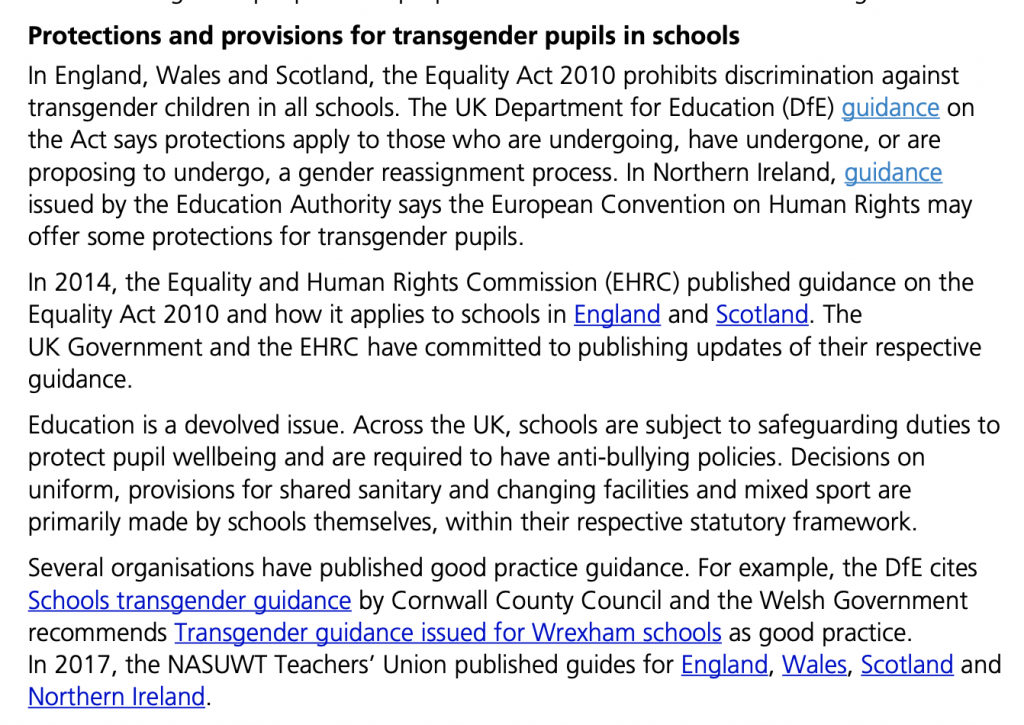
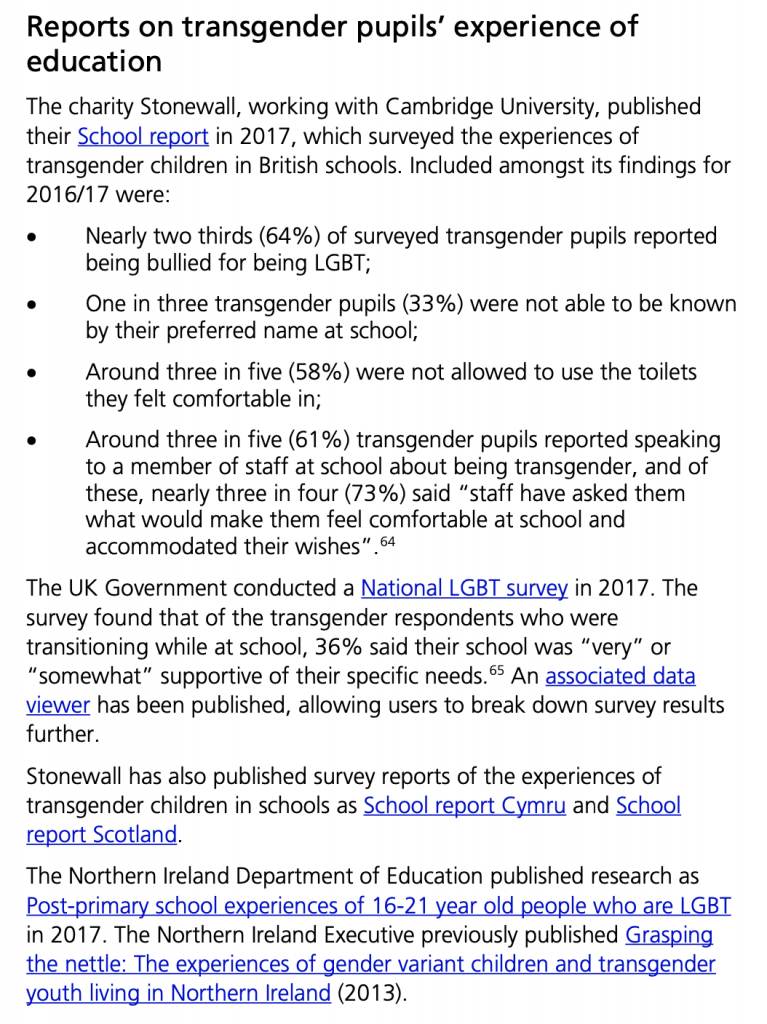
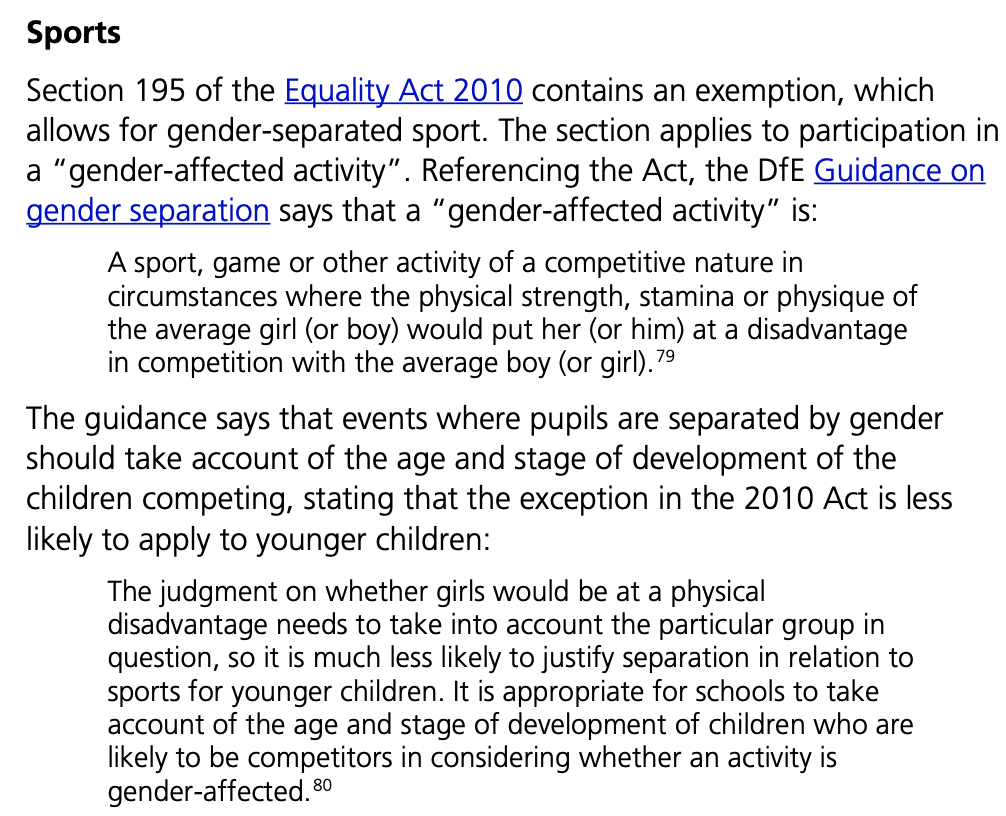
    The document was quietly replaced with an updated version with significant sections removed. Almost all of the content about trans kids, the law and their rights has been taken out. At the time of writing you can see for yourself here.

    Here’s an example, from page 4 of the first version. This entire section has been removed.

    Six pages have simply gone, including almost all of the content relating to schoolchildren: the explanation of how the Equality Act applies to children and to schools, the details of trans kids’ experiences of bullying and discrimination at schools, the explanation of official guidance for schools, the details about access to sports, the details of policies of devolved governments… all disappeared.

    This is gone:

    And so is this:

    It’s hard to see any other explanation other than this: Liz Truss knows she can’t change the Equality Act to allow overt discrimination against trans children. So instead, she’s going to change the official government guidance to achieve the same result.

    I don’t have words to describe my disgust.

    Update: The House of Commons Library says the missing sections are being updated and that yet another version of the document will be published “early next week”. It is not clear why entire sections on sports and on bullying had to be removed in order to clarify one item and add a reference to an ongoing legal case, which are the only changes the HOCL says will be made; in the meantime MPs are not being given very relevant information in a document they do not know is incomplete.

    Liz Truss’s statement on gender recognition reform, which this document is supposed to brief MPs on the background to, is scheduled for Wednesday. 

  • Discomfort

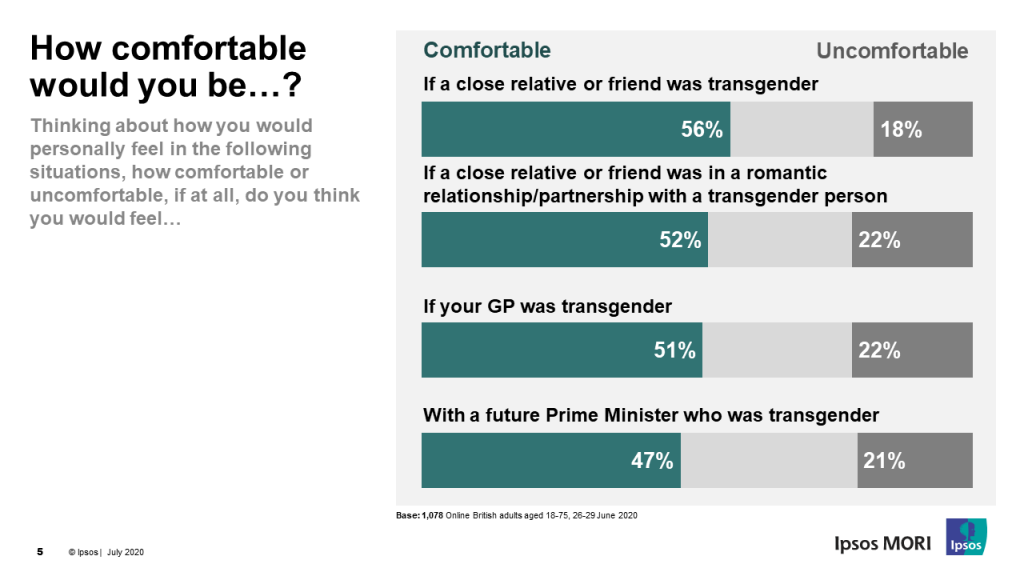
    A new study by Ipsos MORI reports that 7 in 10 Britons believe trans people face discrimination, that only 1 in 10 believe trans rights “have gone too far”, and that 6 in 10 women agree that gender and biological sex are not always linked. Given the tone and volume of anti-trans coverage in recent years that’s somewhat encouraging.

    I wrote the other day about the “yuk factor”. The poll provides some evidence that it exists.

    And as with all of these surveys, there’s a demographic gap. The older you are and the more right-wing you are, the more anti-trans you’re likely to be. That demographic, of course, is also the demographic that buys the papers and reads the websites that churn out constant anti-trans scaremongering. Funny, that.

  • Paperwork

    This arrived yesterday.

    Including obtaining medical reports, the process of getting my Gender Recognition Certificate took ten months and cost nearly £300.

    I have mixed feelings. That’s partly because I felt I had to get the certificate: the messages coming from the UK government make me worried that it may remove some anti-discrimination protections from trans people who don’t have GRCs. So in that respect it feels like I’ve been forced to apply: “Nice human rights you’ve got there. Shame if anything were to happen to them.”

    I also feel somewhat resentful, because the process is horrible, drawn out and stressful. One of my crucial medical reports – a very simple form – took three months to arrive, delaying my application, because the clinician said he was too busy to do it; some unclear language in a doctor’s hastily scribbled notes meant I had to provide a written statement about some extremely personal and upsetting things I didn’t want to think about, let alone go into detail about in a document that would be read by multiple strangers. And throughout the process I was aware that if my application was rejected there’s no right to appeal; I’d have to wait six months before having to start the whole process again.

    Ultimately, it’s a lot of money and effort for something that won’t affect my daily life at all, let alone yours. It means I can now legally become another woman’s wife rather than her husband, it means HMRC won’t misgender me, and that’s about it. Misinformed and malevolent people have spent more than two years scaremongering about what’s ultimately a largely inconsequential piece of paper.

    And yet, and yet.

    My GRC still means something to me. It means something in the same way that my formal diagnosis of gender dysphoria meant something. The Gender Recognition Panel is a branch of the HM Courts & Tribunal Service. Its president is a judge. My application was assessed by a judicial panel consisting solely of legal and medical professionals, and I can promise you that they are very, very thorough and very, very serious.

    Hence my mixed feelings. It’s a horrible process to go through and it’s been a weight on my mind for a long time. But I can’t help feeling that it’s also a form of validation.