Twenty-eight U.S. Christian right groups have spent millions of dollars pursuing conservative agendas that threaten LGBTQ and women’s rights in Europe, a new investigation by British news website openDemocracy found Tuesday.
Category: LGBTQ+
-
They’re here
-
Representation
Stephen Paton writes in The National about the abuse currently being thrown online at Mridul Wadhwa, who is a potential SNP candidate. You’d think that Wadhwa would be exactly the kind of person a supposedly progressive, forward-thinking country would want: she’s an advocate for Black and minority ethnic voices and has spent fifteen years working to tackle violence against women.
Nope. Because Wadhwa is trans, she’s being demonised as a danger to women. That’s where we are now: someone who actively works to help vulnerable and abused women, the manager of a rape crisis centre, is being abused by the “protect women” crowd.
With no recourse to revert to arguments about safeguarding or any other progressive cover, anti-trans activists within the SNP have been forced to reveal the crux of their position which is, simply, they do not want a trans woman to be recognised as a woman.
The fundamental belief at the core of anti-trans activism is that trans people are deceivers who should be “morally mandated out of existence”. That means making it impossible for trans people to exist in society at all: no healthcare, no safe spaces, no legal recognition, no protection from abuse or discrimination. And definitely no political representation.
-
One potato
Because I live in the central belt of scotland, I’m not going out anywhere right now. The pubs and venues are all closed, so there are no gigs to go to, no open mics to play, no comedy shows to cackle at. I can’t meet my friends in restaurants and I can’t cook for them at home. With a couple of exceptions there are no online things either. All my communication with my friends is via texts or instant messaging and the only people I spend any time with in real life are my children.
One of the results of that is that I don’t pay much attention to what I wear right now. Nobody’s going to shove themselves into underwired bras or clacky heels unless they absolutely have to, and I absolutely don’t have to. If I’m not going out, there’s no reason to bother with make-up or fun clothes; if I didn’t have to go to the shops or pick up the kids I’d probably stay in my dressing gown all day. My AW2020 signature look is “Carrie puts the bins out.â€
It’s surprisingly demoralising. I feel like a human potato, or something else similarly ungendered. A disembodied head in a jar, perhaps, or a balloon with a face on it. Something that doesn’t exist in the world but independently of it.
I feel ungendered because gender is partly a performance, a feedback loop where you perform a particular role – such as “man†or “woman†– and people respond to you accordingly, both positively and negatively. So in non-COVID times I inhabit the world as a woman and spend time with people who recognise me as and respond to me as a woman. That’s an important corrective to the ongoing demonisation of people like me, which happens daily in the press and constantly online. In myriad ways it shows you that the narrative in your own head, that the world is a hateful and dangerous place for people like you, is not true.
For most of this year, that corrective has been taken away. The press haven’t stopped and the social media bullies continue to abuse trans people and anyone who supports trans people. If anything, covid has made them worse: they have more time to spend online, and they have become bolder and less concerned about maintaining a veneer of respectability. And the real-life interactions that give the lie to their scaremongering are not happening.
That’s not all. LGBT+ groups have all had to move online, as have the life-affirming Pride events. Healthcare has been reduced to the occasional phone call; no monitoring, no referrals. Safe spaces are shuttered.
I’ve written before that this is a hard road to walk. It’s harder still when you can’t walk it at all.
-
Nouns and pronouns
One of the minor weird things about having a different name and pronouns to the ones you were assigned at birth is that they sometimes feel like an odd fit with other aspects of who you are. For example, I mentioned being my son’s dad in my last post; on the radio the other day I laughed as I recounted my daughter saying affectionately but exasperatedly, “Dad! Why are you like this?” after one dad joke too many. To some eyes and ears, I know, the juxtaposition of “dad” and “woman” is weird. I know because sometimes it feels jarring to me too. But just because I’m not a man doesn’t mean I’m not a dad. A dad’s pronouns don’t have to be he and him.
Kids get this, so for example I recently overheard my daughter telling a friend “oh, that’s just my dad, she’s playing a video game”. Â But many adults apparently don’t, or perhaps more accurately won’t.
It was international pronouns day yesterday, a day that could just as easily be entitled “come on, don’t be a dick to people day”, and I saw lots of people claiming that in much the same way trans women apparently don’t have pelvises, they don’t have pronouns. She/her, he/him, they/them weren’t for them. They didn’t need such silliness. They are too sensible for such political correctness and they don’t have any time for people who cared about such things.
I bolded their pronouns to help them out. I’ll stop now.
Everybody has pronouns. Without them, speech and writing would be awfully cumbersome: we’d have to say things like “Uncle David called to say that Uncle David wasn’t going to be around this weekend. Uncle David is off to do a thing and Uncle David won’t be back until Monday. I’m not sure where Uncle David is going. I forgot to ask Uncle David.”
If you don’t think you have any pronouns, chances are it’s because people don’t habitually get yours wrong. The kind of guy who goes on the internet to damn people who include pronouns in Twitter bios would probably lose his shit pretty quickly if people started routinely addressing him or describing him as she, her, madam or miss.
I mean, you would, wouldn’t you? Imagine going through life being misgendered every single day: in shops, on the phone, at social things, at work…
Yes, I am making a face right now.
The same people who would be the first to lose their shit if people started using the wrong pronouns for them – in many cases, people who lose their shit if anybody misgenders their pets – expect others to put up with it, even when it’s actually malicious. Why should they have to treat anybody else with the same respect they demand for their dog? They’ll call people whatever pronouns they damn well like!
Once again we’re in “It doesn’t happen to me personally so nothing should change” territory with a side order of “but mummy! I don’t want to be nice to other people!” It takes virtually no effort to be a little more considerate of others, but sadly for some that’s still too much to ask.
-
Rainbows
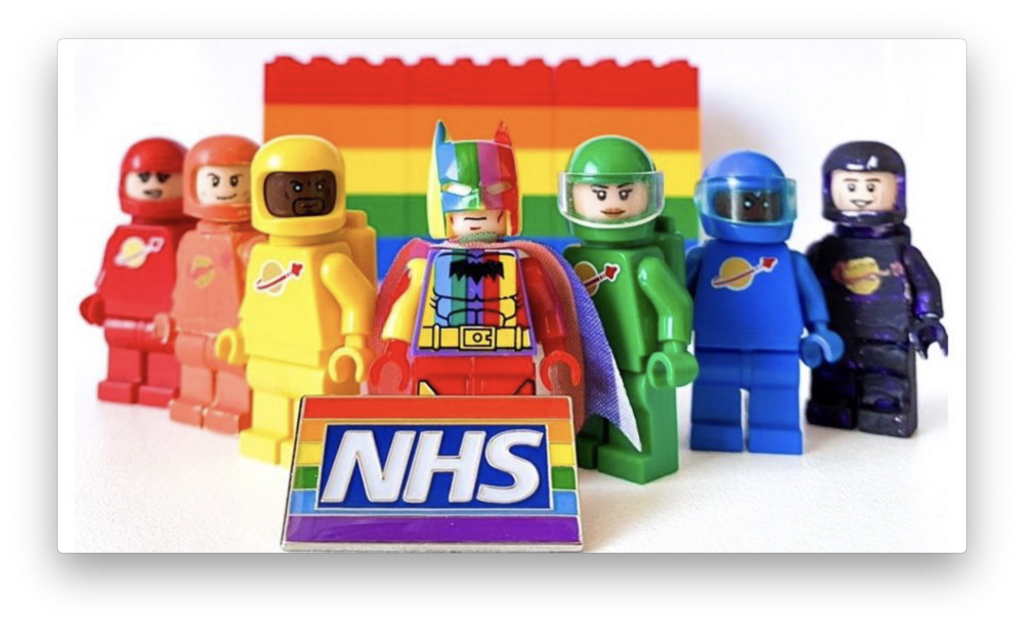
The COVID-related adoption of the rainbow flag to mean “I like the NHS” has caused dismay for many LGBT+ people. It’s not because they’re snowflakes. It’s because some of the flags, badges and other merchandise have appropriated two things: the Pride flag, and the logo of a very specific NHS initiative that’s been running for several years.
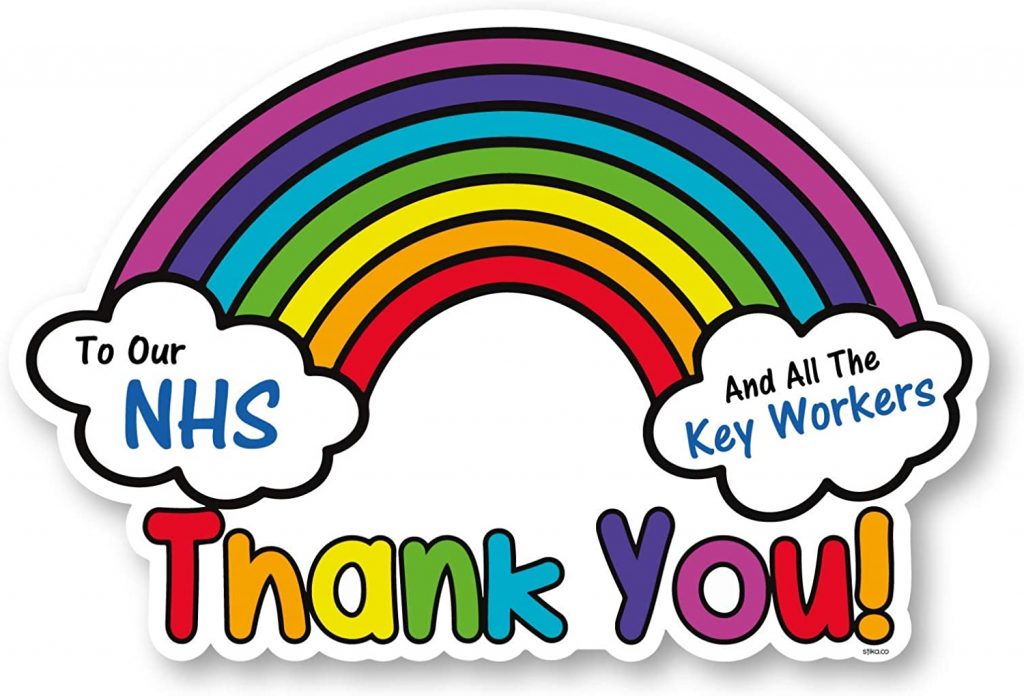
The original NHS rainbow was, well, a rainbow: seven colours in a semi-circle with clouds at either end. Here’s one.
But we’re seeing more and more of this. This is a “Thank You NHS Hero” flag from Amazon:
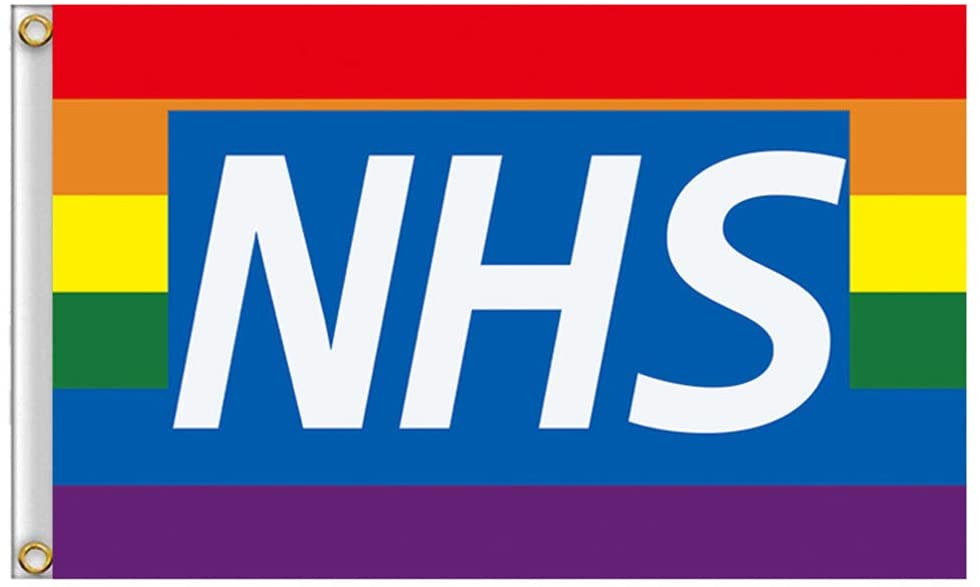
As you can see, it bears a strong resemblance to the Rainbow NHS Badge, shown below.
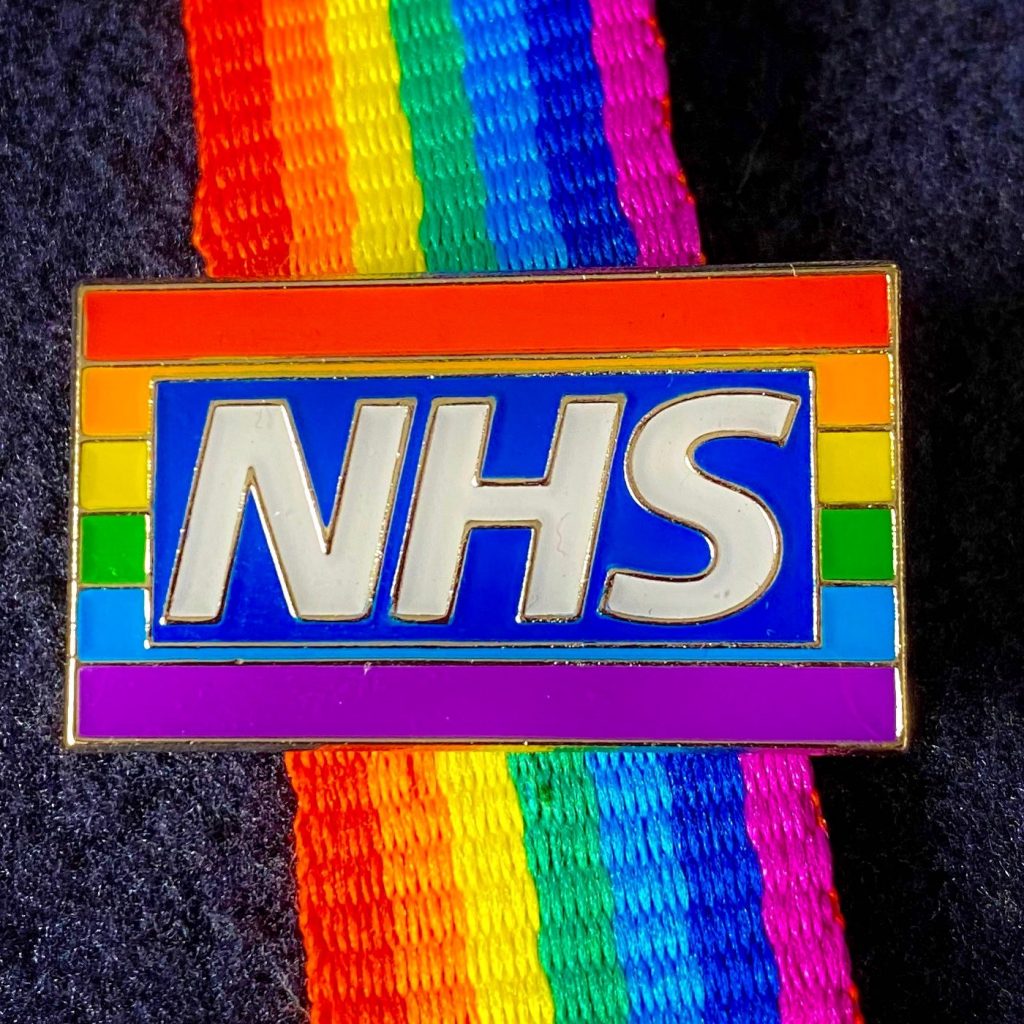
The former is cheap Amazon tat. The latter is the logo of a specific initiative to improve access to healthcare.
The Rainbow NHS Badge programme was created because many LGBT+ people have experienced appalling treatment from healthcare workers. Those experiences, and hearing about those experiences, can make LGBT+ people very wary of accessing NHS services. That reluctance can cost lives.
To try to address this, the Rainbow NHS badge project was created in late 2017. The aim was to create “a strong visual symbol to say to LGBT+ people accessing NHS healthcare, ‘I am a good person to talk to about LGBT+ issues and I will do my best to help you if I need it.’” The badge combined two instantly recognisable images: the NHS logo and the Pride flag.
There’s a potted history of the whole programme here.
It’s not just a badge. It’s also a commitment to equal healthcare and equal treatment, something LGBT+ people cannot take for granted. Prior to COVID, the badges were in use in 223 NHS trusts in England with more to follow and it was also rolling out to GP practices and other organisations.
Rainbows are important to LGBT+ people. They indicate safe spaces in a world that’s often very unsafe; in the NHS, they indicate that somebody is safe to talk to. The horizontal Pride flag is recognised globally as a symbol of LGBT+ people and LGBT+ inclusion.
Now, though, we’re being told that any and all rainbow flags – including the Pride flag – mean the NHS. They don’t.
Here’s The Portal Bookshop:
I appreciate the rainbow arguments seem silly to anyone on the outside but let me put it this way.
For years, if you saw the rainbow flag up somewhere, queer people knew they would be safe there.
Now? Is it safe? Or does that person support the NHS – and want to send you to it?
The Pride flag is not a rainbow, but it’s beginning to be used by people who don’t know the difference. So the use of the six-colour pride flag in NHS-related branding and merchandise – and clothes shops and supermarkets have been particularly bad for this, cynically rejigging their Pride ranges to make them about the NHS instead – is taking a very specific symbol and ignoring its meaning. As The Portal bookshop put it on Twitter, it’s having “a symbol of safety and unity snatched out from under us in six months flat.”
If there’s a silver lining to this cloud, it’s that it’s driving adoption of a newer, alternative Pride flag called the Progressive Pride flag. It was designed by Daniel Quasar in 2018 and adds more colours to represent people of different colours and genders.
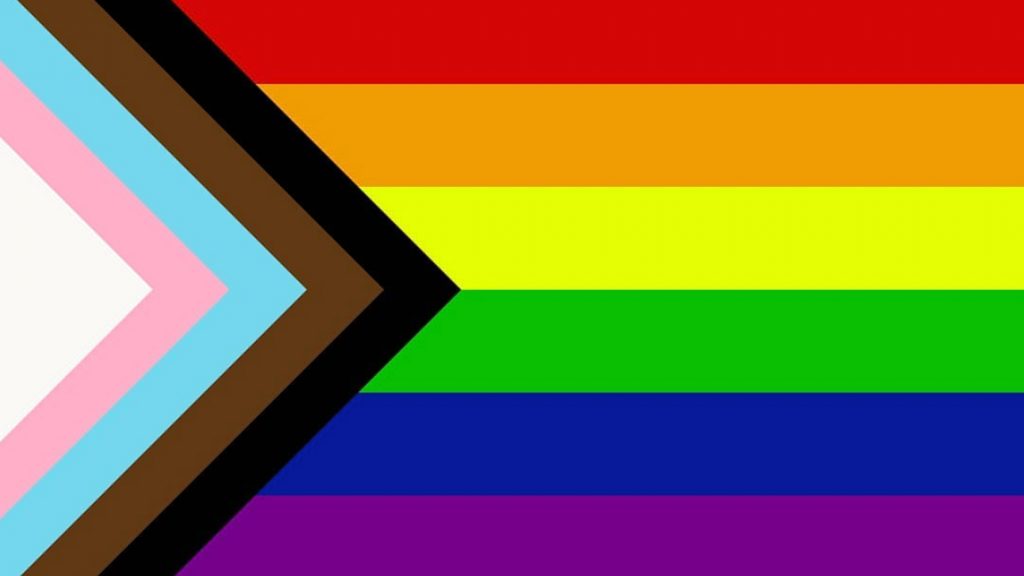
As Tom Haynes wrote on TheTab.com:
I’m certainly not trying to tell you LGBT+ people own the very concept of rainbows… but the way brands and the Tories have taken the rainbow and ran with it is uncomfortable to watch. Looking at summer streets full of boomers dangling actual Pride flags with NHS written on them, it’s hard not to to think: yeah this is a form of erasure. There’s a nuance here that most people are missing.
-
Why trans people go private
There’s a good piece by GenderGP head of patient services Adi Ni Dhálaigh Gourdialsing in PinkNews about trans people accessing private healthcare.
In 2016, the Women and Equalities Commission bravely and unreservedly found that: “The NHS is failing in its legal duty under the Equality Act in this regard. There is a lack of continuing professional development (CPD) and training in this area amongst GPs. There is also a lack of clarity about referral pathways for Gender Identity Services. And the NHS as an employer and commissioner is failing to ensure zero tolerance of transphobic behaviour amongst staff and contractors.â€
Fast forward to 2020 and little has changed. We still have: No NICE guidelines on the medical interventions available for gender incongruence; no standards of medical education set for this area of healthcare by the General Medical Council; no continuing professional development (this is the responsibility of the Royal Colleges and Postgraduate Deaneries); no agreed standards of care for NHS trusts and clinical commissioning groups; no UK-wide medical guidelines; and healthcare that is provided in super-specialised clinics, which are supposed to cater for just 500 patient cases per year.
I’ve been involved in a few consultations about trans healthcare recently and absolutely none of the issues being raised in the consultations are new. Trans people go private or self-medicate because in many parts of the UK the NHS tells them to wait nearly six years before they can discuss getting any kind of treatment.
-
Intended consequences
The anti-trans mob and their evangelical Christian pals are behind a judicial review that could have chilling effects on young women’s access to contraception. That’s not a potential unintended consequence. It’s the whole point.
Stonewall’s Nancy Kelley, writing in the i Paper:
If [we] chip away at the idea that children and young people are not fit to know what’s best for them, we open the door towards eroding Gillick Competency. ‘Gillick’ was a case in 1985 which established that young people under the age of 16 can consent to their own medical treatment, without the need for parental knowledge or permission.
Gillick is a cornerstone of children and young people’s rights and helps ensure young people can access the healthcare service they may need, including abortion, contraception or sexual health services.
So, this case isn’t just about healthcare for trans young people, it’s about a much wider issue: whether we believe children and young people have a right to treat their bodies as their own.
The lawyers representing the people bringing the case say it would push Gillick to ‘breaking point‘. This would give a green light to those who want to use this an opportunity to roll back the healthcare rights of not just LGBT young people, but all young people.
Getting rid of Gillick is a key goal of the religious right, who do not want any teenagers to have access to contraception or sexual health services. The anti-trans women hoping the verdict goes against the NHS are either willing accomplices or deeply, deeply stupid.
-
This is what cancelling looks like
This week, the BBC and The Times both went after the private GP service GenderGP, an ongoing target of the anti-trans mob.
I’ve written about GenderGP before: it’s a practice that enables trans people to access healthcare privately when the NHS expects them to wait for many years for an initial assessment. I’m a former patient, so I can attest that while it isn’t perfect it is also serious and professional in its prescribing. It certainly isn’t handing out HRT like sweeties.
The reporting was full of innuendo but didn’t find anything significant to report. Despite this, the UK’s pharmacy regulator has responded to the bad publicity and removed GenderGP’s ability to prescribe HRT to trans people with immediate effect.
Overnight, thousands of trans adults have had their private healthcare stopped – not because GenderGP has been proven to have done anything wrong, but because two of the most powerful media outlets in the country have targeted it.
The anti-trans mob, of course, are rejoicing about this. Removing life-saving trans healthcare from thousands of adults, as far as they’re concerned, is something to celebrate.
Trans people will continue to need medicine. By shutting down safe, legal services, all that’s going to happen is that trans people will turn to possibly unsafe services instead. If you’re one of the people affected, there’s a good thread of (safe) options here.
Once again this gives the lie to the idea that any of this is about ‘reasonable concerns’ or ‘protecting women’. These people want us dead.
-
Faith in the system
Stop me if you’ve heard this before. A bigot does bigoted things that reflect badly on their employer, they get the boot, and the Christian Legal Centre tries to make them a free speech hero. Said centre is then handed its arse on a plate by a tribunal judge who points out the bleeding obvious: you can believe what you like, but you can’t behave how you like.
This week’s case features Karen Higgs, who worked at her son’s Church of England primary school as a pastoral assistant and who was sacked for railing against the same school’s relationship lessons very vocally online. “THEY ARE BRAINWASHING OUR CHILDREN!” You know the kind of thing.
The reason you can’t do this kind of thing is because it brings your employer into disrepute.
Every employment contract I’ve ever signed had one of those clauses. It’s a standard bit of boilerplate that means  that you can’t go around bad-mouthing your employer and expect to stay employed. For example, if you work for a restaurant and tell loads of people on Facebook that the food is shite and you hate the customers, you shouldn’t clear your diary for the next staff Christmas party.Â
The Church of England makes it very clear that its schools value “All God’s Children”, not just the straight cisgender ones with straight cisgender parents, and it has a very clear policy on anti-LGBT+ bullying and how staff in primary schools should discuss issues such as same-sex parenting and trans parents.
In particular it says that primary schools should “promote a strong anti-bullying stance that shows that HBT [homophobic, biphobic and transphobic] remarks and behaviour are unacceptable.” Posting homophobic and transphobic things online is of course in direct conflict with that.
In her defence, Higgs claimed that it was okay to rail against same-sex marriages because while “I am aware that same-sex marriages are now recognised under UK law… I believe that is contrary to God’s law”. But while they may be bound by God’s law in their head, they’re bound by UK law at work.
As school governor Stephen Conlan told the tribunal: “You can post your beliefs without posting this sort of language and it is perfectly possible to communicate your beliefs without using such strong language.”
I feel sorry for the people of faith who these clowns claim to represent. The people demanding “religious freedom” to defame and demonise others don’t represent anybody but themselves. They’re not devout. They’re just dicks.
-
Political differences

Petra De Sutter The photo above is of Petra De Sutter, the newly appointed Deputy Prime Minister of Belgium. She’s also Minister for Public Enterprises. Oh, and she’s transgender.
As the Brussels Time notes, that bit “went almost unremarked upon by Belgian media… [other than] when remarking on the diverse make up of the new government – which consists of 50% women, includes several ministers with a migration background, and is relatively young.”
Meanwhile in Scotland:
The First Minister stepped in to defend one Holyrood hopeful – Rhiannon Spear – after she was targeted with horrified misogynistic abuse from trolls having previously defended transgender rights.
I’ve written about Spear before; she’s a dedicated and impressive young politician who’s been the subject of an ongoing hate campaign simply because she believes in human rights for trans people. And she is not alone. In the UK, women who defend trans rights are subjected to sustained, vicious, misogynistic abuse that’s much more serious than a celebrity being called a bigot on Twitter; any trans person considering political office will receive even worse. So it’s hardly surprising that while Belgium has a trans Deputy Prime Minister, the UK has no openly trans MPs, MSPs or MEPs at all.
De Sutter:
I am proud that in 🇧🇪 and in most of 🇪🇺 your gender identity does not define you as a person and is a non-issue. I hope that my appointment as Minister and deputy PM can trigger the debate in countries where this is not yet the case. #fighttransphobia