Category: LGBTQ+

  • Awareness of hypocrisy

    It’s trans awareness week, and that means we get to see more pridewashing: as with other awareness weeks it’s an opportunity for corporations that don’t give a shit about group X to pretend they give a shit about group X.

    Here’s Twitter.

    TRANS RIGHTS ARE HUMAN RIGHTS

    TRANS RIGHTS ARE HUMAN RIGHTS

    TRANS RIGHTS ARE HUMAN RIGHTS

    TRANS RIGHTS ARE HUMAN RIGHTS

    TRANS RIGHTS ARE HUMAN RIGHTS

    #TransAwarenessWeek

    That the responses to this tweet included very many transphobic ones illustrates the point: this is a network that doesn’t do anything about protracted and/or co-ordinated abuse of trans people and accounts set up specifically to attack trans women but which immediately bans trans people who tell their tormenters to fuck off; a network that often takes years to act against repeated violations of its anti-abuse policy by accounts with large audiences; a network that for many trans people is unusable without blocking hundreds or even thousands of accounts; a network where reporting even the most blatant examples of hate speech is largely pointless.

    You can’t wrap yourself in the trans pride flag when you have policies to protect minority and marginalised groups that you simply don’t enforce.

    As one person pointed out in the comments to Twitter’s post:

    You’re not even taking action against the transphobes in the replies here.

  • Irredeemable bullshit

    Dianna Anderson reviews Irreversible Damage: The Transgender Craze Seducing Our Daughters. The book is at the centre of yet another trumped-up free speech row because US retailer Target chose not to stock it and Amazon chose not to take adverts for it. Some trans people are unhappy that it’s number one in the Amazon transgender studies chart, because while it’s many things it certainly isn’t a study. It’s part of a moral panic.

    Anderson:

    Irreversible Damage is the Michelle Remembers of 2020. It is clearly designed to speak to parents of teenagers who have come out as trans, particularly to parents of children assigned female at birth. These teenagers, Shrier argues, are coping with their ongoing pain of being assigned female, of going through puberty, by deciding it would be easier to escape womanhood altogether and become a man. In true moral panic fashion, Shrier blames iPhones for isolation that causes teens to doubt themselves, Youtube stars for making transition seem like The Answer to everything, the Medical Establishment for making it far too easy for kids to access gender affirming treatments, and school districts for teaching “gender ideology” to kindergartners. This book has it ALL.

    The one thing it does not have, however, is the voices of the young teens in question.

    This is a “study” of teenagers that doesn’t study any teenagers, a book about trans people that doesn’t believe trans people are real.

    Like the completely invented pseudoscience of “Rapid Onset Gender Dysphoria” it’s based on interviews with parents; the book has very little understanding of or insight about the actual teenagers it talks about because Shrier didn’t talk to most of them. According to this review it also grossly misrepresents the treatment available to teenagers, telling readers that twelve-year-olds are being given surgeries. They aren’t. And at core it pushes a very stereotypical view of women: “Far from giving us explorations of what womanhood can be, Shrier narrows it back down to the biological function of breastfeeding and having babies, excluding women who choose not to engage in such activities from the banner of true womanhood.”

    As Anderson points out, the book fails to support its central premise: that teenagers are being rushed by various sinister forces into making decisions they will regret.

    Shrier’s panic is simply an invented, elaborate narrative, unsupported by the actual facts, that trans identity is somehow contagious – just as gay people were discriminated against in the 1970s because apparently we were going to teach it to your children.

  • “It’s just scary to say forever”

    A thoughtful essay by Jude Ellison Sady Doyle on staying in a relationship through transition.

    Sometimes I wonder if it’s true — whether staying married is a sign of cowardice. Was I supposed to bust up my refuge just so I’d have battle scars? Do I need to have a second adolescence, sleep around, raise hell, to know who I am? Am I as real as I think, standing here in this bathroom, talking about male pattern baldness and being called “bud” and trading De Niro impressions because he just watched Heat, or does even he think of me as an eccentric straight girl? Does he love me, or is he humoring me?

    When do I get to stop asking these questions? Which coming-out, which medication, which surgery, which friendship, which sex act, which relationship, which instance of survived bigotry, will ever make me feel like enough?

  • “Go home, make a cup of tea and dress normally”

    Like many – and I suspect most – trans people I’ve experienced transphobic abuse, both online and in the real world. And like many trans people I didn’t report the real-world stuff to the police. I gave up on reporting online abuse to social networks years ago.

    A new survey by anti-violence charity GALOP suggests I’m not alone.

    Just one in seven trans people who experienced a transphobic attack – be it physical, verbal, sexual or online – reported it to the police.

    Seventy per cent said this was because they felt that the police could not help them. A third said they expected the police to be transphobic, while another third said they experienced too many transphobic incidents to be able to report them all.

    This simply shouldn’t happen in a civilised society:

    One trans person who did report a transphobic incident to the police said: “One officer said I left myself open to being abused because I ‘chose to be different’.

    “Misgendering throughout the interview then told that the physical assault, death threats and threats of further violence against me weren’t strong enough to do anything about and maybe I should ‘go home, make a cup of tea, and dress “normally”‘.”


  • “This is a tough gig”

    There’s an interesting story in The Guardian about a trans woman who’s had facial feminisation surgery. I’m glad it’s been positive for her, but I’m also glad that the piece also interviews Juno Roche about the reality for trans women like me.

    Facial feminisation has allowed for the creation of “a kind of two-tier system where, on the whole, the most successful trans people are beautiful people that pass,” Roche continued. “People who are proud to be trans, and those people who can’t afford the surgery, fall into a separate category. That’s most people. And we have to create safety for everyone. It impacts on so many people, not just trans people.”

    Roche understands the appeal of facial surgery for so many trans women. “If somebody wants to have an easy life, then boy, trans people deserve an easy life. This is a tough gig. But the truth is, if testosterone has shaped your face, it will have shaped your shoulders, your shoulder-to-hip ratio. It will have shaped your hands. Where does it stop?”

    That’s exactly how I feel about it. If I had the money, and after dropping well over £10,000 on electrolysis and losing all my savings to COVID I certainly don’t, I don’t think I’d consider FFS. I consider electrolysis essential for me, because facial hair is the pumpkin in my particular Cinderella story: it limits where I can go and for how long I can go there. Hormones have made some worthwhile changes to my body. I haven’t ruled out other things. But I’m pretty sure that unless I win six figures on the lottery, FFS isn’t in my future.

    I absolutely understand the desire for FFS. I’ve seen enough mockery of trans women’s appearances and experienced some of it myself to know that the people who claim to be “gender critical” are quite happy to judge trans women’s looks against the very same beauty standards they so deplore when applied to cisgender women. And the rest of the world judges us too.

    A trans woman who is not conventionally beautiful (in a white, thin, cisgender, stereotypically feminine sense) will be reminded of this constantly through her life. FFS can make that much less likely to happen, and like cosmetic surgery generally it may make you more visually attractive to other people – something you’re going to think about if you’re single and fed up with people swiping left on you in dating apps.

    But even if I could afford it, if I had the budget for the tracheal shave and the hair transplant and the brow reduction and the jaw reshaping,  I would still have these shoulders, this height, these proportions, this voice. And there would always, always be another thing to change.

    Sophia, the woman in the story, looks pretty. But she’s still unsatisfied.

    “On my face, I’m 75% there. I still have things I want to do on my body.” She nodded. “I’m planning other surgeries.”

  • A slackening grip on reality

    There’s an interesting and disturbing long read by Alex Hern in The Guardian: The story of Facebook, QAnon and the world’s slackening grip on reality. It talks about how Facebook in particular encourages conspiracy theories.

    The social network has always prided itself on connecting people, and when the ability to socialise in person, or even leave the house, was curtailed, Facebook was there to pick up the slack.

    But those same services have also enabled the creation of what one professional factchecker calls a “perfect storm for misinformation”. And with real-life interaction suppressed to counter the spread of the virus, it’s easier than ever for people to fall deep down a rabbit hole of deception, where the endpoint may not simply be a decline in vaccination rates or the election of an unpleasant president, but the end of consensus reality as we know it. What happens when your basic understanding of the world is no longer the same as your neighbour’s?

    The focus on this piece is QAnon, but there are strong parallels with another largely social media-driven movement, anti-trans activism – so much so that I’ve seen a number of people describe such obsessive activism as “QAnon for middle-class women”. Like QAnon its adherents claims there is a sinister conspiracy to target children; like QAnon they are often anti-semitic, alleging that the sinister conspiracy is funded by Jewish people generally and George Soros specifically; like QAnon they believe that there is a secret cabal of people who control the media and politics; like QAnon they include celebrities talking shit to large audiences.

    “The industries that many celebrities work in – film, music, sport – were among the hardest hit by shutdowns. So even more than most of us, they suddenly found themselves with nothing to do but sit on Twitter,” Phillips says. “Not all of them did a Taylor Swift, spending the time recording an album. Some of them started sharing wild rumours to millions of followers instead.” This, then, is how we end up with Ian Brown, the former frontman of the Stone Roses, declaring that conspiracy theorist is “a term invented by the lame stream media to discredit those who can smell and see through the government/media lies and propaganda”.

    And like QAnon, it’s bullshit that can only be perpetuated by denying reality and surrounding yourself with fellow conspiracists.

    It’s not easy to overturn someone’s sense of reality, but even harder to restore it once it has been lost.

    What frightens me most about this – and there are lots of things that frighten me about it – is that we know these conspiracies lead to real-world acts.

  • Recognition

    President-elect Joe Biden specifically mentioned trans people in his acceptance speech the other evening. Trans people worldwide breathed a sigh of relief: while the US presidency is of course directly relevant to the American people, Trump’s embrace of anti-LGBT+ evangelists had, and has, worldwide effects.

    If you’re not trans, you might wonder why a mere mention got so many of us so emotional. Here’s writer Parker Molloy, posting on Twitter.

    There have been several times during this presidency that I woke up, looked at my phone, and felt my heart just sink through the floor because the president is a needlessly, intentionally cruel person.

    This was one of the days, back in 2017. https://www.cnn.com/2017/07/26/politics/trump-military-transgender/index.html [link goes to story about Trump’s ban on trans people serving in the military]

    It just came out of nowhere. And while I’ve never been in the military, never will be… it’s usually a bad sign when governments start singling out groups to ban from things like their militaries.

    His rationale didn’t make sense. The cost was minimal, there hadn’t been problems since the ban was lifted during the Obama era, etc.

    But the reason that hit me with such a sense of unease was that if you can convince people who go around talking about how much they love “the troops,” and convince them that some of those troops should be kicked out with a new policy based solely on who they are, you can CERTAINLY convince the public to accept government-sanctioned discrimination against those who aren’t in the military.

    It was a very “oh shit, he’s going to really start leaning into a series of policies aimed at hurting trans people.” And he did. Pretty consistently from there on out.

    And then it later came out that he just did it on a whim. There was no legitimate need, he just wanted to make the bigots in the House Freedom Caucus happy (their name is very ironic. “Freedom”) and didn’t want to go to a meeting.

    During his presidency, Trump didn’t just institute a ban on trans people in the military. His administration and his evangelical friends attempted to exclude trans people from human rights protections, attempted to permit employment discrimination against trans people, and decided to make it legal for doctors and emergency responders to refuse any healthcare to trans people. And as Molloy says, that’s just us. The last four years have been an unending assault on marginalised people of every kind.

    In that context, to hear the US President-to-be mention trans people without an insult and without an announcement of yet another threat to our human rights is cause for celebration. That’s how low the bar is for us right now.

    Molloy:

    I can’t say I’m sad to see the end of an era where I’m going to have to wonder if I’m going to wake up to the president tweeting out a deranged attack on people like me just for the fun of it.

  • Barefoot and pregnant

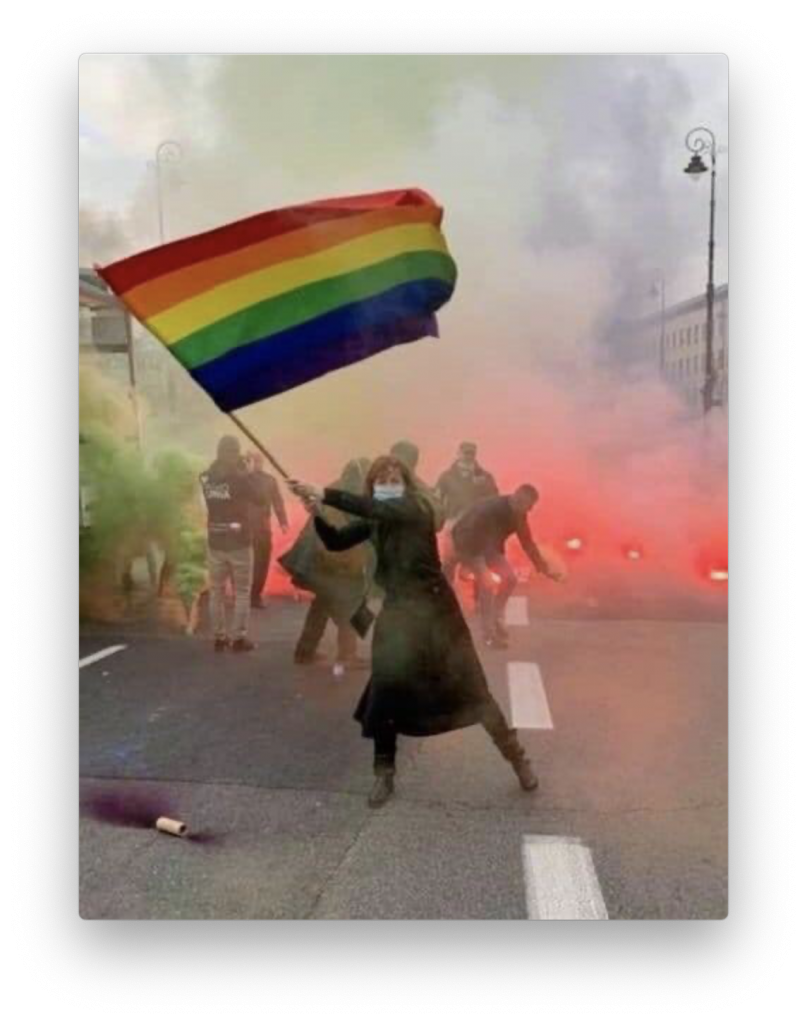
    This powerful photo is from Poland, where women and LGBT+ people are protesting truly awful anti-abortion legislation. The government was elected partly because of its anti-LGBT+, “family values” stance; as is always the case, “family values” also means restricting women’s rights in order to keep them barefoot and pregnant.

    Here’s another family values politician, the US Republican Senator Lindsey Graham, speaking this week.

    I want every young woman to know there’s a place for you in America if you are pro-life, if you embrace your religion, and you follow traditional family structure. That you can go anywhere, young lady.

    As in Poland, the family values here are of the barefoot and pregnant variety.

    Cas Mudde, writing in the New Statesman:

    Most far-right politicians take a traditional view of gender that sees women first and foremost as mothers, discouraging them from working outside of the household. The idea that women are “virgin-mothers” points to a kind of benevolent sexism where women are vulnerable and dependent upon (and deserving of) protection from strong men. Such politicians view gender ideology as a threat to the fundamentally different and “natural” roles that men and women play in society.

    Women’s reproductive and sexual freedom, gay/bi/pan women and trans women are at odds with that worldview.

    the global far right converges on one thing: they all denounce contemporary feminism and “gender ideology”, and see women, first and foremost, as the “womb of the nation”. Consequently, far-right men believe it is their right (and even duty) to control and police their women. After all, as the Hungarian Speaker of Parliament recently said, “individuals’ decisions on having children are public matters.”

  • Lockdown and mental health

    Like many people I’ve been struggling this year. Lockdown and COVID restrictions have been hellish for many people’s mental health.

    The promise of lockdown was that it was a necessary evil: we did it to save the NHS and to buy time to create an effective contact tracing system. That time was squandered, and England is about to go into lockdown again.

    This, by Owen Jones for The Guardian, is very good.

    This is purgatory, a barren parody of real life. We’re living in monochrome, an existence bedevilled by tedium, stripped of spontaneity, robbed of little joys but defined by ever greater stresses. This relentless assault on our wellbeing will only intensify: those left fearing for their imperilled jobs in a nation with a shredded safety net in place of a welfare state; the young being deprived of their best days; the old, denied the dignity and support they deserve in their later years; the millions who were already struggling with their mental health even before the old world collapsed; those imprisoned with domestic abusers, or LGBTQ people locked away with bigoted relatives.

    This is a conversation we need to have. As things stand, talk of the mental impact of the world’s greatest crisis for three quarters of a century has been monopolised by corona deniers and anti-lockdown agitators.

    Being sad and lonely is clearly lesser than being dead, or causing the deaths of other people. But nevertheless the damage to people’s mental health is much more important and will cause much more misery than the damage to corporations’ profits. To date the UK government has been much more concerned with the latter.

    the deprivation of our liberty was not supposed to be an endless cycle of outbreaks and national lockdowns; it was to prevent the NHS being overwhelmed so it could continue to function, to stop needless deaths and to buy time to establish a functioning test and trace system. Its failure means our mental wellbeing has been needlessly tossed on a bonfire – not because of partying youngsters but because of a government that relied on shambolic private contractors and sought to put the economy ahead of human life, with terrible consequences for both.

    I’ve written before that while our COVID death toll is already in the tens of thousands, others are in the low single digits: Vietnam, which has a long land border with and extensive travel to and from China, has had just 35 deaths. Vietnam took COVID seriously. Here, we bribed people to go to Wetherspoons.

  • Nobody checks anything

    Yesterday, multiple newspapers reported the return of Woolworths, a retail chain that no longer operates in the UK. The story was in the Metro.It was in the Daily Star. It was in the Mirror. It was in the Brighton Argus, and Birmingham Live, and the rest of the UK’s local press. It was everywhere.

    It was bullshit.

    Not a single journalist at any of those titles bothered their backside to check whether it was true before publishing. It wasn’t. The story was based on tweets from a fake account that couldn’t even spell the company name properly. That was enough for acres of coverage.

    This is how too much journalism works now. All you need is a Twitter account and a logo and nobody fact-checks what you’re saying or investigates who you actually are; if it’s going to get clicks, it’s going to get published. It’s harmless when we’re talking about pic’n’mix, but this is exactly how anti-LGBT+ groups and right-wing lobbyists get coverage too. Far too many supposed “alliances” and “institutes” are little more than social media fronts for people who are extremely dodgy. They can only do their jobs because too many journalists aren’t doing theirs.