Category: LGBTQ+

  • Reds in her head

    If you had any remaining doubts that trans people are the go-to bogeymen for the bigoted, the venal and the incompetent, look no further than disgraced former prime minister Liz Truss. Despite only being in office for 44 days before resigning, Truss managed to spook the markets, send borrowing rates into orbit and tanked the value of the pound: she was unable to stay in power long enough to outlast an iceberg lettuce in a blonde wig, a real thing that was created by the Daily Star to mock her intellect and political nous.

    Earlier this month Truss rolled out the age-old excuse for the damage done and the fact that she couldn’t organise a piss-up in a brewery: it wasn’t me. Instead, she was the victim of “a very powerful economic establishment, coupled by a lack of political support.” When that didn’t fly, she decided on a new claim: it was the trans what done it. Truss is now telling appreciative audiences of far-right US republicans that she was the victim of a UK deep state and a civil service packed full of “trans activists” and “environmental extremists”.

    It’s easy to mock her, and we should: sharing the story earlier I captioned it “and are those trans activists in the room with us right now?”. But it demonstrates something wider: this is the former equalities minister, whose job was to represent LGBTQ+ people, and she is an anti-trans ideologue and a fantasist for whom trans people are her very own reds under the bed.

    Those are qualities that apply just as much to her former equalities sidekick and current equalities minister Kemi Badenoch, who is currently facing multiple questions over her own competence and in particular her uneasy relationship with telling the truth. The bulk of the scrutiny is over her lies about the Post Office scandal, but Freedom of Information requests have also demonstrated that she lied when she claimed to have consulted extensively with LGBTQ+ groups; the only groups she met were two anti-trans groups. Meeting requests by real LGBTQ+ advocacy groups were refused in letters whose tone was very different to the friendly and cheerful messages her office sent to anti-trans activists.

    When unhinged anti-LGBTQ+ politicians are repeatedly given responsibility for LGBTQ+ people’s legal protections, LGBTQ+ people’s safety and LGBTQ+ people’s human rights, Occam’s Razor surely applies: the simplest, most likely explanation is that this is being done deliberately and it is being done maliciously.

  • Deny and distract

    Grief is a horrendous thing, and it’s something we all process in different ways. And Brianna Ghey’s mum, Esther, is grieving something no parent should have to go through: the death of her child, a death whose brutality and ferocity are beyond most people’s understanding.

    With grief comes guilt, an endless parade of what-ifs and if-onlys that come to torture you in the hours where you can’t sleep. And I think Esther Ghey is feeling that acutely right now, because any parent would: of course you’d spend endless hours wondering what you missed, what you could have done differently, what single thing would have prevented this terrible thing from happening. Trying to make sense of the senseless is what we humans do.

    The latest reports suggest that Ghey thinks that social media may have played a part in the death of her daughter. And the way in which this is being reported is starting to look like victim blaming. If Brianna hadn’t been so active online maybe she wouldn’t have been so isolated in real life, and maybe that would mean she wouldn’t have been picked for her vulnerability, and maybe…

    I don’t agree with her, although I understand why Brianna’s mum is on a mission: for many years I’ve been delivering lectures about the regulation of the internet and social media, and sadly every year there are new calls for regulation from yet another grieving parent of yet another kid who should still be here and who is trying to make some sense of a senseless tragedy and ensure no other child experiences what their child experienced. But with this particular horror the press has a vested interest in the internet-did-it narrative, because it lets the real guilty parties off the hook.

    Newspapers blaming the internet for Brianna’s murder have spent six or seven years demanding the institutionalised bullying of trans kids in schools, have fought tooth and nail against hate crime legislation, have portrayed anti-trans hatred as acceptable “debate” and have continually platformed people and organisations who say that trans people are monsters to be hated and feared and eliminated from society.

    As one of the people I follow on social media put it: if you think social media’s bad, you should see what they put in the papers.

    LGBTQ+ people and advocates have been trying to raise the alarm for years, and again and again their warnings have been ignored or even ridiculed. And now that the very thing they feared and tried to prevent is happening, the press, politicians and public figures are doing their very best to deny or distract.

    I’m writing this the day after it emerged that a non-binary kid in the US died after a savage beating by multiple teenagers in the school toilets, a beating that appears to be because of their gender identity; they lived in Oklahoma, whose schools are run by one of the most viciously anti-trans bigots around. Earlier this month, it emerged that a trans teen was stabbed multiple times in North London, an attempted murder apparently because others took exception to seeing a trans person. And despite the best efforts of the press to play it down, the murder of Brianna was in part because one of her killers was repulsed by the fact she was trans.

    I have enormous sympathy for Brianna’s mum. But I think that in her grief and in her pain, in her attempts to make sense of something so senseless, she’s unaware that others are seeking to exploit her, to turn the focus away from the press, the politicians and the public figures who’ve spent six-plus years trying to make the world more lethal for trans and non-binary people.

    I got a call from the BBC last week asking me to come on air regarding Brianna; not to talk about her murder, or the climate of hatred that makes so many of us genuinely afraid, but whether we should ban kids from having phones. I declined, of course. But the framing is telling. There’s no interest in investigating what’s really contributing to the hatred that led to the murder of a young woman, the attempted murder of another and the attack that appears to have killed a third teen. Because that would mean asking questions whose answers are far too uncomfortable, and far too close to home.


  • When even The Guardian sees the bigotry

    It’s very hard to see any light at the end of the anti-trans tunnel; just yesterday, it emerged that a teenager has been charged for the attempted murder of a trans teen in North London. The 18-year-old trans girl was stabbed 14 times in a confrontation that began with strangers shouting transphobic slurs at her; thankfully she survived. But to add insult to injury, the Evening Standard report spent the bulk of its column inches telling us how sad her (alleged) attempted murderer was.

    As an example of how the UK press treats hate crimes against trans people, that’s not unusual: in recent days we’ve also had reports that one of the murderers of trans teen Brianna Ghey has been boasting in prison about how famous the newspapers, which used glamour shots rather than mugshots of her on their front pages, have made her.

    I’ve written before that I really thought the murder of Brianna would finally bring some sanity to the anti-trans moral panic, but it didn’t – although Rishi Sunak may have helped with his attempt to score political points by mocking trans people while Brianna’s mum was in attendance, a move that had even some of the bigot brigade appalled. But maybe we’re finally coming to the end of this vicious panic. Because even The Guardian is now running several pieces highlighting the cruelty and the bigotry of the anti-trans movement.

    The UK edition of The Guardian has arguably done more to legitimise anti-trans pressure groups and narratives than the right-wing press, and some of its key writers have set up their own “gender critical” group to push anti-trans content in the pages of The Guardian and sister paper The Observer. But in the last few days it’s printed several articles critical of anti-trans culture warriors. That’s significant because these are in the UK edition: for some time now there’s been a marked difference in editorial policy between the US edition (pro-LGBTQ+) and the UK one (obsessively anti-trans).

    Today’s piece is about the manufactured controversy over Parkrun fun runs, which began on Mumsnet before jumping to the Daily Mail and being amplified by the right-wing pressure group Policy Exchange.

    so once you erase trans women from physical sport, you move to sports such as chess and darts. From there it’s a short leap to scoffing at people’s pronouns, talking about “men in dresses”, perhaps even a cheap gag during prime minister’s questions while the parents of a murdered trans teenager are watching from the public gallery. Next you start denying the concept of gender fluidity entirely. You demonise the trans woman as a potential abuser or rapist. You describe transition surgery as “mutilation” or “child abuse”. All in the service of pushing the window, inching towards some sunlit horizon in which – as is already beginning to occur in parts of the US – trans people can be legislated out of existence entirely.

    And really the telling part of the parkrun row is the way the anti-trans movement in sport has begun to broaden its focus beyond the Olympic 800m, or national swimming trials, or suppressed testosterone levels, into areas of identity and belonging. The proposed parkrun ban is – short of genital inspectors in the token queues – basically unenforceable. The cruelty is the point here: the desire to forcibly out trans women, even when it might threaten their safety. The message to trans women, trans men – or even anyone who looks like they might be trans – that this is not your space, and you will identify not according to your values but to ours.

    If the bigots have become so bad that even The Guardian is admitting it, maybe sanity will finally prevail after all.

  • The job

    It’s been said so often that it’s a cliché, but the job of journalism is to report the truth. Its job is to investigate, to find facts, and to follow those facts to see where they lead. It is a process of discovering, of uncovering, of seeing and telling what’s really going on.

    In order to do that, you need to be objective. We all have biases, assumptions and other weaknesses. But in journalism the job is to put them aside, to accept that if the facts contradict your pre-existing beliefs then those beliefs need to change. Because your job is not to shore up your own biases, but to find the truth.

    With some irony, the publisher of The New York Times has written extensively about that here.

    Independence asks reporters to adopt a posture of searching, rather than knowing. It demands that we reflect the world as it is, not the world as we may wish it to be. It requires journalists to be willing to exonerate someone deemed a villain or interrogate someone regarded as a hero. It insists on sharing what we learn—fully and fairly—regardless of whom it may upset or what the political consequences might be. Independence calls for plainly stating the facts, even if they appear to favor one side of a dispute. And it calls for carefully conveying ambiguity and debate in the more frequent cases where the facts are unclear or their interpretation is under reasonable dispute, letting readers grasp and process the uncertainty for themselves.

    Sulzberger’s words here are absolutely true, but it’s worth considering why he’s writing the piece: it’s in response to growing criticism that the New York Times often breaks those rules. That’s certainly the case in its reporting of trans issues where, often by using the opinion section to avoid fact-checking, journalists act as anti-trans propagandists.

    One of the worst of many such propagandists is Pamela Paul, whose ongoing campaign against trans people continued this week with a really shoddy piece about teen detransition. When some trans journalists identified howling errors in her reporting, she dismissed them as activists; when they wrote to the NYT about the flaws in her piece, the paper refused to publish it because it was a criticism in part of their output. Their letter is here.

    The issue with Paul’s work is simple enough: she apparently adopts a policy of knowing, rather than searching. She appears to reflect the world as she may wish it to be, not the world as it is. She does not plainly state the facts. And she does not carefully convey ambiguity or debate.

    At its very simplest, journalism’s job is all about the Ws: who, what, when, why. For every assertion you make, you need to provide solid evidence. So if you say there is an epidemic of X, you need to demonstrate that there is indeed an epic of X. But Paul doesn’t do that. Quite the opposite.

    Writing in Slate, epidemiologist Gideon Meyerowitz-Katz, who is neither trans nor a trans activist, investigates the numbers behind Paul’s claimed epidemic of detransition. And – surprise! – they don’t back up her claims.

    That’s not to say that there aren’t detransitioners, or that there isn’t regret. Of course there are. Of course there is. But the question that journalism should be answering isn’t “does this happen?” but “how significant is it?” For example, there are cis women who regret having breast reduction or breast enhancement surgeries, and as far as I can tell the regret rates there are similar, and possibly slightly higher, than the regret rates for top surgery for trans men. Where are the endless editorials about that?

    What’s clear from this evidence is that the vast majority of people do not experience regret, howsoever defined, after transitioning genders. Regret rates are actually much higher for a lot of medical procedures. 

    The whole premise for these articles is a house built on sand. And competent reporters will know that, which means the people who choose not to let the facts colour their articles are incompetent, malevolent or compromised.

    By any metric, the rate of trans detransitioners is tiny; the rate of trans people who regret transition similarly so. Which invites a key question: why the panic? What motive does Paul have to consistently misrepresent what’s actually happening, to abandon the basic tenets of journalism to scaremonger instead? Why is the potential regret of a handful of cisgender people a crisis when the actual removal of healthcare for thousands of trans people is not?

    That’s a rhetorical question.

    Meyerowitz-Katz:

    Ultimately, the question of what proportion of kids or adults regret their transition is only important to a select group: the people who want to transition, and their clinicians. At worst, the rate of regret is still better than other treatments which don’t require national debates over their use, which really begs the question of why anyone who isn’t directly involved with the treatment of transgender people is even weighing in on the topic at all.

  • Study: transition works

    The biggest ever survey of trans people in the US has found, unsurprisingly, that transition makes our lives better. Which of course is why we do it, often at great personal cost. And why so few of us detransition, despite what the anti-trans mob would have you believe. Depending on the category, between 94% and 98% of us say that our lives are somewhat or significantly better as a result of social and/or medical transition.

    The study, of over 84,000 adults, also confirmed yet again that it’s also pretty crap being trans. The unemployment rate among respondents was six times higher than the general population; 5% have been forced to move home because of anti-trans legislation in their state; and nearly half of respondents who’d had healthcare reported negative experiences ranging from refusal of care to actual verbal or even physical abuse. For so many of us the negatives of being trans are almost entirely due to how other people treat us.

  • Sunak

    Just three days after PM Rishi Sunak cried crocodile tears over the death of trans teen Brianna Ghey, he was back to making jokes about trans girls and women in parliament. While Ghey’s mother was in the gallery, and he knew she was there.

  • A gender traitor

    As I’ve said once or twice, Jude Doyle is one of the most insightful people writing about being trans today. This piece, about writer’s block, erasure and being “a gender traitor”, is particularly good even though much of the subject matter is horrible people doing horrible things.

    One of the reasons I love Jude’s writing so much is that he frequently articulates things I’ve been trying and failing to. There’s a really good example of that in this piece:

    If you don’t speak, someone will speak for you. Trans people may rip ourselves apart or drive ourselves mad trying to communicate our existence in some well-reasoned and responsible way, but cis people have no such compunctions. Cis people never stop talking about trans people, because they never have to; cis people can just make shit up, and someone will pay to publish it, pretty much every time…

    Trans people, historically, have a difficult relationship with first-hand testimony. Until very recently, we could only transition by convincing medical professionals we were “really” trans, and we did this by making sure to tell the only story our doctors wanted to hear… This isn’t every trans person’s story. This isn’t any trans person’s story. This is a cis story, created by cis people, and every trans person I’ve ever met has some detail of their biography that contradicts the narrative. Yet instead of concluding that their story is wrong, gatekeepers conclude that trans people are wrong — unless we fit the absolute most stereotypical idea of our gender, in every way, we’re imagining things.

    This, this, so much this.

    A very good example of this is the “born in the wrong body” trope, which was something handed down to us through cisgender people’s media – and which we’ll sometimes use ourselves to try and help cisgender people understand what it’s like to be trans in the simplest, most easily understood terms. It works in much the way that telling little Johnny that Spot has gone to the farm is designed to help children cope with death.

    There’s a name for this kind of simplification: the lie-to-children. Wikipedia: “Educators who employ lies-to-children do not intend to deceive, but instead seek to ‘meet the child/pupil/student where they are’, in order to facilitate initial comprehension, which they build upon over time as the learner’s intellectual capacity expands.” When we take centuries of experiences and compress them into just five words, that’s exactly what we’re doing.

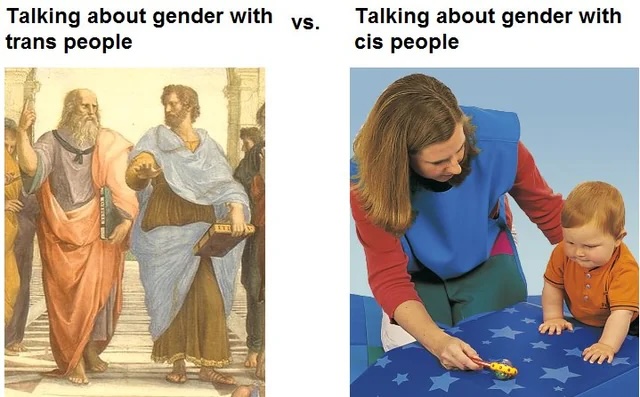
    There is, of course, a meme about it.

    Two images, one of greek philosophers captioned "talking about gender with trans people" and one of a small child being spoken to by a parent or carer marked "talking to cis people about gender".

    And yet all too often this helpful act, this attempt to meet people where they are, is thrown back in our faces as a gotcha, a “HA! NOBODY can be born in the wrong body!” The lie-to-children is met with childlike resistance because all too often we’re trying to help people who don’t want to be helped, who don’t want to listen, who don’t or won’t understand that the simplification isn’t for our benefit. It’s for theirs.

  • Vultures

    I wrote yesterday about newspapers profiting from spreading anti-trans hate: “Trans lives only matter to them if they can be monetised – and the cash is in calling us demons or crying crocodile tears over our coffins.”

    Here’s the Daily Mail today.

    Daily Mail advert: "NOW WATCH THE MAIL'S EXCLUSIVE
40-MINUTE VIDEO DOCUMENTARY"

  • Crocodile tears

    Content warning: child murder, transphobia, slurs

    When primary school children were massacred in Dunblane in 1996, the UK responded with severe restrictions on gun ownership – and when twenty children and six adults were massacred in Sandy Hook elementary school in 2012, most people expected the US to do the same. No sane person can accept the murder of children.

    It turns out that many people can.

    Like the people who expected Sandy Hook to be the moment when the US said “no more”, I expected the same with the brutal murder of Brianna Ghey, whose killers were sentenced this week. Surely the murder of a young trans woman would make the UK’s anti-trans madness stop.

    But I underestimated our politicians and our press. Faced with the murder of a young girl who was chosen in part because she was trans and whose killers used similar dehumanising language to them, they decided to circle the wagons instead.

    From the outset, papers such as The Guardian – which has arguably done more than any other publication to promote transphobic groups in the UK and present them as reasonable rather than the dubiously funded religious and social conservatives they are – seized on initial comments by the police that transphobia wasn’t the motive for the murder. But as the court case continued, it became very clear that that wasn’t true. Transphobia wasn’t the sole motive, but it was still a key motive – a fact so apparent that this week the Daily Mail – the Daily Mail! – ran a headline saying that Ghey was murdered because she was trans.

    The evidence presented by the prosecution left no room for doubt. One of the murderers hated Brianna because she was trans, and he used dehumanising and transphobic language during the planning of her murder. Her isolation, the killers agreed, made her an easier target. One of the murderers wanted to know whether she would scream like a boy or a girl when they stabbed her, and wanted to see her genitals.

    The murderers’ sentencing took that into account; it was a hate crime, fuelled in part by transphobia.

    The response to this has been predictably awful. One of the most prominent famous-author-approved “gender critical” figures turned to Twitter to blame Brianna’s mother, misgendering the girl, sexualising her and calling her mother “evil”. That post was liked by prominent anti-trans authors and journalists.

    Rishi Sunak took time out from making anti-trans jokes in cabinet, overseeing the Tories’ ongoing assault on trans healthcare and human rights and answering Prime Minister’s questions with “but he doesn’t know what a woman is!” to cry some crocodile tears.

    The Telegraph, among other papers, gave one of the murderers the attention she craved by posting not her mugshot but a glamour shot of her on its front page. After all, what’s sexier than a young woman who murders a tranny?

    There have been some lone voices of sanity. Zoe Williams wrote a compelling piece in The Guardian arguing that “Trans people have been used instrumentally as a muster point for the right, and the far right, in media and in politics, and this has concrete, foreseeable results.” But that piece is an outlier from a paper whose own contributors were happily liking that tweet calling Ghey’s mother “evil”.

    The response to the transphobic murder of a young woman has largely been a single, chilling fact: as far as the “gender critical” movement is concerned, the murder of Brianna Ghey is nothing more than inconvenient PR. In some circles – the circles that urge trans kids on social media to “KYS”; the circles that demand the removal of trans kids’ healthcare; the circles that demand schools out trans students, misgender them and isolate them; the circles that speak politely but genocidally about how trans people are “a huge problem for a sane world” and that their numbers should be “reduced” – this is a win.

    For a few days, some of the papers will take it easy on trans people. Brianna’s murder will sell papers; having helped promote the intolerance that got Brianna killed, they’ll spend some time now profiting from it. But in a few days, when the horror has begun to fade, they’ll go back on the attack. Trans lives only matter to them if they can be monetised – and the cash is in calling us demons or crying crocodile tears over our coffins.

    Update: Mic Wright’s piece on the coverage is well worth your time.

  • Faking the news

    There’s an excellent example of how newspapers create and maintain moral panics in the Sunday Times today, when Camilla Long notes with horror that:

    One school in Wales has written to parents saying it will not be providing “litter trays” for children “who identify as cats”.

    The reason for the letter was to debunk the idea that any children were identifying as cats, an anti-trans internet fiction enthusiastically spread by, er, The Times and The Sunday Times on multiple occasions.

    For example: “reports last week of a girl identifying as a cat”, 24 June 2023; “a litter of teenagers who self-identify as cats have begun stalking [a] town”, July 10 2023; “A friend of mine who runs a nice little café was surprised one day to see an adolescent girl enter his establishment, dressed from whiskers to tail as a cat… the girl identifies as a cat, Mum and Dad [explained]”, 24 December 2023. And so on.

    As I’ve written before, there is a horrific grain of truth to the story: some schools do indeed have litter trays in classrooms. Those schools are in America, where litter trays are provided in case a child needs to go to the toilet during an active shooter drill or active shooting.

    Like most anti-LGBTQ+ bullshit, the “kids are identifying as cats” story was fabricated by the right-wing press – in this case Fox News, before being amplified by Turning Point UK (a hard right pressure group) and GB News. It then spread via The Telegraph, the Daily Mail, LBC and, inevitably, The Times and Sunday Times. It was then picked up by beleaguered PM Rishi Sunak who condemned “schools [that] are allowing children to identify as cats, horses and dinosaurs.” None of those things happened.