Author: Carrie

  • Will Alex Salmond destroy the independence movement?

    If you only read one article about Alex Salmond’s trial and the dark side of the Scottish independence movement, you should read this exceptional piece by Dani Garavelli. 

    The trial effectively found that Alex Salmond was – in the words of his own lawyer, overheard on a train while the trial was ongoing – “inappropriate”, “stupid” and an “arsehole”. The defence admitted that Salmond had acted inappropriately towards multiple women, but the prosecution persuaded the jury that his actions were inappropriate rather than criminal. The issue wasn’t whether Salmond abused his power. He clearly did.

    That’s not how some independence supporters see it. To them, Salmond is the blameless victim of a conspiracy, a hero brought low by sinister forces within and without the SNP. They have demonised Salmond’s victims and vowed revenge on them – something Salmond has fuelled – and they believe that Nicola Sturgeon is part of the conspiracy and should resign.

    Garavelli:

    It is clear Salmond is on the warpath. The question is how far will he go? Is he willing to set fire to the house he built, just to watch his enemies burn?

    …Though his supporters would relish it, it is hard to see how he could shrug off the reputational damage the trial has done. More likely he will wield his power from the shadows, manipulating, undermining, bringing his influence to bear. And trying to destroy his former ally. There seems no doubt if he can bring Sturgeon down he will, and to hell with what that does to the cause.

  • We aren’t going anywhere

    It’s international Transgender Day of Visibility today. It’s a day meant to raise awareness of the discrimination trans people face, and to celebrate their contributions to society.

    Some people react to days like this with scorn, especially now: don’t we have more important things to worry about? And that’s exactly why days like this exist.

    In India, a poster campaign is telling people that Coronavirus is spread by trans people. In America, Republican legislators in multiple states have used the pandemic to rush through legislation that discriminates against trans people while making no efforts to protect people from the genuine threat of Covid-19. And here in the UK, the newspapers continue to lie and scaremonger about us and bigots continue to abuse trans people online – in some cases, bullying trans women self-isolating with coronavirus by wishing them and their loved ones dead – and anti-trans groups continue to fundraise and campaign for the right to discriminate against us rather than use their five-figure war chests to help the vulnerable women they claim to represent.

    The title of this post is a sour joke: we’re having a day of visibility when most of us are stuck at home. But even if it’s just online, visibility matters: one of the bigots’ best weapons is the fact that there are relatively few of us, so it’s easy for them to portray us as some sinister “other” instead of the reality: we’re sons and daughters, mums and dads, brothers and sisters, friends and colleagues. The more visible we are, the more people will see through the bigots’ bullshit.

  • Chortling with the cops

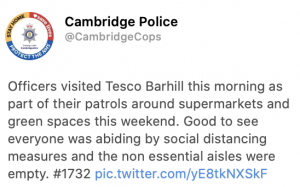
    There’s a really nasty tone creeping into the press right now, with tabloids and local press following the police’s lead and giving ordinary people a kicking. We’re not quite at Two Minutes Hate just yet, but the trickle of “look at these stupid bastards” stories is starting to become a stream.

    A lot of those stories are being fed to them by the police, who are clearly enjoying their new powers: before they’d even come into play, some forces were posting on Twitter with obvious excitement about the new ways in which they’d be able to throw their weight around.

    Inevitably, they are now throwing their weight around in ever more inventive ways: spending thousands of pounds on helicopters to see if anybody’s meeting their pals in the park, flying drones around to intimidate people in the street, shaming people on social media for taking a walk in uninhabited areas, and deciding what is and isn’t acceptable shopping.

    [Update: less than an hour after I wrote this, the BBC reported that the police were harassing corner shop owners for selling Easter Eggs. The Prime Minister’s office has clarified that if a shop is allowed to be open, it’s allowed to sell anything it has in stock. But the episode underlines the wider problem, which is that some police are overzealous – and some of them are particularly overzealous towards members of minority groups.]

    This story, from Plymouth Live, caught my eye.

    Oasis might have thought cigarettes and alcohol were the only things worth living for, but police in Plymouth disagree – especially during the COVID-19 coronavirus lockdown.

    It’s the tone of it that really gets to me. Welcome to “let’s chortle along with the cops”.

    And you’ll need to be as rich as the bickering brothers Gallagher to keep puffing away… because just 15 packets of fags could theoretically land you with nearly £2m in fines – because the fines can double each time you flout the rules.

    The story is based on social media posts by the local cops, who are happily stopping traffic and demanding to know where people are going – and then declaring whether their journey really is essential based on no law whatsoever.

    you cannot just go for a drive, you cannot drive to a destination for exercise, going to the shops for beer and cigarettes is not essential.

    They’re pretty essential if you’re a smoker or dependent on alcohol. And it’s not illegal to go to the shop.

    It’s important that people follow the government guidelines, but this denouncing of ordinary people as villains when they are not breaking any law really disturbs me. We’re already seeing people calling the cops about their neighbours’ behaviour, often without foundation. There’s a narrative developing in the press where blame is increasingly being put on ordinary people, not those in power.

    As commentator David Allen Green wrote on Twitter and later blogged, this is an extraordinary legal situation: overnight, freedom of movement, freedom of association and freedom of worship have been made illegal by a law that MPs didn’t vote on. And the police are already exceeding the powers they have been given:

    Under Regulation 6(1), it is even now a criminal offence to leave your own home, unless (in effect) the police are satisfied you have a reasonable excuse.

    The whole country is thereby (in effect) under house arrest.

    The police, in turn, have been given wide powers to enforce these regulations, including the use of coercive force.

    And in turn, again, the police are interpreting these wide powers even more widely, with roadblocks, drones, and a made-up restriction on “essential travel”.

    The police are also encouraging people to snitch on each other.

    On social media there are accusation and counter-accusation, as neighbours turn on each other.

    People are afraid of the police, and increasingly of each other.

    We all know that power corrupts, that people in authority often overreach and that powers granted in an emergency are often kept long after the emergency is over.

    Green:

    If it were not for this public health emergency, this situation would be the legal dream of the worst modern tyrant.

    Everybody under control, every social movement or association prohibited, every electronic communication subject to surveillance.

    This would be an unthinkable legal situation for any free society.

    Of course, the public health emergency takes absolute priority.

    But we also should not be blind to the costs.

  • Coronavirus isn’t karma

    Harvey Weinstein

    I wrote the other day about not finding any pleasure in the misfortunes of others, even if those people are horrible. But of course some people do, especially when the people are especially horrible. Take the rapist Harvey Weinstein: news that he had tested positive for coronavirus caused much merriment online and off; I saw a comedy show last night in which the comedian chuckled that Weinstein now knew what it meant to have something inside his body without consent.

    It’s a good joke, but the wider sentiment isn’t so funny. As Imani writes on Crutchesandspice.com, there’s an underlying ableism in the reaction to various famous people contracting coronavirus: it portrays the virus as a karmic force that punishes the wicked and the undeserving.

    COVID19, like any other disability, disease or illness, doesn’t have a moral compass and by projecting one onto the virus, people are subtly saying that those who also contract it [deserve to get it].

    Instead of chortling at Weinstein’s misfortune, perhaps we should focus instead on the fact that coronavirus could have horrific effects in prisons -– it could have a death rate much higher than in the wider population. Prisoners tend to be older and have poorer health than the rest of us. No matter what those prisoners may have been convicted of, none of them deserves the death penalty.

    And nor does anybody else.

    Imani:

    Communicable diseases aren’t discerning. COVID19 wants lungs, that’s its only M.O. No one deserves this virus—not even those you hate.

    Viruses don’t separate people into the righteous and the damned, sparing the good and judging the wicked. But some powerful people do believe that there is a hierarchy here, that some people do deserve to catch coronavirus and that others don’t. And sometimes those people say the quiet bit out loud.

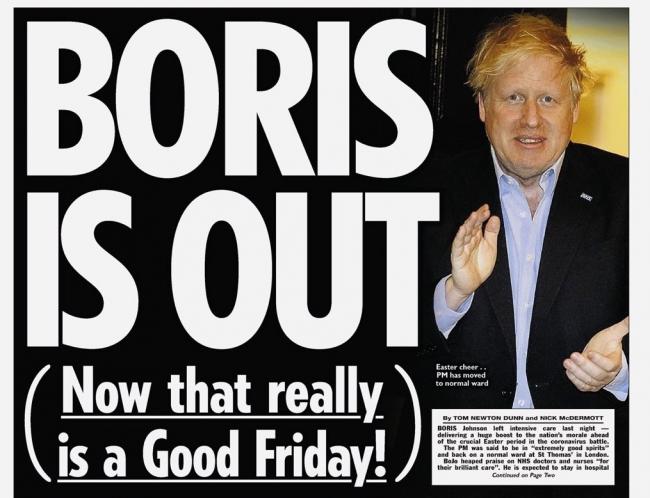
    There was a telling moment on Sky News this morning when the Tory politician Damian Green said that Boris Johnson having coronavirus demonstrated that “even intelligent people trying to do the right thing” can catch it.

    Leaving aside the fact that Boris Johnson clearly wasn’t doing the right thing – he was boasting about shaking coronavirus patients’ hands the other week and hasn’t been practicing the distancing recommended to reduce risk – that “even” is telling: even people who don’t deserve it can catch it.

    This isn’t new, of course. The concept of the “undeserving” has been with us for hundreds of years – the idea of the “undeserving poor” was quite the topic in the 1800s – and it is regularly trotted out by right-wing press and politicians. We saw it most recently when Tory MP Jacob Rees-Mogg suggested that the 72 people who died in the Grenfell fire did so because they weren’t as clever as him. And it’s back with a bang during the pandemic, weaponised by people who believe some lives – their lives – matter more than others.

    In the US, as Imani notes, “The national narrative veered hard right and went from ‘we need to do all we can to flatten the curve’ to ‘maybe we should let the virus run its course and let disabled and elderly die to save the economy.’”

    Coronavirus does not discriminate, and neither should we. We should be particularly alert for people in power who want to divide us into the good and the bad, the righteous and the damned, the deserving and the undeserving. Because you can be sure that their definition of “undeserving” never, ever means people like them.

  • “If people see no path to influencing the powerful, some will kick down”

    Adam Ramsay in OpenDemocracy:

    In the wake of the Andrew Wakefield scandal and two decades of disastrous climate change denial, newspapers surely have a social responsibility to be calm and cautious when contradicting scientific consensus, not turn serious questions of health communication into flesh for bare-toothed columnists to spar over.

    Despite continuing to spread confusion about the virus, the Tory press has been more than happy to denounce people who are confused.

    …When responsibility is cast onto an atomised population, it doesn’t land evenly. It is channelled down the social structures which already exist. Race, class, gender, sexuality: blame is always mobilised against the already marginalised.

  • Fact-checking as fake news goes viral

    The BBC has put together a page fact-checking the latest coronavirus-related nonsense circulating on social media. Today’s crop includes disinfectant-spraying helicopters (nope), a memo from Bill Gates (fake), video showing Turkish food parcels (old) and the official-looking text messages you may be getting right now (criminals).

    As ever, Snopes.com continues to bust bullshit (if you’re in the US, they’re hiring!). The top 50 currently includes everything from Nostradamus predicting Covid-19 (nope) to whether the virus is a distraction created so we don’t panic about the doomsday asteroid that’ll kill us all (oh, come on).

    My favourite fake news story is the one about Russia releasing 500 lions into the streets to enforce its coronavirus lockdown (there isn’t a lockdown, and there aren’t any lions). As Snopes put it:

    No, but we don’t doubt the effectiveness of such a strategy.

  • Useful, free apps for music and video

    [The deals listed here are long gone but the recommendations are still good]

    I get quite annoyed by social media posts urging us all to be productive and/or learn new skills during THE END OF THE BLOODY WORLD but I also get really bored when I’m stuck at home and I find messing around with music helps enormously.

    If you’re a musician or want to be one, there are currently some really useful offers you can take advantage of.

    First up, Fender Play is currently offering three months free. That’s three months of really good lessons for beginners and more experienced players alike. The lessons are for acoustic guitar, electric guitar, bass guitar and ukulele. The deal was originally limited to 100,000 people but it’s been upped to half a million now. Fender:

    We’re all going to be spending more time inside so we might as well make some noise.

    Apple has announced a 90-day trial of its music production studio, Logic Pro X.

    That’s the app I use for almost all of my music, and it’s usually £200. It’s a digital recording studio that’s ideal for any genre of music, and three months is long enough to make some really cool musical projects and/or learn transferable skills that’ll stand you in good stead for any other music production app. There are some really good, free Logic Pro X tutorials to help you get started here.

    If video is more your thing, Final Cut Pro is free for 90 days too.

    For electronic musicians, the mighty (and to me, terrifying) Ableton Live is also free for 90 days. And Avid, makers of Pro Tools, Media Composer and others, is offering 90-day trials too.

    Korg’s wonderful Minimoog synth app is free for another couple of days, alongside its excellent iKaossilator beat-maker.

  • God doesn’t want you to die of stupidity


    I’m normally a big fan of schadenfreude, the feeling of pleasure in others’ misfortunes. But so much of what I’m reading just now just makes me sad. For example, there’s no joy in seeing prime minister Boris Johnson admit to having coronavirus just days after boasting about shaking coronavirus patients’ hands; I’m just sad that he’s probably infected others who will in turn have passed the virus on. I feel sorry for his pregnant girlfriend, who must be terrified right now.

    One of the saddest things I’m seeing right now is people dying from arrogance, from misinformation and from tribalism. In the US, you’re much less likely to take the virus seriously if you’re a Trump voter, very religious or both; the lines aren’t as dramatic here in the UK but there’s still social media activity indicating a similar split between Brexit leaver and remainer.

    Viruses don’t care who you vote for or who you pray to.

    There’s an old Russian sailor’s proverb (often attributed to the gonzo writer Hunter S Thompson, but it was around for hundreds of years before him):

    Pray to God, but row away from the rocks.

    Sadly some people would rather row straight into the rocks and take lots of others with them.

    Here in Scotland, the evangelical politician John Mason initially refused to cancel his face-to-face surgeries and home visits to protect his constituents. When one church closed, he posted on Facebook:

    Surely we should be bold, take risks, and trust in Jesus?

    Trust in Jesus is not an effective anti-viral.

    I detest Mason, but I feel sad that his dark-ages idiocy could have caused people to become infected. And he’s not the only one. The usual contrarian clowns have had their say, and Scotland’s Free Presbyterian Church, another bunch of yahoos I’d happily see cast into a lake of fire, initially refused to cancel church services because:

    attending public worship is not a mere social activity or recreational pleasure

    This idiocy is global. In the US, pastor Landon Spradlin died from coronavirus this week. His death has made him internet famous because before he contracted the virus he shared online posts suggesting the media was creating “mass hysteria” over coronavirus; he also approvingly shared a tale of a missionary who cared for Black Death victims and never contracted the disease because God would ensure that “no germ will attach itself to me.” God must have been looking elsewhere this week. She’s got a lot on her plate.

    Spradlin had previously railed against helping poor and vulnerable people get healthcare; when he got sick, his family had to resort to a crowdfunding website “to help relieve them from the stress of the situation [and] medical bills.” Some people are finding schadenfreude in that, and some have gone as far as to abuse his grieving family on social media. I just feel sorry for their loss.

    And I also feel sorry for the other families who’ll grieve. Politicians’ inaction and media misinformation – particularly noticeable in the US, where the virus will kill many more people than 9/11 did – will cost many lives. As of today, the US has more coronavirus cases than anywhere else in the world. The toll so far is 1,297 deaths. There will be many more.

    You can sum up a lot of current events in a single story.

    No matter what god you may pray to, I’m pretty sure she doesn’t want you to go out like that.

  • We are the people

    There’s been a really nasty outbreak of everything-ism over the Coronavirus and people’s reactions to it. A tweet from the comedy programme Have I Got News For You today was a good example: it captioned a photo of people queuing too closely outside ASDA as “natural selection in action”. The replies included lots of comments about the people in the photograph being “sheep”, a few swipes at some of the shoppers’ weights and in one particularly horrible comment, a description of how someone should park a tank in the car park and machine-gun the shoppers.

    I find it hard to believe that anyone from HIGNFY or any of its social darwinist commenters hasn’t been to at least one supermarket in the last week and bought more than their usual shop or stood within two metres of strangers. But that’s different, isn’t it? They’re not like those people.

    And that’s true. They’re not. They were able to stock up – not panic-buying, no, just getting a few essentials just in case – because they had a car and a credit card and the freedom to shop when they first started to worry.

    They didn’t have to wait to finish a series of shifts or for a meagre pay cheque or for their universal credit payment before they could get a bus to queue with the others to walk past bare freezers, the contents long moved to the chest freezers in suburban garages, the shelves showing the last known location of the multiple packets of rice and lentils currently sitting in oh so many tasteful kitchen cupboards.

    Just because you panic-bought quietly before everybody else started doing it doesn’t make you morally superior. I know I’m not: I bought some extra food before the freezers emptied and the rice ran out. And I also know that had one client not paid me last week, I’d have been queuing up with everybody else outside ASDA.

    It’s a similar story with the elevation of people in parks to national hate figures on social media. How dare people without gardens of their own use public parks after being told to do so by the Prime Minister?

    Those people are us. Yes, some people are idiots – but idiocy isn’t limited to a particular social class, income bracket, waist measurement or postcode, as contrarian columnists and rent-a-gob politicians frequently demonstrate. Most of us are trying to navigate terrifying times with inadequate information, vague and often contradictory direction and a flurry of misinformation in social media and in parts of the mainstream media too. Sometimes we’ll make bad decisions. Sometimes we’ll panic.

    Don’t rage against people going to parks when the government told them to go, and when it won’t stop employers demanding many more non-essential workers cram into the Tube every morning. Don’t blame the panic buyers when the government leaks lurid tales of lockdown to the press and then unconvincingly denies them the next day; don’t blame people for besieging shops when all the online shopping slots are booked solid for six weeks by the worried well. Don’t blame the pubgoers when the PM’s own dad says a pint is your human right and the commentariat tells you it’s your national duty.

    There will be a time to rage, and there will be people deserving of your rage. But not now. And not those people.

  • When empires collapse

    A fascinating piece in Mother Jones by historian Patrick Wyman.

    The fall of an empire—the end of a polity, a socioeconomic order, a dominant culture, or the intertwined whole—looks more like a cascading series of minor, individually unimportant failures than a dramatic ending that appears out of the blue. Carts full of olive oil failing to arrive at some nameless fort because of a dysfunctional military bureaucracy, a corrupt official deciding to cook the books and claim taxes were collected when they really weren’t, a greedy aristocrat bribing that official instead of paying his bill, an aqueduct falling to pieces and nobody willing to front the funds to repair it.

    …Historians will look back at some enormous disaster, either ongoing now or in the decades or centuries to come, and say that it was just the icing on the cake. The foundation had already been laid long before then, in the text of legislation nobody bothered reading, in local elections nobody was following, in speeches nobody thought were important enough to comment on, in a thousand tiny disasters that amounted to a thousand little cuts on the body politic.