Author: Carrie

  • Wait until tomorrow

    Some of my songs are about people who are struggling, either because of the situation they’re in or because of the chemistry in their heads. It’s a subject close to my heart because I struggle too, and some days are considerably harder than others.

    Our song A Moment of Clarity is about that. It clearly resonates with people: almost every time I’ve played it live, whether with the band or solo at an open mic or live-streamed video, I’ve had people tell me that it has connected with them in a really powerful way. Everybody has their struggles.

    On the worst days, three words have been really helpful to me: wait until tomorrow.

    Wait until tomorrow is a deal you make with yourself. You’re not going to try and persuade yourself that what you’re feeling isn’t real, or try to convince yourself that things aren’t as bad as they seem to be right now. All you’re going to do is wait until tomorrow.

    And if you still feel the same tomorrow?

    We’ll deal with that tomorrow.

    I’ve found that some of the very worst days are like a severe storm. In real-world storms, ordinary things turn on us. The wind damages property, fells trees, turns ordinary objects into projectiles; the rain makes land slip and roads flood. Mental storms do much the same, and in some cases do the mental equivalent of a hurricane throwing a cow through the front of your house.

    But all storms, even the very worst ones, pass.

    And when you wait until tomorrow, you’ll often find that your one does too.

    And if it doesn’t?

    We can deal with that tomorrow.

    If you’re struggling with mental health, help is available: I’ve listed a lot of helplines, including LGBT+ specific ones, at the very bottom of the page. If you need to speak to somebody right now, here are some other places that can help:

    Call Samaritans on 116 123 or email jo@samaritans.org.
    Text SHOUT to 85258 to contact the Shout Crisis Text Line (text YM if you’re under 19)
    The Campaign Against Living Miserably, online or 0800 58 58 58.

  • Famous friends

    Jonny Depp lost his libel case against The Sun this week: a judge ruled that when the paper called him a “wife beater”, it was stating a fact.

    It’s worth reminding ourselves of the actual article that sparked the lawsuit:

    The Sun article was based on a blog post by the author in which she said that she was “genuinely happy” to have the actor cast in the film of one of her books; she was aware of the allegations of domestic violence – and the ‘legitimate questions’ of fans – but felt that, as The Guardian put it:

    the circumstances of Depp’s divorce from actor Amber Heard last year were private and should be respected.

    Rowling was, and presumably remains, a friend of the actor: she bought his luxury yacht after holidaying on it.

    The reaction to Rowling’s defence of Depp by victims of domestic violence often assumed that she hadn’t experienced it, because if she had she would not give the actor the benefit of the doubt. But we know now that Rowling has been a victim of domestic abuse, which – as is so often the case – was perpetrated by her male partner.

    The author didn’t use that experience to condemn Depp, however. She used it as partial justification for her anti-trans stance, even though trans women are overwhelmingly victims of domestic violence, not perpetrators of it.

  • Barefoot and pregnant

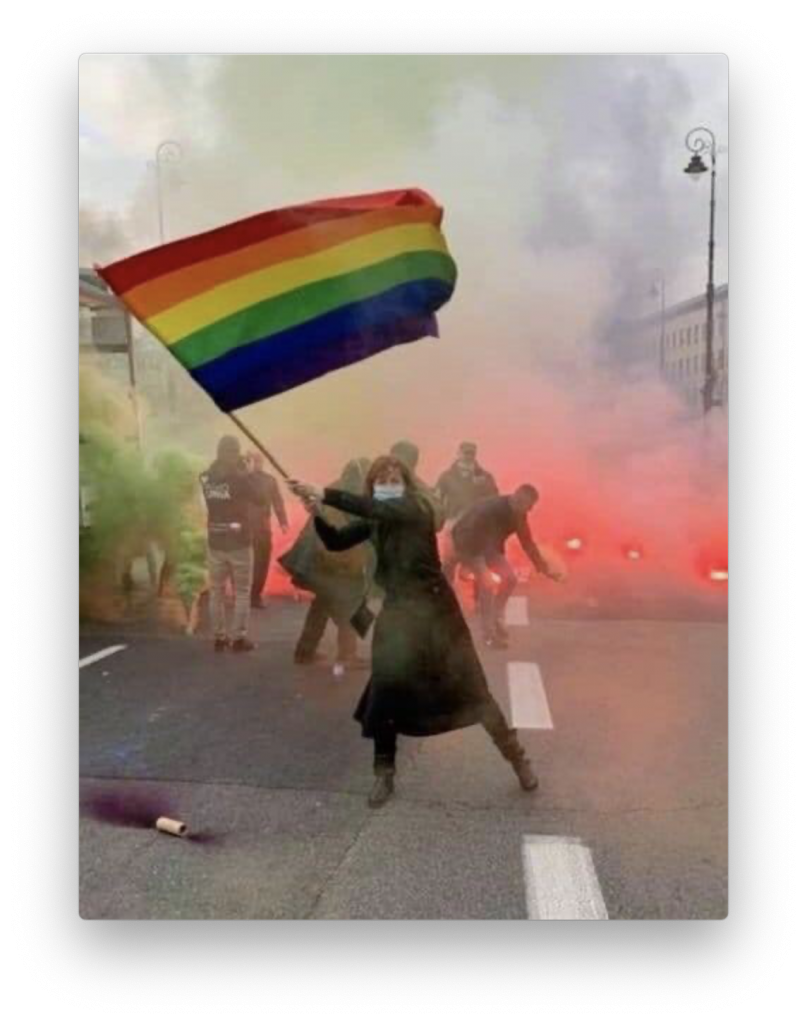
    This powerful photo is from Poland, where women and LGBT+ people are protesting truly awful anti-abortion legislation. The government was elected partly because of its anti-LGBT+, “family values” stance; as is always the case, “family values” also means restricting women’s rights in order to keep them barefoot and pregnant.

    Here’s another family values politician, the US Republican Senator Lindsey Graham, speaking this week.

    I want every young woman to know there’s a place for you in America if you are pro-life, if you embrace your religion, and you follow traditional family structure. That you can go anywhere, young lady.

    As in Poland, the family values here are of the barefoot and pregnant variety.

    Cas Mudde, writing in the New Statesman:

    Most far-right politicians take a traditional view of gender that sees women first and foremost as mothers, discouraging them from working outside of the household. The idea that women are “virgin-mothers” points to a kind of benevolent sexism where women are vulnerable and dependent upon (and deserving of) protection from strong men. Such politicians view gender ideology as a threat to the fundamentally different and “natural” roles that men and women play in society.

    Women’s reproductive and sexual freedom, gay/bi/pan women and trans women are at odds with that worldview.

    the global far right converges on one thing: they all denounce contemporary feminism and “gender ideology”, and see women, first and foremost, as the “womb of the nation”. Consequently, far-right men believe it is their right (and even duty) to control and police their women. After all, as the Hungarian Speaker of Parliament recently said, “individuals’ decisions on having children are public matters.”

  • We live outdoors

    Jonn Elledge has just re-shared this excellent piece he wrote in April about lockdown and those of us who live in cities. He argues that it isn’t country folks who live outdoors; it’s city ones.

    it’s actually the urban residents who live their lives outside, for the obvious reason that their homes are so small they don’t have a choice. If you live in a major city, you are less likely to have a garden, or a spare room, or even – in the age of landlords taking the piss because, hey, who’s going to stop them? – a living room. Finding space to work that isn’t also the space you sleep in means going to a café; space to socialise means going to the pub. If you want to chill out and enjoy the sunshine, you go to a park. What else can you do?

    As he writes, the city is a trade-off: we have a smaller, more expensive home because of the things that surround us and our proximity to things such as our workplaces and social spaces. And that’s great, until those things get locked down.

    this trade-off always seemed like a good one to me – right up until the point three weeks ago when the government announced that all bars, restaurants, galleries and so on were to close, and the entire country was in lockdown for the foreseeable future. At which point I was suddenly just living in a small, expensive space very close to other people, with all the advantages to doing so taken away from me, and without even a balcony to hang out on.

    I have a balcony, but otherwise I’m in the same boat: I’m paying a lot of money to live close to things that aren’t open.

    This isn’t a complaint. Many people have it much, much worse than me: I don’t have to cram an entire family into a tiny flat; my kids are still at school so I can work. But there’s no doubt that the experience of COVID restrictions is very different for city dwellers than it is for suburbanites or our more affluent neighbours (and for those who are partnered rather than those who live alone).

    It also raises interesting questions about the future of cities. If working from home becomes the new normal, if our social spaces die from lack of support, if our cultural centres close and events are unviable, if COVID accelerates the shift from bricks and mortar retail to online, what are cities actually for?

  • Lockdown and mental health

    Like many people I’ve been struggling this year. Lockdown and COVID restrictions have been hellish for many people’s mental health.

    The promise of lockdown was that it was a necessary evil: we did it to save the NHS and to buy time to create an effective contact tracing system. That time was squandered, and England is about to go into lockdown again.

    This, by Owen Jones for The Guardian, is very good.

    This is purgatory, a barren parody of real life. We’re living in monochrome, an existence bedevilled by tedium, stripped of spontaneity, robbed of little joys but defined by ever greater stresses. This relentless assault on our wellbeing will only intensify: those left fearing for their imperilled jobs in a nation with a shredded safety net in place of a welfare state; the young being deprived of their best days; the old, denied the dignity and support they deserve in their later years; the millions who were already struggling with their mental health even before the old world collapsed; those imprisoned with domestic abusers, or LGBTQ people locked away with bigoted relatives.

    This is a conversation we need to have. As things stand, talk of the mental impact of the world’s greatest crisis for three quarters of a century has been monopolised by corona deniers and anti-lockdown agitators.

    Being sad and lonely is clearly lesser than being dead, or causing the deaths of other people. But nevertheless the damage to people’s mental health is much more important and will cause much more misery than the damage to corporations’ profits. To date the UK government has been much more concerned with the latter.

    the deprivation of our liberty was not supposed to be an endless cycle of outbreaks and national lockdowns; it was to prevent the NHS being overwhelmed so it could continue to function, to stop needless deaths and to buy time to establish a functioning test and trace system. Its failure means our mental wellbeing has been needlessly tossed on a bonfire – not because of partying youngsters but because of a government that relied on shambolic private contractors and sought to put the economy ahead of human life, with terrible consequences for both.

    I’ve written before that while our COVID death toll is already in the tens of thousands, others are in the low single digits: Vietnam, which has a long land border with and extensive travel to and from China, has had just 35 deaths. Vietnam took COVID seriously. Here, we bribed people to go to Wetherspoons.

  • Tiers and clowns

    I live in Glasgow, which is currently in Level 3 coronavirus restrictions. I don’t think we’re likely to move to level 0, near-normality, this side of Spring. And that’s me being optimistic.

    Until then, we have to live under restrictions. And those restrictions often seem contradictory or based on very dubious assumptions. I’m going to talk specifically about Scotland here, because the English approach is a horror story.

    One of the most important restrictions is on socialising. Until the virus is effectively eradicated and Glasgow moves into Level 0, I can’t have anybody in my home unless they’re a tradesperson there to do work.

    I live mostly alone (my children stay with me half the time) in a flat with a large, open plan, well-ventilated living area. I can’t invite one of my friends into my home to sit three metres away from me, but I can meet six people in a café and sit around a small table with them for a long period of time. That café may have another two dozen people in it, or it may be roughly the same size as and no better ventilated than my bathroom.

    I can’t invite one of my friends into my home, but I can go to church with up to 50 other people. I might even sing some hymns, because while communal singing is advised against – singing is a significant disease transmission vector – it is not prohibited.

    I can’t invite one of my friends into my home but I can go to a wedding reception or a wake with 20 other people.

    So I can’t meet one person in a safe and extremely low risk way, but I can meet more people in a much higher risk environment amid many other people.

    There are other restrictions too. When I pick up and drop off my children I must wear a face covering in the street outside their school, even though the risk of outdoor transmission by passing near another adult is zero, but I don’t need to wear a face mask in a café full of other people, an indoor environment where we know the transmission risk is particularly high. I can’t travel outside Glasgow, but I can if it’s for work – so I can travel from my high-risk area to have a business meeting in a café with six people in a low-risk area.

    I understand the necessity for restrictions. But restrictions need to be evidence-based, consistent and clear. The current restrictions are unclear, inconsistent and ever shifting. I have to go online to check what we are and are not allowed to do because it appears to change every couple of days, so for example the school-mask thing was a late addition to this week’s restrictions.

    I’m no fan of the anti-mask, anti-lockdown crowd who demand the freedom to kill your gran, or the clowns I saw on Instagram last night having a riotous gender reveal house party in Clydebank (such parties seem to bring out the idiots; I’ll no doubt come back to that later). These people are modern day Typhoid Marys. But to combat their bullshit, ignorance and sheer selfishness, governments need to persuade everybody else that the restrictions are not only necessary but proportionate; that other people, whether those people are Government advisors or their next door neighbours, are not getting an easier ride than they are.

    And that’s not the feeling I’m getting from my social networks. There’s confusion, and anger, and resentment, and in some cases – such as my own – deep, deep despair at the prospect of being banned from seeing the people I care about for yet more months. And when people feel that way about public health messaging their attitude changes: instead of “what do I need to do to keep everyone else safe?”, it becomes “what can I do without getting caught?”

  • Nobody checks anything

    Yesterday, multiple newspapers reported the return of Woolworths, a retail chain that no longer operates in the UK. The story was in the Metro.It was in the Daily Star. It was in the Mirror. It was in the Brighton Argus, and Birmingham Live, and the rest of the UK’s local press. It was everywhere.

    It was bullshit.

    Not a single journalist at any of those titles bothered their backside to check whether it was true before publishing. It wasn’t. The story was based on tweets from a fake account that couldn’t even spell the company name properly. That was enough for acres of coverage.

    This is how too much journalism works now. All you need is a Twitter account and a logo and nobody fact-checks what you’re saying or investigates who you actually are; if it’s going to get clicks, it’s going to get published. It’s harmless when we’re talking about pic’n’mix, but this is exactly how anti-LGBT+ groups and right-wing lobbyists get coverage too. Far too many supposed “alliances” and “institutes” are little more than social media fronts for people who are extremely dodgy. They can only do their jobs because too many journalists aren’t doing theirs.

  • Never boring

    I think Pet Shop Boys are one of the greatest singles bands of all time, and I’ve long been drawn to their mix of melancholy and euphoria. Their 1987 chart-topper It’s A Sin remains one of the strangest, most rewarding pop songs ever to reach number one in the UK chart.

    It’s also a hell of a record for a confused teenager who’s battling with their identity:

    When I look back upon my life
    it’s always with a sense of shame
    I’ve always been the one to blame
    For everything I long to do
    no matter when or where or who
    has one thing in common too

    It’s a sin

    Oh man, the times I’ve cried to that one.

    If you’re tired of overly worthy rock memoirs, Chris Heath’s two books about Pet Shop Boys touring – Literally and Pet Shop Boys Versus America – are wonderful, waspish and hilarious.

    Singer Neil Tennant was a huge influence on me – he was a journalist for Smash Hits, my very favourite magazine – and he coined the term “imperial phase” to describe the temporary period in an artist’s career when they can do no wrong and create incredible things.

    Depending on who you ask, the Pet Shop Boys’ imperial phase ended when they released Behaviour. But others think that album was their peak. It certainly included one of their very greatest songs.Writing for The Quietus, Fergal Kinney does a deep dive into a dense, divisive album 30 years after its release.

    Show me your Beatles, show me your Bowie, and I will show you ‘Being Boring’. A masterpiece, to be sure, but also something more elusive than that. Entering the charts at 36, ‘Being Boring’ eventually climbed to 20, but its legacy wouldn’t be measured in chart success. It became, for many, a song of a lifetime, and for a generation of LGBT people an essential and early monument to a senseless tragedy.

    I’ve seen Pet Shop Boys live a few times and Being Boring makes me cry every time. Just writing about it now has choked me up. It’s a beautiful sad song.

    The track’s impressive vocabulary (cache, trepidation, haversack) belies a simply structured lyric – a three act drama that begins with Dowell and Tennant’s childhood, takes in their move to London and ends, as Tennant explained to the Guardian, “looking back at what’s happening, and I’m doing what I’m doing, and he’s dead”. Of course, part of the song’s enduring hold is its resonances well beyond gay life. It looks at the biggest of themes – friendship, loss, the passage of time. Anyone who’s life has involved some degree of escape, some degree of self-actualisation can’t fail to be grabbed a little too tightly by lines such as “I never dreamt that I would get to be/ The creature that I always meant to be.”

  • They’re here

    TIME magazine:

    Twenty-eight U.S. Christian right groups have spent millions of dollars pursuing conservative agendas that threaten LGBTQ and women’s rights in Europe, a new investigation by British news website openDemocracy found Tuesday.

  • Let them eat handbags

    The UK appears to be having one of its periodic outbreaks of idiocy when affluent people claim that they could absolutely feed a family of 12 on 23p a week and have money left over. So Twitter is currently full of people claiming you can buy a chicken in Aldi for £2 (this, clearly, is the branch of Aldi in Madeupshire) and that with that, a carrot and the Blitz spirit you can eat like kings for a fortnight.

    You can’t.

    Jack Monroe literally wrote the book on this stuff: she’s been helping people make tasty and nutritious food on low budgets for years. And she’s absolutely furious at the people sharing selected bits of her advice as if it’s evidence that struggling to afford food is the result of personal failings, not poverty.

    As she wrote two years ago:

    Again, having choices around the food you eat is a privilege. Not having to shop exclusively from the white labels of the value ranges, or raiding the battered old veg at the end of the day at the market, is a privilege. Not mentally calculating the pennies difference in every item that goes into your shopping basket is a privilege, and one that millions of people in the UK (and across the world) increasingly do not have. Access to fresh fruit and vegetables, and the means with which to buy them, is a privilege.

    And it’s not just buying core ingredients. All those kitchen cupboard essentials, the seasonings and the spices and the stock cubes, have to be bought too. You need pots and pans and utensils and something to cook on, and the money to pay for the energy to cook with. And so on, and so on, and so on.

    One of the problems with this blame-the-poor narrative, which returns far too frequently, is that you absolutely can survive on sod-all money when your cupboards are already stocked, all your bills are paid and you’re only doing it for a week. But all you are doing is having a holiday in somebody else’s misery. Poverty means not just buying your food from the bargain aisle – an aisle that, when I was living in a leafy suburb, was always picked clean by affluent women of a certain age who’d block the area with their trollies until they’d had their pick of the reduced items – but being unable to pay bills, replace the clothes your children have outgrown or gone through and all the other things that demand what little money you have.

    Not only that, but being poor is expensive. You can’t stock the freezer, assuming you have a freezer, with bulk buys because you can’t afford to buy in bulk. You can’t get the best price on energy because you’re on a prepay meter. You can’t buy things that last because they are simply too expensive.

    If you were a satirist, you’d struggle to come up with a better villain in this than Nick Clarke, who suggested that parents struggling to feed their children should not only skip their own meals, but “sell assets”. What assets? “Handbag, pearls, mobile phone?”

    Imagine being so removed from reality that you think the poor are bouncing around with designer handbags and strings of pearls. Poor people don’t have “assets”. They have debt.

    One of the best descriptions of poverty I’ve ever read was by the late Terry Pratchett:

    The reason that the rich were so rich, Vimes reasoned, was because they managed to spend less money. Take boots, for example. He earned thirty-eight dollars a month plus allowances. A really good pair of leather boots cost fifty dollars. But an affordable pair of boots, which were sort of OK for a season or two and then leaked like hell when the cardboard gave out, cost about ten dollars. Those were the kind of boots Vimes always bought, and wore until the soles were so thin that he could tell where he was in Ankh-Morpork on a foggy night by the feel of the cobbles. But the thing was that good boots lasted for years and years. A man who could afford fifty dollars had a pair of boots that’d still be keeping his feet dry in ten years’ time, while the poor man who could only afford cheap boots would have spent a hundred dollars on boots in the same time and would still have wet feet.