Category: Media

Journalism, radio and stuff like that

  • Ten years tipped

    Jude Doyle is on superb form in this piece looking back at the famous “Transgender Tipping Point” cover of TIME. As the piece says, it often feels like we’ve tipped vertiginously backwards with open bigotry against us running unchecked in the press, politics and social media. Who’d have thought ten years ago that in 2024, “transphobe” would not just be a career option but a very lucrative one?

    As one of the contributors, Katherine Cross, told Doyle, not all trans people were thrilled with the TIME cover. “there was a fear that this meant the Eye of Sauron was upon us, that whatever safety was afforded by the shadows of public ignorance was well and truly gone now.” Those fears proved to be well founded, and warnings by other marginalised people – people who knew very well that increased visibility often means little more than painting a target on people’s backs – were sadly prescient.

    Doyle interviews another excellent writer, Parker Molloy, and the two discuss the way in which mainstream media effectively threw trans people to the wolves.

    “The media, once eager to spotlight our stories for clicks and headlines, has largely abandoned us, leaving trans people to fend off a wave of hostility on our own. It feels bleak,” Molloy says. “It feels like we’re on our own, and I just have a hard time imagining things getting better in the near future.”

    Doyle somehow manages to remain optimistic, and there are positives: we have a much wider and better informed community than we did ten years ago, and despite the bigots’ best efforts trans and non-binary people are not going to return to the bad old days when the world could pretend we didn’t exist.

  • Balance

    Lee Hurley of Trans Writes has been tracking trans-related articles in the UK press: The Guardian, The Observer, The Times, The Sunday Times, The Daily Telegraph, The Sunday Telegraph, The Daily Mail, The Mail on Sunday and Private Eye.

    In the 23 days since 16 April there have been 126 articles about trans people in those publications.

    121 of them were negative.

    5 were neutral.

    0 were written by trans people.

  • Complicity

    The Guardian has published a thoughtful article by playwright Jonathan Cash about the 1999 bombing of the Admiral Duncan pub in Soho, which he was injured in. The bomb was planted by a far-right sympathiser, a man who believed that gay men should be put to death. If you’re going to read the whole piece, which is very powerful, be aware that it contains some horrific details of victims’ injuries.

    Cash’s article includes some sections that The Guardian’s own writers, and their peers in other publications, should think about.

    The bombing campaign heralded a change in attitude from some of the UK’s most popular newspapers. Until then, the words “poofs” and “queers” were used in editorials, even in front-page headlines, especially since the advent of the HIV pandemic. Similarly hateful words were used to describe people from other minority groups. These words, in print, encouraged constant, casual discrimination and affected the way that LGBTQIA+ people and ethnic minorities were talked about and treated.

    As far as I am concerned, every single journalist, editor and newspaper proprietor who contributed to these attitudes in print is complicit in the deaths of three people who were standing just feet away from me, and the life-changing injuries of many others, both physical and psychological.

    …If you don’t call out derogatory words about people who are somehow regarded as different, hate is normalised and you’re complicit.

    In the UK we’ve already seen two trans girls stabbed, one fatally, and anti-LGBTQ+ hate crimes – and anti-trans hate crimes specifically – are soaring. Too many writers’ words are contributing to an increasingly violent climate.

  • SLAPP happy

    One of the reasons that Jimmy Savile got away with his abuse for so long was the UK’s libel laws. Savile was highly litigious, and would send his very expensive lawyers after any publication that so much as considered reporting allegations about him.

    The fact that the allegations were true was irrelevant. Savile was rich, and that means he could use the law as a weapon. And he did, from the 1960s until his death in 2011. For five decades he used his money to stop people telling the truth about who and what he was.

    As Meirion Jones explained in The Guardian, The Sun wanted to expose him in 2008 and had multiple signed affidavits from his victims, but – yet again – did not publish. “They would be facing the best QCs money could buy, representing a man who could potentially call Prince Charles, Margaret Thatcher, the heads of charities, the head of the BBC and the pope as character witnesses. The best guess of the lawyers was that a libel action could cost a million pounds… this wasn’t the first or last time that Savile escaped because of our libel laws, which rewarded his deliberate targeting of vulnerable victims. Off the record, journalists have told me of multiple attempts to blow the whistle on Savile from the 1960s onwards that failed because newspapers could not afford the legal risks involved.”

    When even The Sun can’t afford to be taken to court, imagine the chilling effect on smaller publishers and individuals. In Britain, the rich can silence the truth by threatening legal action – action that, even if the defendant were successful, would financially ruin them. As a result, the truth about some famous people will not emerge until they die.

    This kind of bullying is known as a SLAPP – a Strategic Lawsuit Against Public Participation – and the UK government describes SLAPP actions as “an abuse of the legal process, where the primary objective is to harass, intimidate and financially and psychologically exhaust one’s opponent via improper means”. The Law Society says that “Unlike genuine defamation claims – which typically arise out of an attempt to protect or repair the claimant’s damaged reputation – SLAPPs go further, aiming to prevent lawful investigations and discussions about matters of public interest.”

    SLAPPs are legal in the UK, and they – or the threat of them – remain one of the favourite bullying tactics of oligarchs, super-rich individuals who can afford to abuse the legal system. But they have limited reach, which is why you’ll typically find them used only against UK residents who can’t afford to go to court. The oligarchs who use SLAPPs and SLAPP threats rarely, if ever, go after people with money, and they can’t stop people in other countries from telling the truth about who or what they are.

    This post isn’t about Jimmy Savile.

  • How news lost its nerve

    There’s an interesting piece in Semafor about the ongoing cowardice crisis in journalism. It’s about the US but many of the problems it identifies are just as  prevalent in the UK.

    Of all the issues – fear of litigation in the form of SLAPP suits designed to silence legitimate criticism; fear of losing your job for not toeing the company line; fear of losing access to the rich and/or famous people whose names drive traffic; the lack of money in modern journalism; rich and powerful people wielding social media as a weapon – probably the biggest is the removal of the all-important line between news and money.

    At a moment of economic fragility in the media industry, there’s also simply less of an appetite for stories that could damage important business relationships. This has been a particularly challenging balance for glossy entertainment and lifestyle magazines, whose audiences long ago moved online and who now rely heavily on the businesses they cover.

    …The new priorities are reflected organizationally. Editors-in-chief at Hearst, Esquire’s parent company, now report up to general managers, whose singular focus is the bottom line. The general manager who oversees Esquire and other fashion publications, for example, came to the company from the marketing side of digital payment company Venmo.

    The reason for the long-standing line between editorial and a publication’s funding was to prevent conflicts of interest. A publication that’s financially dependent on the people it’s writing about, whether directly in the form of a business relationship or indirectly in the form of access for future stories, is a publication that is no longer independent; it becomes an arm of PR.


  • Freedom to choose

    There’s an interesting and provocative piece in New York Magazine by Andrea Long Chu, in which she advocates for trans people’s freedom. It’s a long read and quite dense in places – and I don’t think she makes it clear enough that the only medical intervention available to trans kids is puberty blocking, which is fully reversible – but she’s very good on the role of transphobic liberals in laundering far-right views for a more mainstream audience.

    The most insidious source of the anti-trans movement in this country is, quite simply, liberals.

    Liberals are the ones “just asking questions” in the pages of newspapers, pretending to be objective when they’re just as biased against trans people as the most rabid right-wingers.

    The very simple fact is that many people believe transgender is something no one in their right mind would ever want to be… If the liberal skeptic will not assert in mixed company that there should be fewer trans people, he still expects us to agree on basic humanitarian grounds that at least there should not be more.


  • Deny and distract

    Grief is a horrendous thing, and it’s something we all process in different ways. And Brianna Ghey’s mum, Esther, is grieving something no parent should have to go through: the death of her child, a death whose brutality and ferocity are beyond most people’s understanding.

    With grief comes guilt, an endless parade of what-ifs and if-onlys that come to torture you in the hours where you can’t sleep. And I think Esther Ghey is feeling that acutely right now, because any parent would: of course you’d spend endless hours wondering what you missed, what you could have done differently, what single thing would have prevented this terrible thing from happening. Trying to make sense of the senseless is what we humans do.

    The latest reports suggest that Ghey thinks that social media may have played a part in the death of her daughter. And the way in which this is being reported is starting to look like victim blaming. If Brianna hadn’t been so active online maybe she wouldn’t have been so isolated in real life, and maybe that would mean she wouldn’t have been picked for her vulnerability, and maybe…

    I don’t agree with her, although I understand why Brianna’s mum is on a mission: for many years I’ve been delivering lectures about the regulation of the internet and social media, and sadly every year there are new calls for regulation from yet another grieving parent of yet another kid who should still be here and who is trying to make some sense of a senseless tragedy and ensure no other child experiences what their child experienced. But with this particular horror the press has a vested interest in the internet-did-it narrative, because it lets the real guilty parties off the hook.

    Newspapers blaming the internet for Brianna’s murder have spent six or seven years demanding the institutionalised bullying of trans kids in schools, have fought tooth and nail against hate crime legislation, have portrayed anti-trans hatred as acceptable “debate” and have continually platformed people and organisations who say that trans people are monsters to be hated and feared and eliminated from society.

    As one of the people I follow on social media put it: if you think social media’s bad, you should see what they put in the papers.

    LGBTQ+ people and advocates have been trying to raise the alarm for years, and again and again their warnings have been ignored or even ridiculed. And now that the very thing they feared and tried to prevent is happening, the press, politicians and public figures are doing their very best to deny or distract.

    I’m writing this the day after it emerged that a non-binary kid in the US died after a savage beating by multiple teenagers in the school toilets, a beating that appears to be because of their gender identity; they lived in Oklahoma, whose schools are run by one of the most viciously anti-trans bigots around. Earlier this month, it emerged that a trans teen was stabbed multiple times in North London, an attempted murder apparently because others took exception to seeing a trans person. And despite the best efforts of the press to play it down, the murder of Brianna was in part because one of her killers was repulsed by the fact she was trans.

    I have enormous sympathy for Brianna’s mum. But I think that in her grief and in her pain, in her attempts to make sense of something so senseless, she’s unaware that others are seeking to exploit her, to turn the focus away from the press, the politicians and the public figures who’ve spent six-plus years trying to make the world more lethal for trans and non-binary people.

    I got a call from the BBC last week asking me to come on air regarding Brianna; not to talk about her murder, or the climate of hatred that makes so many of us genuinely afraid, but whether we should ban kids from having phones. I declined, of course. But the framing is telling. There’s no interest in investigating what’s really contributing to the hatred that led to the murder of a young woman, the attempted murder of another and the attack that appears to have killed a third teen. Because that would mean asking questions whose answers are far too uncomfortable, and far too close to home.


  • When even The Guardian sees the bigotry

    It’s very hard to see any light at the end of the anti-trans tunnel; just yesterday, it emerged that a teenager has been charged for the attempted murder of a trans teen in North London. The 18-year-old trans girl was stabbed 14 times in a confrontation that began with strangers shouting transphobic slurs at her; thankfully she survived. But to add insult to injury, the Evening Standard report spent the bulk of its column inches telling us how sad her (alleged) attempted murderer was.

    As an example of how the UK press treats hate crimes against trans people, that’s not unusual: in recent days we’ve also had reports that one of the murderers of trans teen Brianna Ghey has been boasting in prison about how famous the newspapers, which used glamour shots rather than mugshots of her on their front pages, have made her.

    I’ve written before that I really thought the murder of Brianna would finally bring some sanity to the anti-trans moral panic, but it didn’t – although Rishi Sunak may have helped with his attempt to score political points by mocking trans people while Brianna’s mum was in attendance, a move that had even some of the bigot brigade appalled. But maybe we’re finally coming to the end of this vicious panic. Because even The Guardian is now running several pieces highlighting the cruelty and the bigotry of the anti-trans movement.

    The UK edition of The Guardian has arguably done more to legitimise anti-trans pressure groups and narratives than the right-wing press, and some of its key writers have set up their own “gender critical” group to push anti-trans content in the pages of The Guardian and sister paper The Observer. But in the last few days it’s printed several articles critical of anti-trans culture warriors. That’s significant because these are in the UK edition: for some time now there’s been a marked difference in editorial policy between the US edition (pro-LGBTQ+) and the UK one (obsessively anti-trans).

    Today’s piece is about the manufactured controversy over Parkrun fun runs, which began on Mumsnet before jumping to the Daily Mail and being amplified by the right-wing pressure group Policy Exchange.

    so once you erase trans women from physical sport, you move to sports such as chess and darts. From there it’s a short leap to scoffing at people’s pronouns, talking about “men in dresses”, perhaps even a cheap gag during prime minister’s questions while the parents of a murdered trans teenager are watching from the public gallery. Next you start denying the concept of gender fluidity entirely. You demonise the trans woman as a potential abuser or rapist. You describe transition surgery as “mutilation” or “child abuse”. All in the service of pushing the window, inching towards some sunlit horizon in which – as is already beginning to occur in parts of the US – trans people can be legislated out of existence entirely.

    And really the telling part of the parkrun row is the way the anti-trans movement in sport has begun to broaden its focus beyond the Olympic 800m, or national swimming trials, or suppressed testosterone levels, into areas of identity and belonging. The proposed parkrun ban is – short of genital inspectors in the token queues – basically unenforceable. The cruelty is the point here: the desire to forcibly out trans women, even when it might threaten their safety. The message to trans women, trans men – or even anyone who looks like they might be trans – that this is not your space, and you will identify not according to your values but to ours.

    If the bigots have become so bad that even The Guardian is admitting it, maybe sanity will finally prevail after all.

  • The job

    It’s been said so often that it’s a cliché, but the job of journalism is to report the truth. Its job is to investigate, to find facts, and to follow those facts to see where they lead. It is a process of discovering, of uncovering, of seeing and telling what’s really going on.

    In order to do that, you need to be objective. We all have biases, assumptions and other weaknesses. But in journalism the job is to put them aside, to accept that if the facts contradict your pre-existing beliefs then those beliefs need to change. Because your job is not to shore up your own biases, but to find the truth.

    With some irony, the publisher of The New York Times has written extensively about that here.

    Independence asks reporters to adopt a posture of searching, rather than knowing. It demands that we reflect the world as it is, not the world as we may wish it to be. It requires journalists to be willing to exonerate someone deemed a villain or interrogate someone regarded as a hero. It insists on sharing what we learn—fully and fairly—regardless of whom it may upset or what the political consequences might be. Independence calls for plainly stating the facts, even if they appear to favor one side of a dispute. And it calls for carefully conveying ambiguity and debate in the more frequent cases where the facts are unclear or their interpretation is under reasonable dispute, letting readers grasp and process the uncertainty for themselves.

    Sulzberger’s words here are absolutely true, but it’s worth considering why he’s writing the piece: it’s in response to growing criticism that the New York Times often breaks those rules. That’s certainly the case in its reporting of trans issues where, often by using the opinion section to avoid fact-checking, journalists act as anti-trans propagandists.

    One of the worst of many such propagandists is Pamela Paul, whose ongoing campaign against trans people continued this week with a really shoddy piece about teen detransition. When some trans journalists identified howling errors in her reporting, she dismissed them as activists; when they wrote to the NYT about the flaws in her piece, the paper refused to publish it because it was a criticism in part of their output. Their letter is here.

    The issue with Paul’s work is simple enough: she apparently adopts a policy of knowing, rather than searching. She appears to reflect the world as she may wish it to be, not the world as it is. She does not plainly state the facts. And she does not carefully convey ambiguity or debate.

    At its very simplest, journalism’s job is all about the Ws: who, what, when, why. For every assertion you make, you need to provide solid evidence. So if you say there is an epidemic of X, you need to demonstrate that there is indeed an epic of X. But Paul doesn’t do that. Quite the opposite.

    Writing in Slate, epidemiologist Gideon Meyerowitz-Katz, who is neither trans nor a trans activist, investigates the numbers behind Paul’s claimed epidemic of detransition. And – surprise! – they don’t back up her claims.

    That’s not to say that there aren’t detransitioners, or that there isn’t regret. Of course there are. Of course there is. But the question that journalism should be answering isn’t “does this happen?” but “how significant is it?” For example, there are cis women who regret having breast reduction or breast enhancement surgeries, and as far as I can tell the regret rates there are similar, and possibly slightly higher, than the regret rates for top surgery for trans men. Where are the endless editorials about that?

    What’s clear from this evidence is that the vast majority of people do not experience regret, howsoever defined, after transitioning genders. Regret rates are actually much higher for a lot of medical procedures. 

    The whole premise for these articles is a house built on sand. And competent reporters will know that, which means the people who choose not to let the facts colour their articles are incompetent, malevolent or compromised.

    By any metric, the rate of trans detransitioners is tiny; the rate of trans people who regret transition similarly so. Which invites a key question: why the panic? What motive does Paul have to consistently misrepresent what’s actually happening, to abandon the basic tenets of journalism to scaremonger instead? Why is the potential regret of a handful of cisgender people a crisis when the actual removal of healthcare for thousands of trans people is not?

    That’s a rhetorical question.

    Meyerowitz-Katz:

    Ultimately, the question of what proportion of kids or adults regret their transition is only important to a select group: the people who want to transition, and their clinicians. At worst, the rate of regret is still better than other treatments which don’t require national debates over their use, which really begs the question of why anyone who isn’t directly involved with the treatment of transgender people is even weighing in on the topic at all.
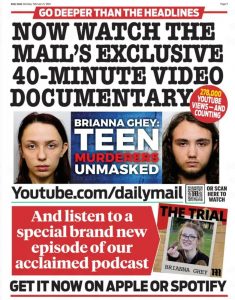
  • Vultures

    I wrote yesterday about newspapers profiting from spreading anti-trans hate: “Trans lives only matter to them if they can be monetised – and the cash is in calling us demons or crying crocodile tears over our coffins.”

    Here’s the Daily Mail today.

    Daily Mail advert: "NOW WATCH THE MAIL'S EXCLUSIVE
40-MINUTE VIDEO DOCUMENTARY"